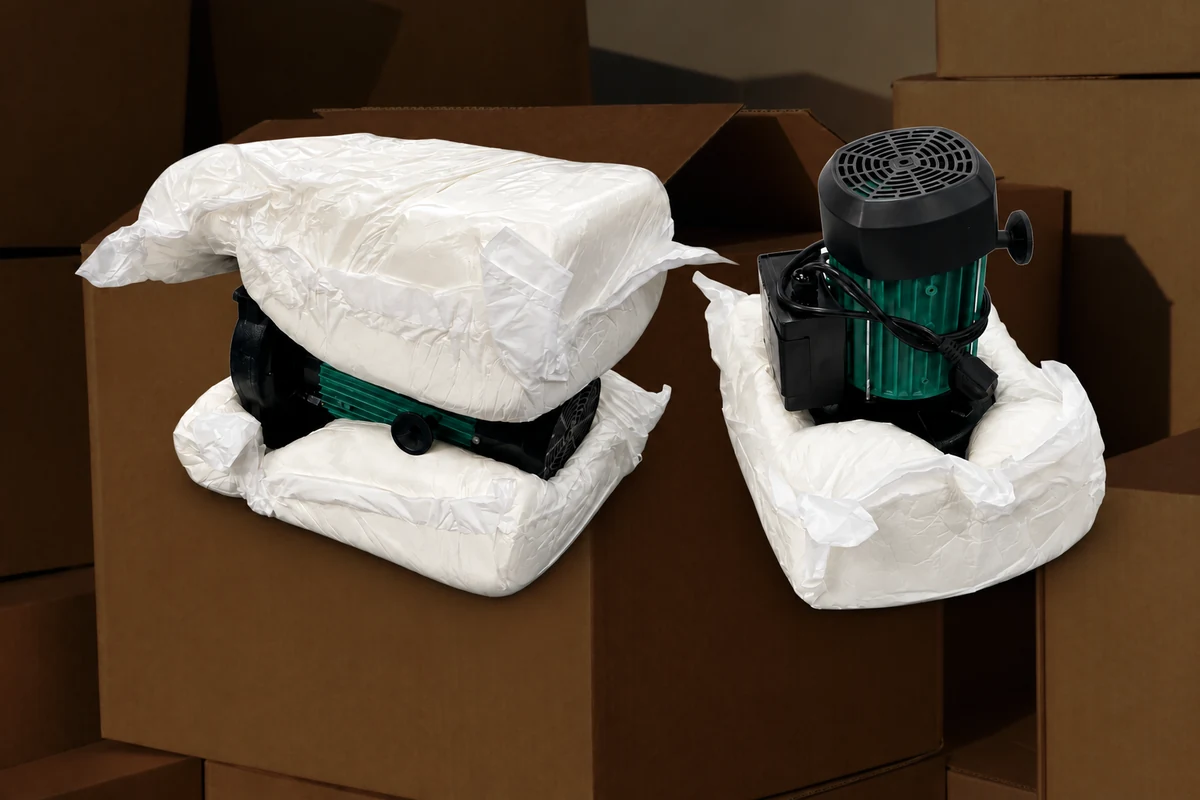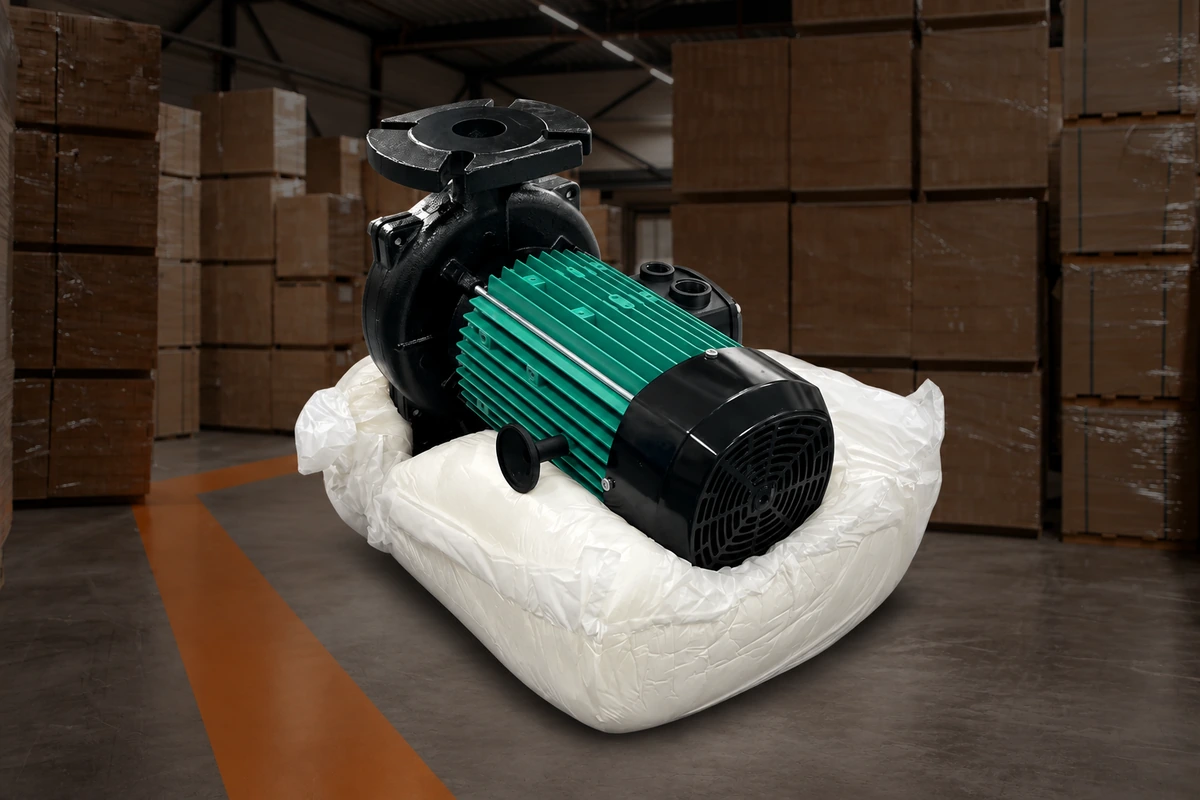
A product does not always need to be fully surrounded by foam-in-place cushioning. Top-and-bottom cushions or localized supports are valid candidates when they bear on suitable product surfaces, control movement, and preserve the cushioning space required by the package design. The finished package must then demonstrate the required protection.
Full wrap is worth evaluating when the product needs support around several faces or an irregular outline. It is not automatically the strongest design: foam placed against a fragile fitting can create a problem, while a carefully positioned partial cushion leaves that fitting clear.
Start foam-in-place cushion design by deciding where the product can accept load, where it needs clearance, and which movements the package must control. Bag count follows those decisions.
Mark the Support Areas Before Choosing the Layout
Choose cushion locations from the product’s load-bearing surfaces, not simply from the empty spaces in the carton. A space large enough for a foam bag is not necessarily a useful support position.
On a product drawing, identify three kinds of area:
- Load-bearing areas: bases, feet, or housing sections that the product design permits to carry packaging loads.
- Locating areas: suitable surfaces where contact can limit sideways movement or rotation, without assuming that they can carry the product’s full weight.
- Keep-clear areas: lenses, connectors, shafts, thin covers, delicate finishes, or other features with contact restrictions.
Include the intended shipping orientation and any heavy end of the assembly. Equal-size cushions on opposite sides do not imply equal loading. A motor mounted at one end changes the demands on the support beneath that end.
Next, follow the load through the package: from the product’s allowed contact surface, through the cushion, into the outer package. This exposes a common design mistake—a cushion touches a broad cover, but the cover is not intended to support the assembly behind it.
Material grade and cushion thickness must suit these locations. The foam-in-place packaging density guide explains why changing the bearing area changes the material-selection problem. Choosing the layout first on paper does not mean choosing the foam independently afterward; both need to be developed together.
Which Foam-in-Place Cushion Design Fits the Product?
Use full wrap when several faces need close contour support, top-and-bottom cushions when suitable upper and lower contact zones can locate the product, and local supports when specific robust areas can do the necessary work. Each arrangement still needs an answer for movement toward every relevant carton face.
Here, “full wrap” means surrounding the product with film-contained foam cushions. It does not mean pouring reactive material directly onto the product or creating a moisture-tight enclosure.
| Layout | Useful starting condition | Main design question | Common oversight |
|---|---|---|---|
| Full wrap / encapsulation | Irregular outline requiring support around several faces | Can the cushions surround the product without loading restricted features? | Cushion shape traps a protrusion during unpacking |
| Top-and-bottom cushions | Suitable contact zones above and below the product | Does the formed geometry also control side movement and rotation? | Flat pads leave lateral movement uncontrolled |
| Corner or local supports | Defined robust areas separated by surfaces that should remain clear | Do the selected positions support and locate the whole assembly? | Carton corners are mistaken for product support points |
Full Wrap: Plan the Split as Carefully as the Coverage
Full wrap is most useful when its additional coverage supports or locates the product in ways that a simpler layout does not. Covering more surface area is not a protection target by itself.
Review each feature along the product outline. A recess beside a handle, an undercut below a flange, or a projecting connector affects how a formed cushion can be removed. Plan separate cushion sections and their removal directions before making the sample. The customer should not need to pull a cushion across a vulnerable feature to release the product.
Leave designated features clear even within an otherwise surrounding layout. “Full” describes the overall arrangement; it does not authorize pressure on every surface.
Top and Bottom: Check What Stops Sideways Movement
Top-and-bottom cushions work when their shape and contact locations control the required movement as well as supporting the product vertically. Two flat pads alone do not demonstrate lateral restraint.
Look at the formed edges and contours: which suitable surfaces stop the product moving left, right, forward, or backward? What prevents a narrow or unevenly weighted item from rotating between the pads? Do those contacts remain clear of fragile projections?
If the answer depends on squeezing a thin top cover or pressing a connector against the carton, revise the geometry. Additional local cushioning is one possible design change; a different product orientation or outer package may be more appropriate. The top cushion must have a defined contact area, rather than simply filling the remaining headspace.
Local Supports: Protect the Product’s Strong Points
Local cushions belong at structurally suitable product locations. Four carton corners are not a universal support pattern, and a fragile product corner is not automatically a suitable bearing surface.
Consider a hypothetical pump assembly with a robust main housing and a projecting shaft. A candidate layout would support the permitted housing areas and keep the shaft clear. Placing foam directly beneath the shaft because it occupies an empty corner would move the load to the wrong feature.
Local supports also need sufficient cushion thickness and control of rotation. If the remaining clearance allows the assembly to pivot into a carton wall, the layout needs further development even when the bottom supports carry its static weight.
For heavy equipment requiring a pallet, crate, blocking, or mechanical restraint, establish those structural elements first. The equipment packaging guide explains the role of foam alongside them.
Empty Space Is Not Necessarily Missing Protection
An unfilled region is acceptable when it is part of a design that preserves clearance and controls product movement. Empty space beside a protected shaft serves a different purpose from an uncontrolled gap beside a load-bearing housing.
Review the narrowest clearances around the actual product, especially at projecting features. A carton with generous overall dimensions can still leave little cushioning space beneath a low foot or beside an offset connector. Filling a neighboring cavity does not increase that local clearance.
The same distinction matters when reducing coverage. Removing a side cushion changes the design if that cushion previously prevented rotation. Replacing full wrap with local supports therefore requires a new layout evaluation, not simply a lower dispense setting.
Compare Complete Sample Packs
Compare candidate layouts with the actual product and outer package. A good-looking foam shape, a closed carton, or a lower bag count does not establish shipping performance.
For each sample, record the support positions, minimum cushion thicknesses, sensitive-feature clearances, and removal sequence. Check the finished cushion geometry after unpacking: did the foam form against the intended surfaces, and did the product remain in the specified position? Include the product’s relevant functional checks alongside surface inspection.
Use those observations to refine the candidates, then evaluate protection under the shipment conditions the package must withstand. ASTM D4168 addresses transmitted shock characteristics of foam-in-place cushioning and considers the film, foam, and box together. Its relevance is the combined assembly; citing the method does not mean a particular layout has passed a distribution test.
Compare material use and packing effort only with protection results attached. If a partial-support design uses less material but leaves the product free to rotate, the lower consumption has not resolved the packaging task.
For a SelectPack layout review, provide the product dimensions, mass, shipping orientation, permitted support surfaces, keep-clear features, and internal carton or crate dimensions. Include how the recipient will lift the product out. These details let the SelectFoam equipment and material options be considered against a specific cushion arrangement rather than a request to “fill the box.”