The practical answer to how to use perforated cardboard for packaging is to assign it one job: fill open space, wrap a product, create a layer above or below it, or separate items that should not touch. Expand and form the sheet only as required for that job, then place it without bulging the carton, crushing the product, or contacting a surface that could be marked.
The right method depends on the product, the box, and the distribution requirements. Perforated cardboard can be useful in a repeatable packing process, but adding more material does not automatically create better protection. Heavy, fragile, high-value, or surface-sensitive products may require another cushioning system, a restraint method, a protective barrier, or a qualified package design.
This guide focuses on packing-station execution. It assumes the material has already been produced from suitable corrugated cardboard and released for packing. It does not compare machine output types or replace packaged-product testing.
How to Use Perforated Cardboard for Packaging by Job
Perforated cardboard is easier to use consistently when packers choose the method before reaching for material. The four methods solve different problems.
| Packing method | Primary job | Typical placement | Main mistake to avoid |
|---|---|---|---|
| Void fill | Limit movement in open space | Beside or above the product | Overfilling an oversized box |
| Wrapping | Add a flexible surface layer | Around the product | Treating wrap as complete impact protection |
| Layering | Separate the product from a surface | Below, above, or between groups | Assuming a soft layer restrains the load |
| Interleaving | Prevent item-to-item contact | Between items or stacked layers | Using pieces that shift out of place |
If the available material does not behave as the packing method requires, do not compensate by forcing more into the box. Confirm the intended material structure first with the guide to cardboard shredder output types, then return to the packing task.
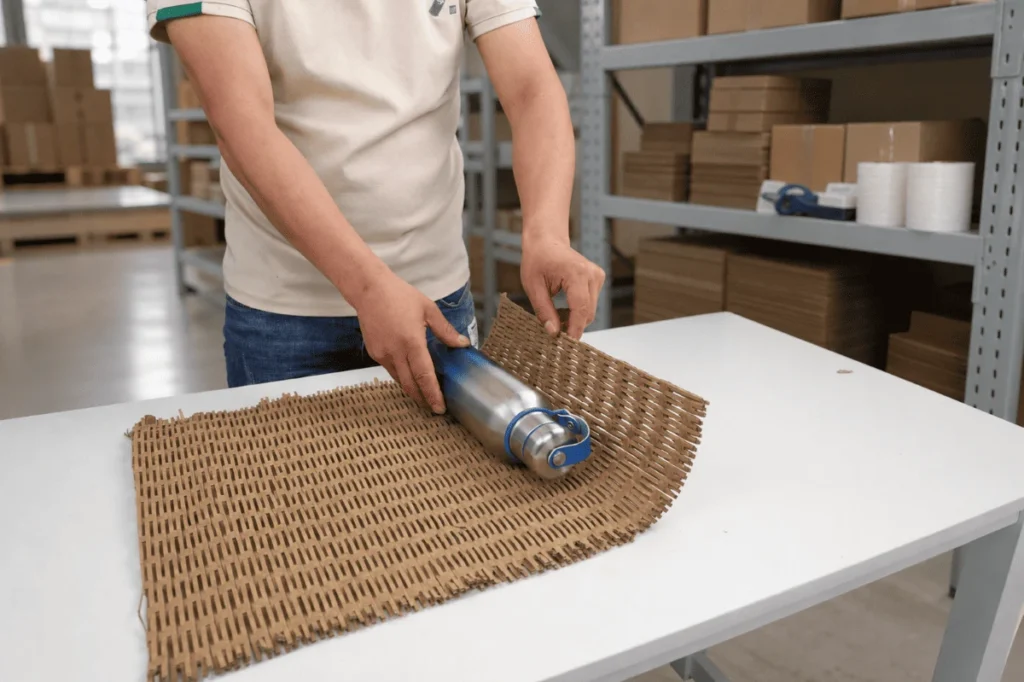
Prepare the Packing Station for Consistent Use
A repeatable method begins before the first carton is packed. Keep clean, dry perforated cardboard within easy reach, but separate it from unprocessed cartons, removed tape, labels, and other debris. Material with sharp contamination, moisture, sticky residue, or loose foreign matter should not be placed against a product.
For a recurring SKU, define these points in the station work instruction:
- The approved shipping carton.
- The position and orientation of the product.
- Which of the four packing methods applies.
- Where the cardboard should and should not contact the product.
- Whether a primary wrap, hygiene barrier, corrosion protection, or surface barrier is required.
- What other protection or restraint must remain in the pack.
- The condition that requires the operator to stop and escalate.
Do not assume recycled corrugated material is suitable for direct contact with every product. Food, medical, clean-room, corrosion-sensitive, electrostatic-sensitive, and easily marked products may require controlled primary packaging or another qualified material. The product owner and packaging specialist should define the contact boundary.
Do not ask each operator to invent a different arrangement. A short pack instruction is more useful than a general direction to “add enough cardboard.”
Method 1: Use Perforated Cardboard as Void Fill
Void fill limits movement by occupying unused space around a product. It should support a reasonably sized carton, not compensate for a box that is much larger than the item.
Position the Product Before Filling the Voids
Place the product in its intended orientation with any required primary wrap, insert, corner protection, or barrier already installed. Decide whether it should remain centered or held away from a particular wall of the carton. Filling random gaps before establishing the product position can lock the item into the wrong location.
Fill Side Voids in Manageable Sections
Expand, fold, or form manageable sections of perforated cardboard and place them into the side voids. Work around the product rather than filling one side completely and pushing the product toward the opposite wall.
The material should remain resilient enough to occupy the space. Compressing it into a hard mass can waste material and transmit pressure directly to the product. Loose placement, however, may settle and leave the item free to move. The approved packing method should define the usable condition for the specific product and carton.
Control the Top Void Before Closing
Add material above the product only when the pack design calls for top retention or space filling. Close the carton without forcing the flaps or creating a visible bulge. If the box cannot close normally, remove material and check whether the carton, product position, or packing method is wrong.
A gentle manual movement check can reveal an obvious empty void or unstable product before sealing. It is an in-process check, not evidence that the shipment will withstand distribution hazards.
Method 2: Wrap an Item With Perforated Cardboard
Wrapping is useful when the material needs to conform around an item or create separation between the product and the outer carton. It works best when the sheet is large enough to stay around the product without many loose overlaps.
Begin with the product on a clean surface. If its finish can be scratched, abraded, or contaminated, use the specified surface barrier rather than placing recycled corrugated material directly against it. Lay the perforated cardboard flat, open the perforated structure as required, position the item, then bring the material around the main faces without pulling it so tightly that the structure becomes flat and rigid.
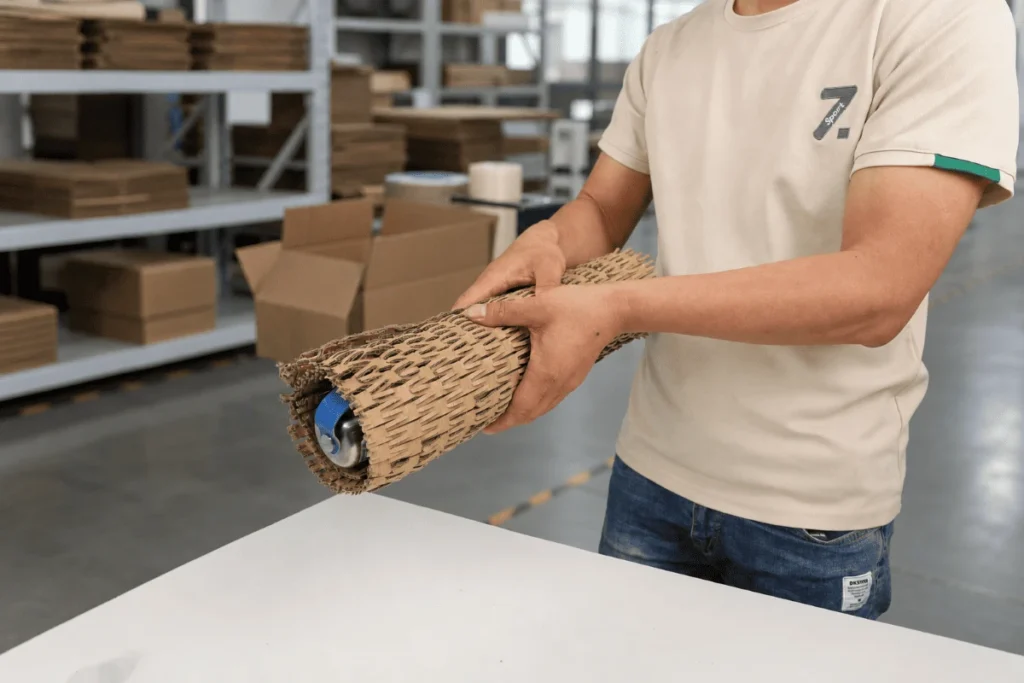
Secure the wrap only with the method allowed by the pack specification. Tape should not touch a sensitive product surface, and loose edges should not interfere with carton closure. Once wrapped, place the item in the carton and address any remaining movement separately. A wrap may provide surface separation or light cushioning, but it should not be assumed to restrain a heavy item inside an oversized box.
Method 3: Create Bottom, Top, or Intermediate Layers
Layering places perforated cardboard across a larger area instead of concentrating it in isolated voids. A bottom layer can separate the product from the base of the carton. A top layer can occupy controlled headspace or separate the product from the closing flaps. An intermediate layer can divide two packed levels.
Cut or fold the layer so it sits flat within the carton footprint. Material that climbs the sidewalls or bunches at the corners can create uneven support. Place the product or product group onto the center of the layer, then check that the material remains in position as the rest of the pack is assembled.
Layering is not the same as blocking, bracing, or load-bearing support. If the product can shift because of its mass, shape, or center of gravity, the package may need a fitted insert, restraint, corner system, or another engineered solution.
Method 4: Interleave Products That Should Not Touch
Interleaving uses a sheet or section of material between adjacent items or stacked components. Its main purpose is separation. It can reduce direct product-to-product contact and help organize repeated layers inside a carton.
The interleaf should cover the contact area and remain in place during packing. A piece that is much smaller than the product can slide aside, while an oversized piece can fold against the carton and disturb the stack. Align each layer before adding the next product, and use a separate surface barrier if the corrugated material itself could leave marks.
Do not use interleaving as the only control for unstable, sharp, very heavy, or easily damaged items. Where products can roll, tip, or concentrate load on a small point, use an approved cell, divider, restraint, or insert instead.
Combine Methods Without Losing Control of the Pack
Some cartons need more than one method. A mixed-product order might use an interleaf between two components, a wrap around a surface-sensitive accessory, and void fill around the assembled group. The sequence matters:
- Install any required product-specific protection.
- Wrap or interleave individual items as specified.
- Position the complete product group in the carton.
- Fill remaining side and top voids without changing that position.
- Confirm that the carton closes normally and the pack matches the work instruction.
Avoid building a package through repeated trial and error on the packing line. If operators must improvise a new combination for every order, the SKU mix, carton range, or pack instruction needs review.
Correct Common Packing-Station Problems
| Observation | Likely packing issue | Practical correction |
|---|---|---|
| Product moves before sealing | A side or top void remains | Reposition and fill the void; check box size if the gap is large |
| Carton flaps bow | Material is overfilled or compressed | Remove material; confirm the box and product orientation |
| Product surface shows marks | Direct contact or contamination is unsuitable | Add an approved barrier or change the material |
| Interleaf shifts | Piece size or stacking varies | Match the contact area and align each layer |
| Fill amounts vary by packer | The work instruction is subjective | Define placement, amount, and stop condition by SKU |
| Material contains debris | Material streams are mixed | Separate storage and reject contaminated material |
| Formed material collapses | Output or forming method varies | Check released material and the station method; do not overfill |
These corrections address visible execution problems. They do not prove that the package will protect the product through vibration, shock, compression, moisture, or other distribution hazards.
Know When a Packing Method Needs Formal Validation
An operator check is appropriate for confirming that a carton closes, the product is positioned correctly, and no obvious void was missed. It is not a substitute for a transport test or a customer-mandated packaging qualification.
The International Safe Transit Association explains that different ISTA test procedures serve different purposes, from basic screening to general simulations of distribution hazards. The correct approach depends on the packaged product and its distribution system; the product and package are evaluated together.
Escalate the package design when:
- The product is fragile, heavy, high-value, or difficult to restrain.
- Damage history indicates that the current method is not adequate.
- The product needs moisture, electrostatic, temperature, corrosion, or surface-contact controls.
- A customer, carrier, retailer, or internal specification requires qualification.
- A new product, carton, route, or material changes the approved configuration.
For a broader fit decision and the boundary between everyday void fill and more demanding protection, use the guide to shredded cardboard packaging and package validation.
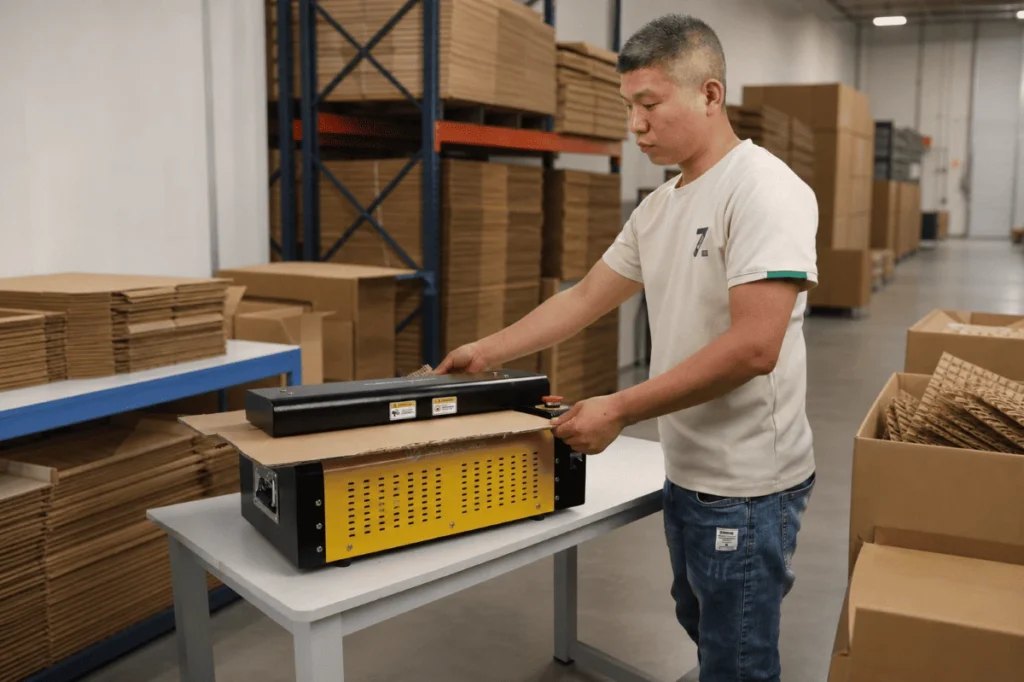
Turn the Method Into Standard Work
Start with a small group of representative SKUs rather than applying one rule to every shipment. For each SKU, document the carton, product orientation, material-contact boundary, packing method, required complementary protection, and stop condition. Record one accepted example pack at the station using measurements or written placement details that another trained packer can reproduce. Then review recurring problems such as movement, carton bulging, inconsistent material use, or slow assembly.
The goal is not to maximize how much perforated cardboard goes into each box. It is to use the right method in the right location while keeping the pack repeatable and within its verified protection limits.
For the broader equipment decision—including output type, suitable cardboard, machine format, capacity, installation, and cost—continue with the cardboard shredder planning guide.
If your operation is still evaluating how to produce perforated cardboard at the required width and volume, review the SelectPack cardboard shredder range and prepare representative cartons, packing tasks, and workflow information before requesting a recommendation.