In many packaging operations, cardboard shredders are adopted as a practical way to reuse used corrugated boxes and reduce reliance on purchased void fill. When selecting a cardboard shredder, businesses often focus on visible specifications such as motor power, cutting speed, or machine size. However, one critical factor is frequently overlooked: the output type of the shredded cardboard.
The way cardboard is cut—whether into straight strips or expanded mesh—has a direct impact on packaging efficiency, cushioning performance, material consumption, and overall operating cost. Choosing the wrong output type can result in inadequate product protection, wasted material, or unnecessary slowdowns on the packing line.
This article explains the two most common cardboard shredder output types—strip-cut and mesh-cut cardboard—and compares their structural characteristics, packaging performance, and ideal use cases to help businesses make an informed decision.
What Are Cardboard Shredder Output Types?
Cardboard shredder output types describe the physical form of corrugated cardboard after it passes through the cutting system. The output pattern affects how the converted material can be handled and placed inside a carton, but it does not by itself determine processing speed, energy use, operating cost, or protective performance.
Those outcomes also depend on the cardboard, cutter geometry, machine model, packing method, product, carton, and distribution environment.
Strip-Cut Cardboard Explained
Strip-cut cardboard is produced by cutting corrugated board into separate, relatively flat strips. Depending on the cutter design and input material, the strips may vary in width, length, stiffness, and consistency.
Strip-cut output can be evaluated for packing tasks such as:
- Filling defined open spaces inside a carton
- Separating compatible products
- Building layers between suitable items
- Supporting repeatable loose-fill arrangements
The strips must remain in the intended position during handling and transport. Suitability should therefore be confirmed with the actual cardboard, product, carton, and placement method.
Mesh-Cut Cardboard Explained
Mesh-cut cardboard, also called perforated or expanded cardboard, remains connected after cutting and can be opened into a three-dimensional sheet.
This connected structure can be evaluated for:
- Wrapping suitable products
- Layering and interleaving
- Separating items inside a carton
- Maintaining a defined material placement
- Filling suitable carton spaces after expansion
The amount of expansion depends on the cut pattern, cardboard construction, board condition, and how the operator opens the material. A mesh structure may support wrapping or layering, but its appearance alone does not demonstrate a particular level of cushioning or transit protection.
Strip-Cut vs Mesh-Cut: Structural Differences
Shape and Physical Structure
Strip-cut output consists of separate, relatively flat pieces. The strips can be portioned into open carton spaces, arranged in layers, or used as separators when the packing method keeps them in the intended position.
Mesh-cut output remains connected after cutting and can be opened into a three-dimensional sheet. This connected form can make it easier to create a defined wrapping, layering, or interleaving pattern.
The actual volume and handling characteristics of either output depend on:
- Cardboard flute and wall construction
- Board thickness and condition
- Moisture and contamination
- Cut width or perforation pattern
- Machine configuration
- The way the operator places or expands the material
For this reason, storage volume and material utilization should be measured with representative output rather than inferred from the output label.
How Structure Affects Placement
Neither output structure has a universal protection rating.
Loose strips may work as void fill in one carton but settle, compress, or shift in another. Expanded mesh may conform around a product, but its protective result still depends on material quantity, orientation, product weight and fragility, carton fit, surface sensitivity, and distribution hazards.
Treat each output as a candidate packing material rather than a guaranteed cushioning level. The relevant question is not which structure looks more protective, but whether the complete packed product performs as required.
Flexibility and Wrapping Capability
Mesh-cut material can be opened around a product as a connected sheet, which may make it easier to maintain a defined wrapping or layering pattern.
Strip-cut material remains loose and can be easier to portion into open carton spaces or arrange as separators.
Whether either method is suitable depends on the product surface, carton geometry, material quantity, placement method, and the operator’s ability to repeat the pack consistently.
Packaging Use Cases: When to Evaluate Strip-Cut Cardboard
Packing Tasks to Consider
Consider strip-cut output when the packing task involves:
- Filling defined open spaces
- Separating compatible products
- Building simple layers inside a carton
- Placing loose material in a repeatable carton configuration
It may be evaluated for lightweight or non-fragile products, but suitability should be confirmed with the actual product, carton, cardboard, and material quantity.
Do not select strip-cut output because of an assumed speed, power, maintenance, or cost advantage. These factors must be compared at the machine-model and workflow level.
Possible Operating Environments
Strip-cut output may be evaluated in environments such as:
- E-commerce fulfillment
- Warehousing and distribution
- Manufacturing and parts packaging
- Repetitive packing stations using defined carton sizes
These examples identify possible applications, not a universal recommendation for every operation in those industries.
What to Verify in a Strip-Cut Trial
During a representative trial, check:
- Whether the strips remain where operators place them
- Whether the material settles after handling or vibration
- How much material is required per completed carton
- Whether operators can repeat the same placement consistently
- Total cardboard preparation, processing, and placement time
- The specific machine’s throughput and duty cycle
- Rated or measured power use for the defined workload
- Maintenance and cleaning requirements for the selected model
The useful productivity measure is completed and acceptable packs per hour, not cutter feed speed alone.

Packaging Tasks to Evaluate with Mesh-Cut Cardboard
Packing Tasks to Consider
Consider mesh-cut output when a connected sheet is useful for:
- Wrapping suitable products
- Creating layers between compatible items
- Interleaving products
- Maintaining a defined material placement
- Providing surface separation
- Filling suitable carton spaces after expansion
Irregular, surface-sensitive, or damage-sensitive products may be candidates for a mesh-cut trial, but the mesh structure alone does not demonstrate adequate protection.
Possible Operating Environments
Mesh-cut output may be evaluated for products handled in industries such as:
- Electronics and electrical components
- Glassware and precision instruments
- Industrial parts and spare parts
- E-commerce and fulfillment
- Export and distribution packaging
These industry examples indicate possible trial applications. They do not establish a verified protection level for every product in the industry.
What to Verify in a Mesh-Cut Trial
During a representative trial, check:
- Whether the sheet expands consistently with the available cardboard
- Whether it provides the required coverage around the product
- Whether cut edges or recovered board can mark sensitive surfaces
- Whether the material compresses, loosens, or shifts inside the carton
- How much material is required per completed pack
- How much operator time is required for expansion and placement
- Whether packers can repeat the same wrapping or layering pattern
- Whether the complete package passes the required handling and transport checks
Mesh-cut output should be treated as one component of the package, not as a protection rating by itself.measurable protection benefits.
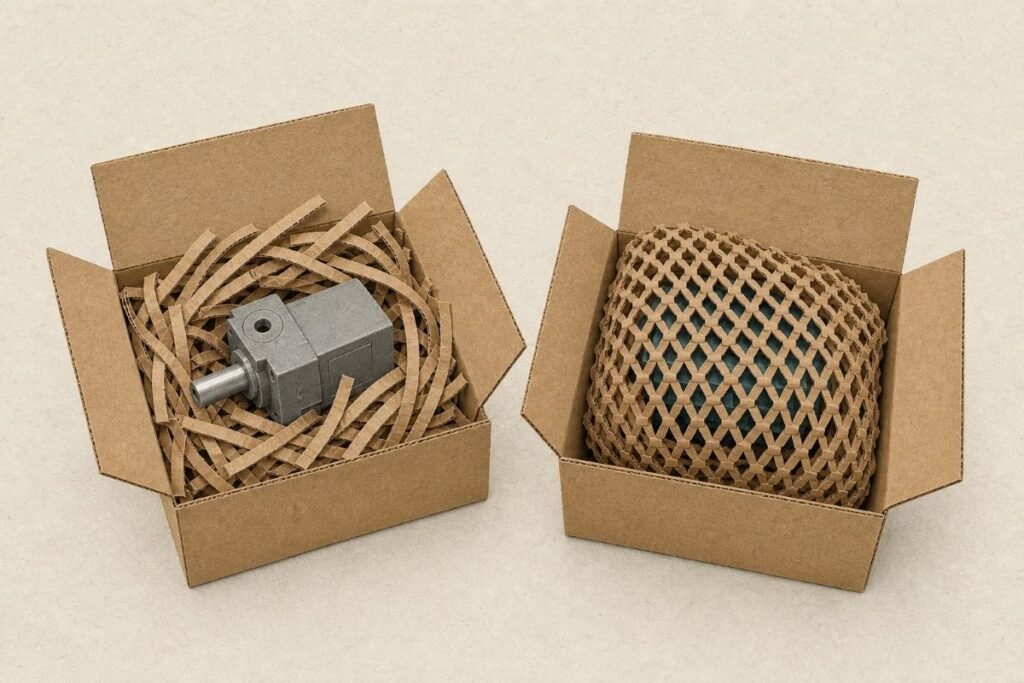
Real-World Application Comparison
The following comparison illustrates two different placement methods:
- Loose strips placed into open carton space
- Connected mesh placed around or between products
The images demonstrate how the two output structures can be handled. They do not establish which pack provides better transit protection.
A valid comparison should use representative:
- Cardboard
- Products
- Cartons and closures
- Material quantities
- Packing instructions
- Handling and distribution conditions
Record whether the product moves, whether the material settles or compresses, whether surfaces are marked, and whether operators can repeat the pack consistently. mesh-cut cardboard often outweigh the higher material and storage costs.
Compare the Complete Packing Process, Not Output Labels
Output type alone does not determine material cost, processing speed, energy use, labor, maintenance, or total cost of ownership.
These factors should be measured with representative cardboard, defined packing tasks, and the specific machines under consideration.
| Metric | Recommended Measurement |
|---|---|
| Material use | Grams, sheets, or converted area used per completed carton |
| Packing labor | Minutes per 100 cartons, including cardboard preparation, processing, and placement |
| Throughput | Completed and acceptable packs per hour, not cutter feed speed alone |
| Energy | Rated or measured kWh for a defined workload and machine model |
| Storage and handling | Space used by incoming cardboard and converted output in the actual workflow |
| Maintenance | Manufacturer schedule, cleaning time, wear parts, downtime, and service labor |
| Packaging performance | Product movement, surface condition, package integrity, damage, and rework |
| Total cost | Equipment, labor, energy, rejected cardboard, maintenance, purchased backup materials, and damage-related cost |
Processing Speed and Throughput
A faster cutter does not necessarily create more completed packs per hour if cardboard preparation, output handling, or material placement becomes the bottleneck.
Compare the complete process:
- Collecting and sorting cardboard
- Removing unsuitable materials
- Cutting or sizing oversized cartons
- Processing the cardboard
- Expanding or collecting the output
- Placing the material
- Closing and checking the carton
Use the same cardboard, product, carton, operator instructions, and batch size when comparing two configurations.
Power and Energy Use
Motor power is a model specification, not an output-type characteristic.
A lower-rated motor does not automatically mean lower operating cost if the machine requires more passes, more preparation, or longer runtime.
For a useful comparison, record:
- Rated motor power
- Actual operating time
- Cardboard processed
- Completed packs produced
- Idle and active operating pattern
- Power required for any supporting equipment
Total Cost of Ownership
Calculate total cost with site-specific data rather than general assumptions.
Include:
- Machine purchase and installation
- Cardboard preparation labor
- Packing labor
- Electricity
- Maintenance and wear parts
- Rejected or unusable cardboard
- Purchased backup packaging
- Waste handling
- Damage, returns, and repacking
For a more detailed cost framework, see Cardboard Shredder vs Buying Void Fill: Cost & Sustainability Comparison.
Validate the Complete Package
Protective performance should be verified with the complete product-and-package combination.
ISTA test procedures distinguish basic screening tests from general simulation tests that represent transport hazards. For broader shipping-unit evaluation, ASTM D4169 provides a framework based on anticipated distribution hazards.
The appropriate test depends on the product, shipment method, customer requirements, damage risk, and distribution environment.
A material sample or machine demonstration confirms that cardboard can be converted. It does not by itself validate the finished package.
Choosing the Right Cardboard Shredder Output for Your Business
Key Questions to Consider
Before selecting an output type, answer the following questions:
- What packing task must the output perform: loose void fill, wrapping, layering, interleaving, or separation?
- What products, cartons, and recovered cardboard will be used in normal production?
- Can operators place the material consistently, and does it remain in position after handling?
- Which specific machine models meet the required input limits, duty cycle, throughput, power, workspace, and maintenance conditions?
- What did the representative sample conversion and complete-package test show?
The output decision should follow the packing task and test result, not assumptions about speed, cost, or protection.
Strip-Cut, Mesh-Cut, or 2-in-1 Solutions
Some operations have repeatable packing tasks for both loose strip-based fill and connected mesh used for wrapping, layering, or separation.
A 2-in-1 machine may support both workflows, but dual-output capability must be confirmed for the specific model. It should not be selected only because additional flexibility appears useful.
In SelectPack’s current range:
- The Hippo P20 produces mesh-cut output.
- The Hippo PT20 produces strip-cut output.
- The HippoPlus PT50-X is the dedicated 2-in-1 configuration.
Compare the actual machine specifications, permitted cardboard, operating pattern, and sample output before selecting a configuration.
Once the required output has been identified, use the cardboard shredder guide for packaging operations to compare input limits, machine format, capacity, installation, and current model options.
Sustainability Considerations
Both output formats can support the reuse of suitable on-site corrugated cardboard when the converted material passes the packaging trial.
Whether the process reduces purchased materials or waste handling depends on:
- The amount of suitable cardboard available
- The percentage of rejected material
- The amount of converted material used per pack
- Machine energy and labor
- The quantity of purchased packaging displaced
- Local recycling and waste-handling arrangements
Do not claim a lower carbon footprint without a defined life-cycle comparison and supporting data.
For a site-specific comparison of purchased packing materials, waste handling, labor, and equipment cost, see Cardboard Shredder vs Buying Void Fill: Cost & Sustainability Comparison.
Conclusion: Aligning Output Type with Packaging Strategy
Strip-cut and mesh-cut cardboard should be compared first by material structure and packing task.
Strip-cut output is a candidate for loose filling, separation, and other defined placements using discrete strips.
Mesh-cut output is a candidate for connected wrapping, layering, interleaving, separation, and other tasks that benefit from a connected sheet.
Do not infer processing speed, power demand, maintenance, operating cost, or damage reduction from the output label alone.
Before making a decision:
- Compare specific machine models.
- Convert representative cardboard samples.
- Define repeatable packing instructions.
- Build complete test packs.
- Validate the configuration against the handling and distribution hazards relevant to the operation.
A 2-in-1 machine may be appropriate when an operation has repeatable, validated packing tasks for both output formats. It should not be selected only because greater flexibility appears useful.
The right output is the one that operators can place consistently and that performs as required with the actual product, carton, cardboard, closure method, material quantity, and distribution environment.
Related Resources
- How to Choose the Right Cardboard Shredder for Your Business
- Cardboard Shredder vs Buying Void Fill: Cost & Sustainability Comparison
- Industrial Cardboard Shredder ROI: How Long Does It Take to Pay for Itself?
- Cardboard Shredder for Packaging: How Businesses Turn Waste into Void Fill
- Protective Packaging Equipment and Materials
- Paper Cushioning Machines