A cardboard shredder, baler, and compactor send cardboard to different destinations. Choose a packaging cardboard shredder when suitable corrugated boxes can become void fill, wrapping, or layering material that your packing operation will use. Assess a baler when segregated cardboard must leave as a handled recycling unit. Assess a compactor when the contracted downstream process is containerized waste collection and volume reduction, not packaging-material production.
Start with the required destination, not machine size or headline throughput. A facility may convert part of its cardboard for packing and bale the surplus, but only when each stream has a named owner and a confirmed outlet. The decision depends on the usable corrugated supply, actual protective-packaging demand, recycler or waste-contractor requirements, and material travel through the building.
SelectPack supplies cardboard shredders and perforators for producing packaging material. It is not presented here as a supplier of balers or compactors. Those equipment categories, pickup arrangements, and recycling requirements should be confirmed with qualified vendors and the facility’s recycler or waste contractor.
Cardboard Shredder vs Baler: Start with the Required Output
The clearest dividing line in a cardboard shredder vs baler decision is what must leave the machine.
- A packaging cardboard shredder or perforator changes suitable corrugated board into loose strips or expanded, perforated material for use in packing.
- A baler compresses material into a bale that can be handled and transported as a material unit.
- A compactor compresses refuse into a container for transport.
Actual baler and compactor configurations vary, so the final equipment specification must come from the selected manufacturer. The receiving recycler or hauler must separately confirm material and collection requirements.
| Decision point | Packaging cardboard shredder or perforator | Cardboard baler | Compactor |
|---|---|---|---|
| Primary job | Make packaging material from approved corrugated | Consolidate cardboard for recycling | Reduce refuse volume |
| Typical input | Clean, dry corrugated within model limits | Cardboard accepted by the baler and recycler | Material accepted by the compactor and hauler |
| Output | Strip-cut or expanded cardboard | Compressed bale | Compacted container load |
| Next destination | Packing station or nearby buffer | Bale storage, then collector | Collection or transfer route |
| Packaging use | Can serve approved packouts | Does not make packing material | Does not make packing material |
| Material flow | Cartons in; loose output to packing | Stage, bale, eject, store, and collect | Load waste; retain collection access |
| Space required | Feed, collection, operator, buffer, and service space | Staging, ejection, handling, storage, and pickup space | Container, loading, service, and truck access |
| Confirm downstream | Protection need, output, input limits, and demand | Grade, contamination, bale, handling, and pickup rules | Accepted material, container, schedule, and destination |
This matrix is a routing screen, not a substitute for an equipment quote or downstream service agreement. A buyer still needs model-specific information on electrical supply, feed limits, operating mode, guarding, maintenance access, and material handling. The recycler or hauler must separately confirm what it will collect and under which conditions.
When a Packaging Cardboard Shredder Fits
A packaging cardboard shredder fits when the operation has both a reliable input stream and a defined internal use for the output. Having many empty boxes is not enough. The outbound packing process must regularly consume the type of void fill, wrapping, pads, or interleaving that the selected machine can produce.
The strongest fit usually has these characteristics:
- Incoming corrugated boxes can be separated from wet, contaminated, coated, or otherwise incompatible material.
- Staff can remove prohibited foreign objects and prepare sheets within the selected machine’s documented limits.
- Packing stations have a repeatable need for the resulting output.
- There is a controlled route from receiving or carton breakdown to shredding and then to outbound packing.
- The facility can prevent loose output from accumulating faster than packers consume it.
- Product protection will be confirmed with representative products, boxes, loads, and shipping conditions.
Before quoting, document the cardboard stream by type and condition, not only by an estimated number of boxes. The cardboard preparation guide explains why contaminants, dimensions, thickness, and feed preparation must be checked against the machine documentation.
A cardboard shredder is a weak fit when the facility has little outbound packing demand, when the available cardboard is inconsistent or unsuitable, or when the resulting material cannot meet the product’s protection requirements. It should also not be selected merely as a substitute for a waste-volume reduction system. If the real objective is to prepare large quantities of cardboard for off-site recycling, a baler assessment is more relevant.
When a Cardboard Baler Fits
Assess a baler when segregated cardboard should leave the facility as a consolidated material unit. Speak with the receiving recycler or collector before fixing the equipment specification. Accepted cardboard grade, contamination limits, bale requirements, pickup arrangement, and handling method can change the practical choice, and these conditions vary by service provider.
The workflow must account for more than loading cardboard into a chamber. It may require:
- A collection route from receiving, replenishment, and unpacking areas.
- A staging area that does not block pedestrian, forklift, or emergency routes.
- Safe bale ejection and a defined method for moving the bale.
- Floor space for finished bales awaiting pickup.
- Dock or collection access coordinated with the recycler.
- Trained, authorized personnel and machine-specific procedures.
Baling equipment introduces serious crushing and unexpected-startup hazards. OSHA’s cardboard-baling guidance highlights collection, forklift, moving-part, crushing, and unexpected-startup risks. Applicable regulations, the exact baler manual, and the employer’s procedures must govern guarding, inspection, training, hazardous-energy control, jam response, and maintenance. These requirements belong in procurement and site planning, not as additions after installation.
A baler is not the right tool when the primary objective is to create protective packaging at the point of use. A bale is an outbound recycling unit; it is not a consumable for the packing bench.
When a Compactor Fits
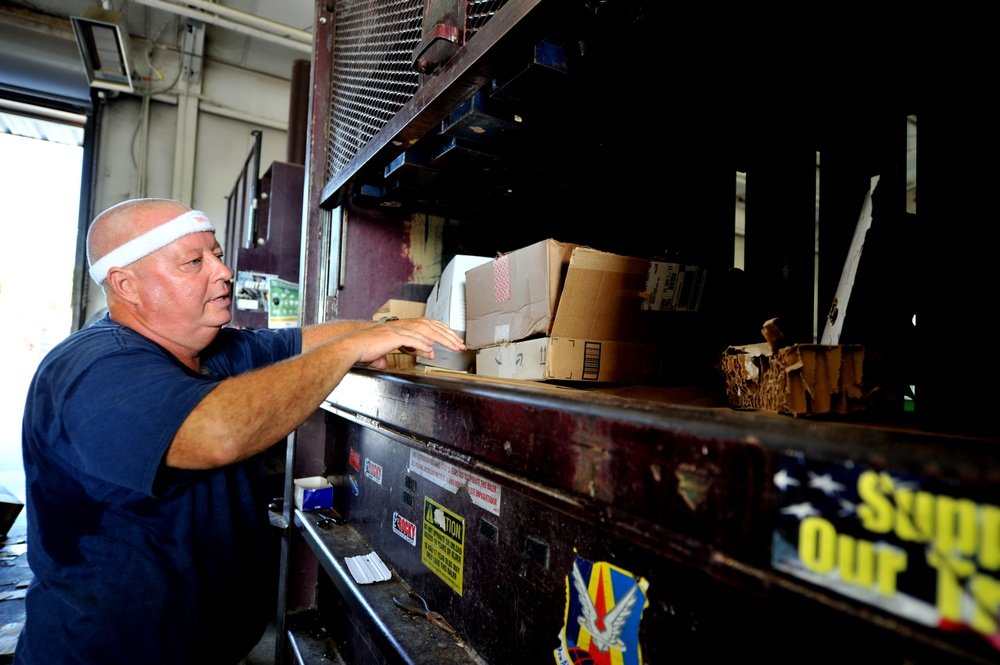
Assess a compactor when the main requirement is to reduce the volume placed into a collection container and the waste contractor supports that configuration. This may suit a residual-waste stream or a service model built around a particular compactor and container arrangement. It should not be assumed to preserve cardboard as a separately marketable recycling stream.
Confirm the downstream contract before comparing compactors:
- Which materials may enter the compactor?
- Is cardboard kept separate or mixed with other material?
- Where does the compacted material go after collection?
- How is contamination handled?
- Who owns, exchanges, services, and cleans the container?
- What access does the collection vehicle need?
- What happens when the unit or container is unavailable?
If the business wants to preserve corrugated cardboard for recycling, confirm segregation, contamination, collection, and acceptance requirements with the recycler or hauler. A compactor does not create packaging output that can return to outbound shipping.
Compactors are hazardous powered machinery. OSHA’s machine-guarding overview describes the general need to protect operators from moving-part hazards. Site planning must also address the loading interface, pedestrian separation, service access, hazardous-energy procedures, and who is authorized to respond to a jam or stoppage. The selected compactor’s manufacturer instructions and applicable workplace rules control those details.
A Hybrid Workflow Often Solves Two Different Problems
The choice does not always end with one machine. A warehouse can have a reuse stream and a recycling stream because the available cardboard and the internal demand for packing material rarely match perfectly every day.
Reuse first, bale the surplus
In this arrangement, selected clean corrugated boxes are converted into packaging material only at the rate outbound packing can use them. Remaining recyclable cardboard is segregated and sent to a baler. This avoids treating every box as shredder feed and prevents a large buffer of loose packaging material from becoming a new storage problem.
The control point is the diversion rule. Operators need a simple method for deciding which cartons are suitable for the packaging machine, which should remain available for box reuse, and which should go directly to the recycling stream.
Reuse suitable cardboard, compact residual waste
A facility may use a cardboard shredder near packing while sending unsuitable residual material to a compactor. This only works if the waste contract accepts those materials and the facility keeps recyclable or reusable streams separate where required. The compactor should not become the default destination simply because sorting rules are unclear.
Use all three only when each stream has an owner
A large site could use a packaging cardboard shredder, an OCC baler, and a residual-waste compactor. The equipment count is justified only when each stream has a defined source, destination, operator, storage area, and downstream service. Adding machines without assigning material ownership can increase touches, congestion, and training burden.
Map Material Travel Before Comparing Equipment Footprints
Machine dimensions alone do not show whether a workflow will fit. Draw the path of cardboard from the point where boxes become empty to the final destination of each output.
For a cardboard shredder workflow, map:
- carton breakdown and sorting;
- preparation and temporary staging;
- travel to a centralized machine or point-of-use unit;
- collection of loose output;
- replenishment of packing stations; and
- overflow when cardboard supply exceeds packaging demand.
For a baler workflow, add the ejection zone, bale movement path, storage position, and recycler pickup point. For a compactor workflow, add the loading route, container-service clearance, and collection-vehicle access. In every layout, check forklift intersections, pedestrian exposure, fire routes, doorways, floor loading, maintenance clearance, and housekeeping responsibilities with the appropriate facility specialists.
If the operation is considering a packaging cardboard shredder, use real peak arrivals and packing consumption rather than a daily average alone. The cardboard shredder sizing guide provides a starting framework for separating average demand, peak demand, duty cycle, output requirement, and layout constraints.
Information to Collect Before Requesting Quotes
Send each relevant supplier the part of the workflow that its equipment must solve. A cardboard shredder supplier does not need to design the recycler’s bale pickup contract, and a baler vendor cannot determine whether perforated cardboard will protect a customer’s product.
| Input for the decision | Why it matters |
|---|---|
| Cardboard source and condition | Screens reuse, recycling, and disposal routes |
| Typical and peak arrivals | Exposes staging and sizing needs |
| Protective-packaging use | Confirms internal demand for converted output |
| Product protection needs | Keeps packaging performance in scope |
| Recycler or hauler rules | Defines acceptance, handling, and pickup |
| Packing-station locations | Informs centralized, local, or hybrid layout |
| Material touches and travel | Reveals labor and congestion |
| Electrical and site limits | Screens equipment fit |
| Output-handling method | Identifies carts, lifting, storage, and access |
| Roles and safety controls | Defines operating, service, and stoppage ownership |
Use this information to compare complete workflows rather than isolated machine prices. Include internal transport, collection service, material storage, operator time, training, maintenance, and any handling equipment. Exclude claimed savings that depend on an unconfirmed recycler price, pickup arrangement, or level of internal packaging consumption.
Choose the Destination, Then Choose the Machine
Choose a cardboard shredder when compatible corrugated material can move back into a proven packaging process. Choose a baler when segregated cardboard needs to become a handled recycling unit. Choose a compactor when the downstream waste service requires containerized volume reduction. Choose a hybrid workflow when reuse demand absorbs only part of the cardboard stream.
If the internal-reuse route remains under consideration, use the broader cardboard shredder decision guide to review suitable cardboard, output types, machine formats, sizing, installation, and cost before shortlisting equipment.
Close the decision with three written confirmations. The packaging team owns the packout and protection decision. The recycler or waste contractor owns material acceptance and collection terms. The equipment supplier owns the quoted model’s input, operation, installation, and service information.
If the selected destination is an internal packing station, use SelectPack’s cardboard shredder product hub to shortlist an output type and form factor. A useful inquiry should include representative cardboard samples, the intended packing job, measured demand, peak periods, site conditions, and the planned destination for cardboard that will not be converted.