
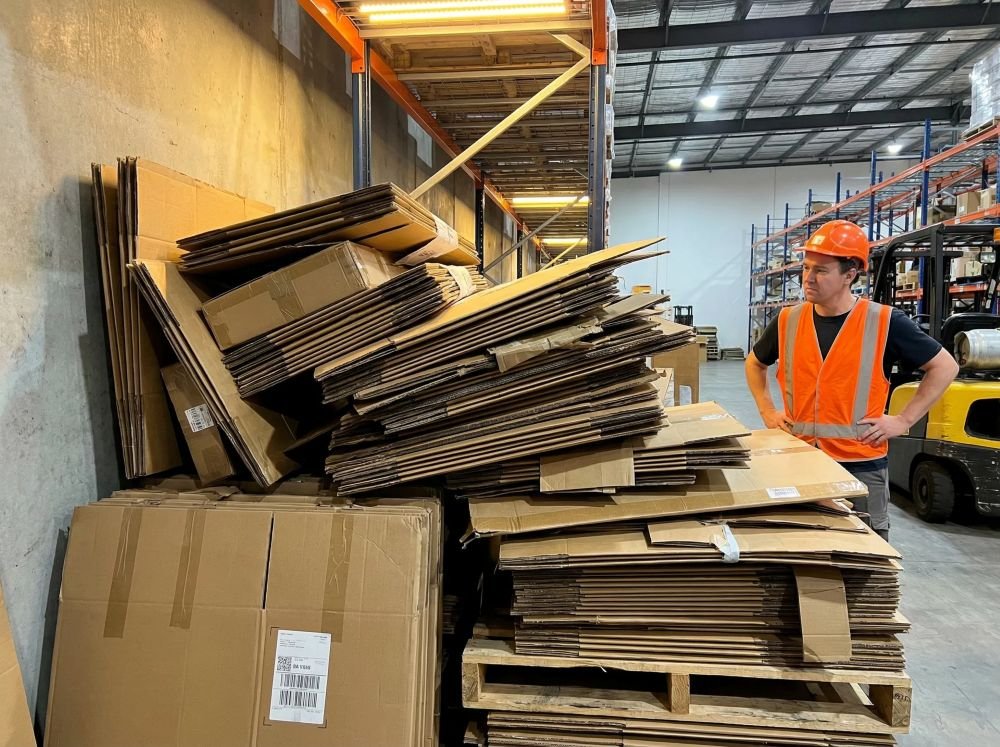
Many warehouses, manufacturers, distributors, and fulfillment operations face the same costly mismatch: incoming goods leave behind a steady stream of corrugated boxes, while outbound orders still require purchased void fill, bubble wrap, or other protective packaging. As volume grows, the business may spend more time, space, and money handling and removing one material while continuing to buy another.
A cardboard shredder can connect these two material flows by converting suitable, clean used cartons into mesh-cut sheets, cardboard strips, or both for packaging. It is most likely to make sense when a business has a reliable cardboard supply and recurring demand for wrapping, layering, separation, or void fill at the same site.
However, it is not a universal replacement for purchased protective packaging, nor is it the same as a document shredder, baler, or compactor. Cardboard quality, product sensitivity, packing method, shipping route, peak demand, labor, space, power, and package testing all affect whether on-site conversion works in practice. This guide explains how the machines work, where they fit, how output types and machine formats differ, and what to check before selecting one.
What Is a Cardboard Shredder for Packaging?
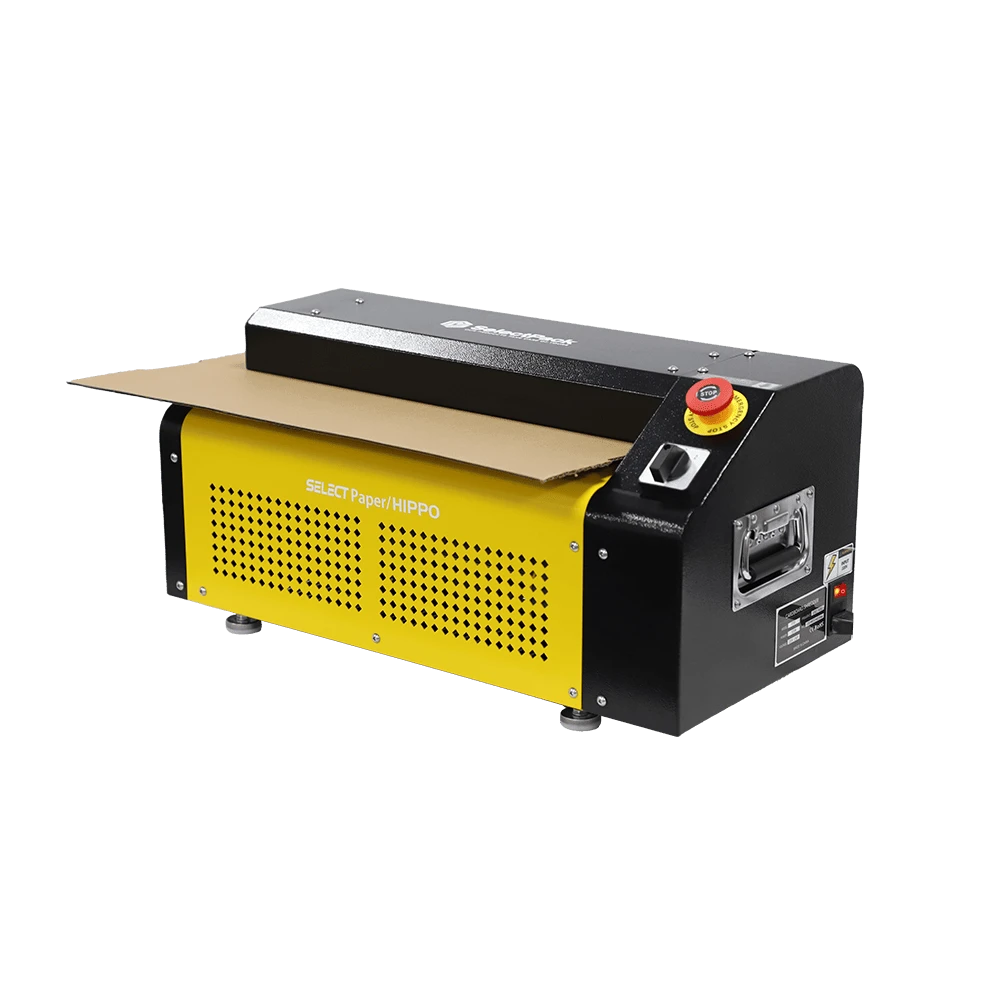
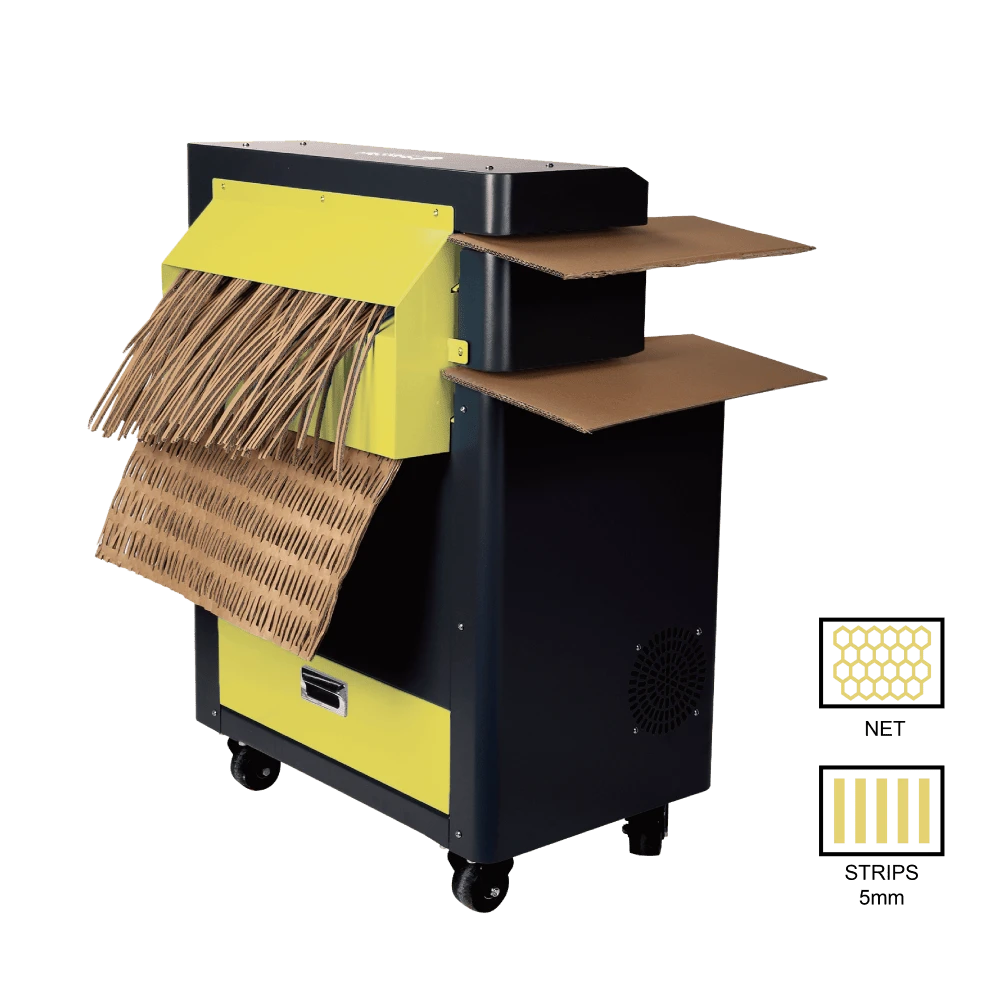
A cardboard shredder for packaging is a machine that converts corrugated cardboard into material that can be evaluated for reuse in packing. Depending on the cutting system, it produces either a connected, expandable mesh sheet or separate cardboard strips.
The terms cardboard perforator and cardboard converter are also used for this equipment. Labels such as industrial cardboard shredder and commercial cardboard shredder describe the operating context, not a standard capacity class. Input range, feed width, output, operating pattern, footprint, power, and support still need to be compared for the machine under consideration.

How Does a Cardboard Shredder Machine Work?
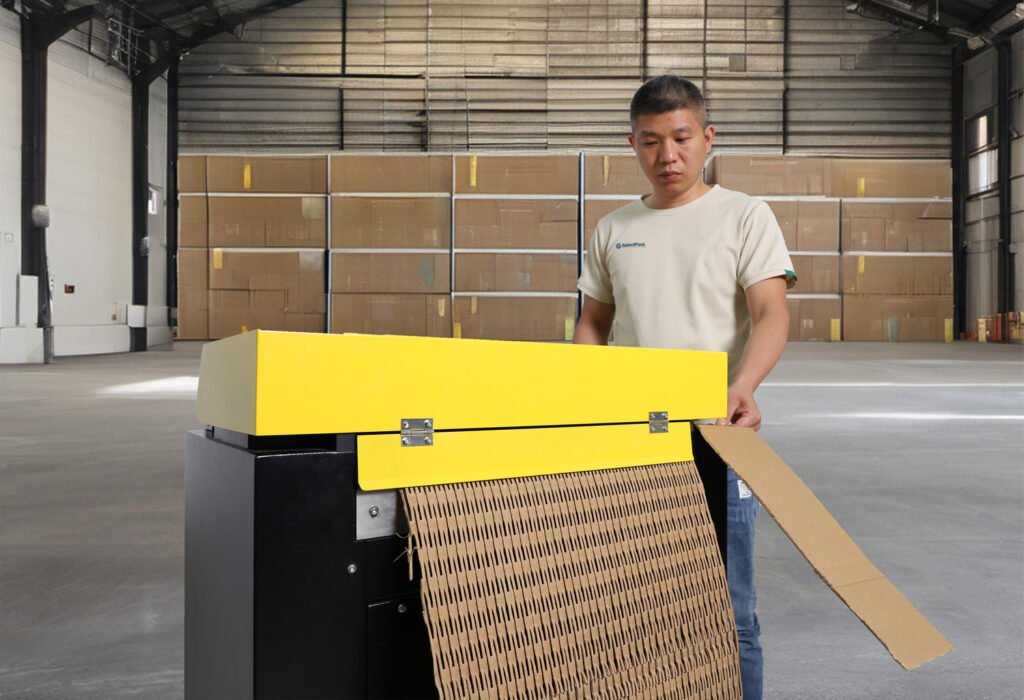
For mesh-cut packaging, a cardboard shredder converts suitable flattened corrugated board into expandable material in three basic steps:
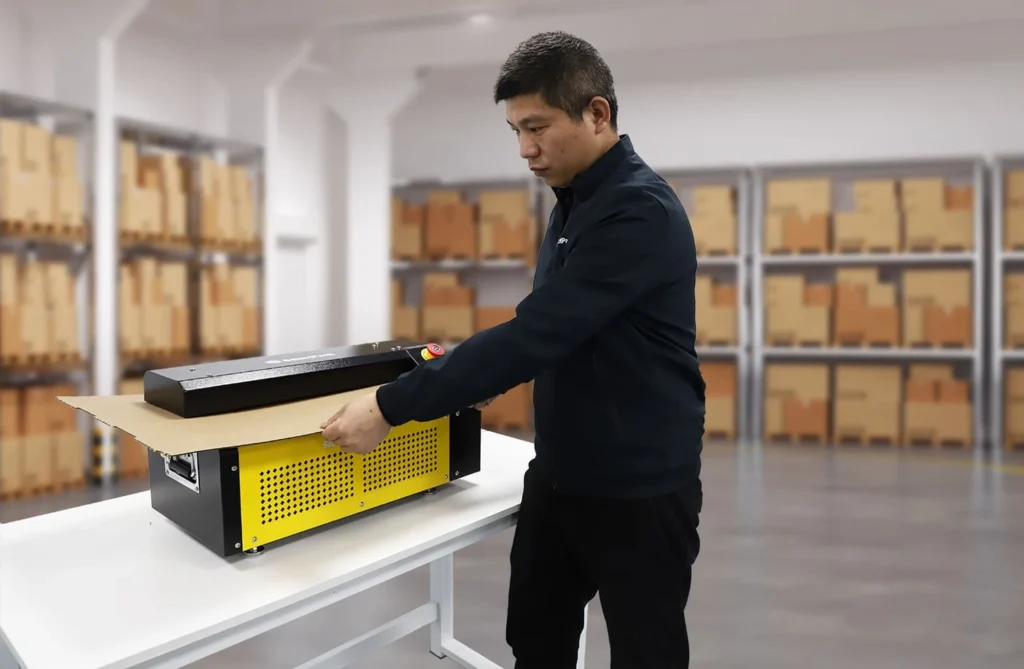
- Feeding: The operator screens and flattens the cardboard, then feeds it through the guarded intake opening according to the machine’s instructions.
- Cutting and perforating: Powered cutting rollers draw the board through the machine and create a staggered pattern of slits while keeping the sheet connected.
- Mesh formation: As the converted sheet exits, it can be expanded by hand into a flexible, three-dimensional mesh. The material can then be evaluated for wrapping, layering, separation, or void fill with the actual product and carton.
Permitted board construction, thickness, folds, attachments, feed direction, and operating cycle vary by model, so the supplied manual takes priority over general guidance.
For a closer explanation of the process, see how a cardboard shredder works.
Mesh-Cut vs Strip-Cut: Comparing Cardboard Shredder Output
Choose the packaging job before choosing the cutter. The right output is the one that packers can place consistently and that performs with the packed product under expected distribution conditions.
| Option | What it produces | Common uses to evaluate | Trial questions |
|---|---|---|---|
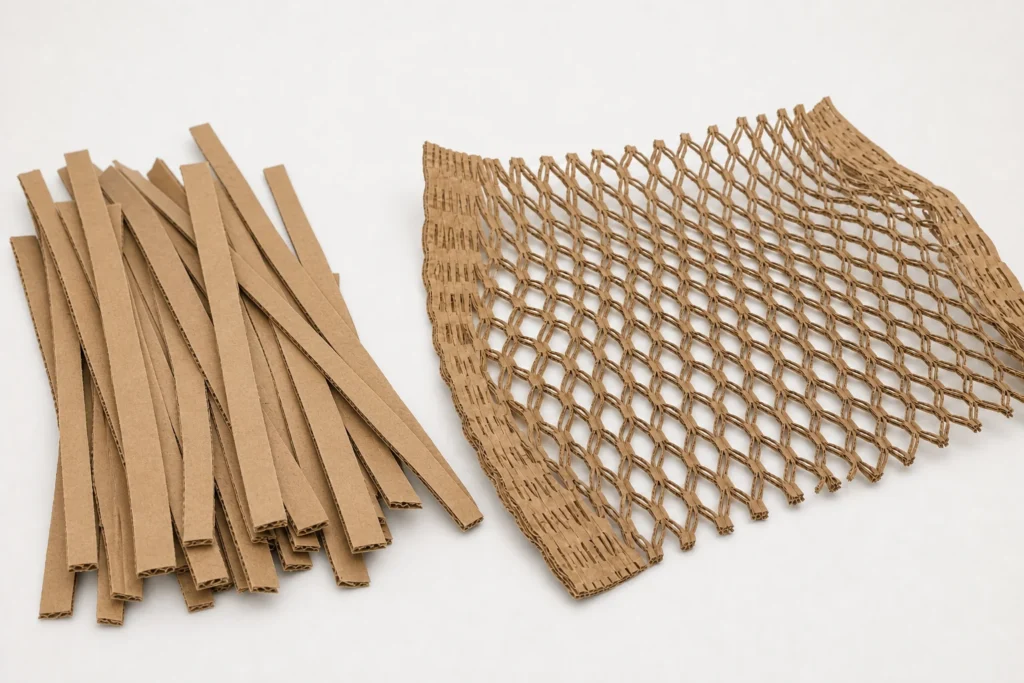
| Mesh-cut | Expandable connected sheet | Wrapping, layering, and separation | Does it open and cover consistently? |
| Strip-cut | Loose cardboard strips | Filling open carton space | Do the strips stay in place or settle? |
| 2-in-1 machine | Both mesh and strip output | Operations using both formats | How are modes changed and outputs identified? |
Mesh is often easier to handle as a connected layer or wrap. Strips can be easier to distribute into irregular open spaces. Neither is automatically better, and output should not be selected from appearance alone.
The guide to mesh-cut and strip-cut cardboard provides a closer comparison of material structure, handling, and trial questions.
Common Uses for Perforated Cardboard in Packaging
Converted cardboard can be evaluated for several packaging tasks:
- Wrapping: opening a mesh-cut sheet around a product that tolerates its surface and edges.
- Layering and interleaving: separating compatible items or adding a layer between a product and the outer carton.
- Surface separation: reducing direct contact or rubbing between suitable parts.
- Void fill: placing strips, or another tested arrangement of converted board, in open carton space.
- Internal handling: using a defined pack method for transfers between suitable workstations or facilities.
Whether these uses work depends on product weight, shape, fragility, finish, carton space, material placement, and distribution hazards. Recovered cardboard may be inappropriate for direct contact with food, medical items, clean components, moisture-sensitive products, or delicate finishes.
A machine demonstration only shows that a sample can be converted. Evaluate the complete package with representative products, cartons, closures, material quantity, and placement. The ISTA test-procedure overview helps distinguish basic screening from more formal simulation approaches.
Converted cardboard is one component of the pack, not a protection rating by itself. Mesh does not automatically provide enough cushioning, and loose strips do not automatically prevent movement. Product geometry, carton strength, closure, and material placement remain part of the result.
For station-level placement methods, see how to use perforated cardboard for packaging.
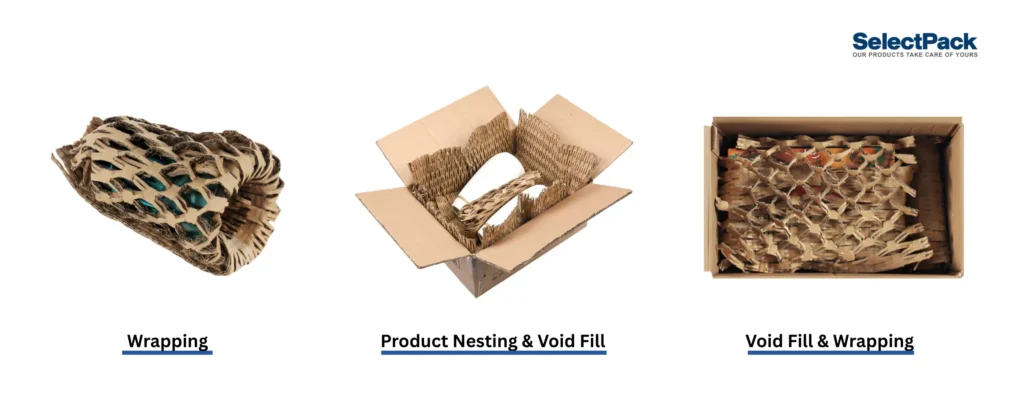
perforated cardboard made by HippoP10Benefits and Limitations of Reusing Corrugated Cardboard for Packaging
Potential value and operating limits should be considered together.
| Potential benefit | Limitation or condition |
|---|---|
| Uses a selected on-site cardboard stream | Supply and quality can vary by day, season, source, and location |
| May reduce purchases for suitable packs | Savings apply only to material genuinely displaced after testing |
| Produces material close to where it is used | Collection, preparation, conversion, and staging require labor and space |
| Offers mesh, strips, or both, depending on the machine | Each output needs a suitable and repeatable packing use |
| Extends the useful life of suitable cartons before recycling | Some boxes are better reused directly, recycled, or diverted |
| Gives packers an additional material option | It does not correct oversized cartons or replace specialized protection by default |
Noise, dust or loose fibers, presentation, storage, cleaning, parts, and machine downtime may also affect the decision. These factors are best checked with the facility’s own cardboard and pack method.
Measure the benefit at the level of accepted packs and material actually displaced. A large cardboard waste stream alone does not prove that the output will be suitable or that the operation will save money.
Is a Cardboard Shredder Right for Your Business?
The fit becomes clearer when cardboard supply, packaging demand, and site conditions are considered together.
A cardboard shredder is more likely to fit when:
- Usable cartons and recurring packaging demand overlap during the same peak periods.
- The proposed output and pack method have been tested with representative products and cartons.
- Staff, space, power, and a suitable operating area are available.
- Backup packaging and a defined route for unsuitable cardboard remain available.
Reconsider the fit or plan an alternative when:
- Board construction, moisture, contamination, or attachments vary enough to create substantial sorting and rejected material.
- Product or customer rules restrict recovered material.
- Oversized cartons create most of the empty space; improve carton selection before producing more fill.
- The main goal is recycling consolidation, or usable board cannot cover peak demand; compare a baler, compactor, recycling service, purchased backup material, or a hybrid process.
If these conditions point to a practical fit, use the cardboard shredder selection guide to compare input profile, output style, capacity, duty cycle, and workspace before choosing a model.
What Types of Corrugated Cardboard Can a Shredder Process?
“Cardboard” covers materials that vary by wall construction, flute, paper weight, coating, moisture, damage, folds, adhesive, tape, labels, and foreign attachments. Processability therefore depends on the machine and supplied documentation.
- Prepare for processing: Clean, dry corrugated board within the documented construction, dimensions, and thickness.
- Check before processing: Double-wall or unusually heavy board, multiple folds, coatings, uncertain adhesives, tape, labels, staples, clips, or other attachments not clearly covered by the machine documentation.
- Divert from the shredder: Wet, oily, chemically or biologically contaminated board; material outside the documented range; restricted board; or cartons better suited to direct reuse.
Do not feed an unfamiliar item simply to see whether the cutter accepts it. Check uncertain material against the machine documentation or written supplier guidance, and keep a recycling or disposal route for unsuitable board.
The cardboard preparation guide covers input condition, attachments, and preparation in more detail.

Tabletop vs Floor-Standing Cardboard Shredders
Form factor affects material flow and the space around the machine, not only its footprint.
| Factor | Compact/tabletop format | Floor-standing format |
|---|---|---|
| Often considered for | Local packing areas or distributed stations | Central conversion or a dedicated station |
| Site requirement | Stable support plus feed, discharge, and service clearance | Floor, operator, feed, discharge, transport, and service clearance |
| Material movement | Can keep output near the packer | May require collection and replenishment between areas |
| Main sizing risk | Assuming a compact machine will meet peak demand | Assuming a larger machine will solve preparation or packing bottlenecks |
Neither label defines a universal capacity. Compare the documented input range, feed width, operating pattern, power configuration, clearances, and complete route from incoming boxes to finished packs.
Point-of-use conversion can reduce replenishment distance but places preparation, training, and inspection at each station. Central conversion can simplify oversight and service, although output then has to be stored and moved to packers. The better layout depends on where usable cartons appear and where the output is consumed.
The broader guide to choosing between desktop and floor-standing cardboard shredders connects this layout decision with cardboard volume, packing-station count, output requirements, and available workspace.
How to Choose the Right Cardboard Shredder Size and Capacity
Use a short sequence to create the initial shortlist:
- Define the job. List the products, cartons, current packaging material, and whether mesh, strips, or both should be evaluated.
- Test representative board. Use samples that reflect normal variation and compare common flattened cartons with the feed opening.
- Measure one peak period. Compare usable board supply and converted material demand over the same hour, shift, or dispatch window using one consistent unit. Do not size from daily averages or expanded mesh volume.
- Observe the full station. Cutting speed is not finished-pack throughput; collection, preparation, feeding, output handling, replenishment, and normal stops all matter.
- Check site and support. Confirm space, power, operating pattern, duty cycle, manual, training, maintenance, warranty, parts, and service route for the quoted configuration.
A single successful sheet does not establish usable station capacity. Observe a representative mix of board and compare the complete conversion rate with packaging consumption during the same peak interval. Use these observations to refine the shortlist, then apply the cardboard shredder sizing guide to peak-period supply, demand, and RFQ data.
Cardboard Shredder Installation, Safety, and Maintenance Requirements
Plan the operating area around incoming cardboard, preparation, operator position, feed and discharge clearance, output collection, pedestrian or vehicle routes, electrical isolation, and service access.
Follow the manufacturer’s instructions, local law, and the site’s risk assessment. Guards should remain in place, operators should not reach into the cutting area, and jams, damaged guards, repeated stops, or unfamiliar noise should follow the machine’s stop and escalation process. Internal access and maintenance belong to trained, authorized personnel under the site’s energy-control rules.
For U.S. workplaces, OSHA 1910.212 is relevant to machine guarding, while OSHA 1910.147 addresses hazardous-energy control during covered servicing and maintenance. Other locations should apply their own requirements.
Use the installation checklist to review layout, utilities, access, and pre-delivery questions.
Cardboard Shredder Cost, ROI, and Void-Fill Alternatives
The cost includes more than the machine price. Compare freight, installation, site changes, training, labor, energy, cleaning, maintenance, parts, backup material, and package testing with the packaging purchases and handling costs that could realistically be displaced.
Start with a preliminary low, base, and high range using current site data and the installed-cost quotation. After a trial, replace assumptions with observed material use per pack, usable cardboard yield, labor, utilization, displaced purchases, operating costs, and packaging results. There is no universal payback period.
For an early screen, estimate annual packaging purchases and handling costs that may be avoided, then subtract added operating labor, energy, maintenance, testing, and backup-material costs. Compare the resulting range with the total installed cost. If the net benefit is small or negative under conservative assumptions, the business should compare the alternatives before advancing the project.
| Alternative | Consider it when |
|---|---|
| Direct carton reuse | Boxes remain serviceable without conversion |
| Baler, compactor, or recycling service | The main job is consolidating or removing cardboard |
| Purchased kraft paper or other protection | Consistent supply, cleanliness, presentation, or validated protection is more important than using recovered cartons |
| Right-sized cartons | Poor carton selection creates avoidable empty space |
| Hybrid process | Converted cardboard fits some products or periods but not all demand |
The comparison should also consider packing quality, damage, customer acceptance, and interruption risk. A cheaper material is not a saving if the finished pack no longer performs as required.
The cost comparison examines purchased material, on-site conversion, and hybrid use. The cardboard shredder ROI guide provides the detailed input and sensitivity framework.

Compare SelectPack Cardboard Shredder Models and Output Options
SelectPack’s current range covers mesh-cut and strip-cut output in compact/tabletop and floor-standing formats, plus a floor-standing 2-in-1 configuration.
| Model family | Current models | Format | Key decision question |
|---|---|---|---|
| Mesh-cut | Hippo P10, Hippo P20, Hippo P30 | Compact/tabletop | Which feed width, observed station rate, and mesh application fit the packing area? |
| Mesh-cut | HippoPlus P50, HippoPlus P80 | Floor-standing | Does the format fit peak material flow, space, utilities, and service access? |
| Strip-cut | Hippo PT10, Hippo PT20, Hippo PT30 | Compact/tabletop | Will the strips remain contained and perform consistently in the tested pack method? |
| Strip-cut | HippoPlus PT50 | Floor-standing | Does the floor-standing format fit material flow, utilities, and service access? |
| 2-in-1 | HippoPlus PT50-X | Floor-standing | Does the operation have a repeatable use for both mesh and strip output? |
Before purchasing, confirm the current feed width, permitted cardboard, power configuration, dimensions, operating pattern, safety documentation, and service terms for the quoted model.
Compare SelectPack Industrial Cardboard Shredder Models
Review the current range by output style, feed width, machine format, and application, then request a recommendation for your cardboard samples, packaging requirements, and site conditions.
Why Choose SelectPack?
SelectPack did not simply add a cardboard shredder to its product catalog. We developed a complete product range around practical packaging requirements. Our team considered how logistics and manufacturing operations handle suitable used cartons, match the output format to their packing methods, fit equipment into the available workspace, and maintain a repeatable workflow.
Our range covers compact tabletop and floor-standing machines, with mesh-cut, strip-cut, and 2-in-1 options. The right configuration depends on your cardboard type and size, preferred output format, required capacity, available space, site power, and service requirements.
Ready to turn suitable used cartons into a practical packaging resource? View all cardboard shredder models to explore and compare the available options, or contact us today for a recommendation based on your application.
Related Guides for Choosing and Operating Cardboard Shredders
Learn the Basics
- Cardboard Shredder Output Types: Strip-Cut vs Mesh-Cut Cardboard for Packaging
- How to Use Perforated Cardboard for Packaging: Void Fill, Wrapping, Layering, and Interleaving
Choose the Right Machine
- How to Choose the Right Cardboard Shredder for Your Business
- How to Size a Cardboard Shredder for Your Packaging Operation
Calculate Cost and ROI
- Cardboard Shredder vs Buying Void Fill: Cost & Sustainability Comparison
- Industrial Cardboard Shredder ROI: How Long Does It Take to Pay for Itself?
Operate and Maintain
- How to Prepare Cardboard for a Cardboard Shredder: A Practical Business Guide
- Cardboard Shredder Installation Checklist: Site and RFQ Checks Before Delivery
Cardboard Shredder FAQs
-
Can a regular office shredder shred cardboard?
Only if its manufacturer lists the specific cardboard and use. Most office shredders are selected for paper destruction, not corrugated packaging conversion.
-
What can converted cardboard be used for?
Potential uses include mesh wrapping, layering, separation, and strip-based void fill. Material, quantity, and placement should be evaluated with the actual product and carton.
-
Can it process double-wall cardboard, tape, labels, or staples?
Acceptance depends on the machine, board construction, and attachment. Check the documented limits and representative samples, and remove anything not clearly permitted.
-
Is a tabletop or floor-standing machine better?
Tabletop machines may suit local stations; floor-standing machines may suit central conversion or larger material flow. Decide from peak demand, space, power, labor, and service access.
-
Is converted cardboard suitable for fragile products?
Possibly, but the output alone does not establish protection. Evaluate the complete package against relevant handling and distribution hazards.
-
How long does a cardboard shredder take to pay back?
There is no universal period. Installed cost, usable cardboard, labor, maintenance, material displaced, utilization, and accepted packs all affect the result.