Foam-in-place cushioning does not establish electrostatic discharge (ESD) protection. Before approving foam packaging for electronics, identify the product’s ESD requirements, the packaging materials responsible for meeting them, and the evidence for the exact configuration. A successful cushioning trial answers a different question from an ESD assessment.
Start with the customer’s approved packaging specification or ESD owner. A bare circuit board, an assembly with exposed connectors, and a finished instrument in an enclosure should not automatically receive the same packaging instructions. The review must account for the condition in which each product is packed, shipped, and opened.
Foam-in-place belongs in this decision as a candidate for mechanical support. Buyers should approve that role alongside the required electrical protection, with responsibility for both clearly assigned.
Who Defines the ESD Requirement for This Shipment?
The product or customer ESD authority should define the electrical protection requirement before the packaging supplier recommends a complete pack. Purchasing should collect that requirement rather than translate a request for “antistatic packaging” into a material order without further detail.
Build a short requirement record around the actual shipment:
- Product identity: part number, revision, shipped configuration, and exposed sensitive parts identified by the product owner.
- Handling route: where the product is placed into protective packaging, where the package leaves controlled handling, and where it will be opened.
- Customer instructions: required materials, closures, markings, applicable specifications, and any restrictions on substitution.
- Approval authority: the person responsible for the ESD decision and the person responsible for transport packaging performance.
For a distributor, include the next customer’s repacking step. A carton that arrives unopened at a warehouse presents a different workflow from a shipment split into individual units before delivery. Resolve who supplies and approves the protective packaging for that second movement.
If the customer specification is missing, record the requirement as unresolved. Asking a supplier to quote several cushioning options is still possible; approving an unspecified ESD claim is not.
Which Properties Need Separate Evidence?
Low charging, charge dissipation, and discharge shielding describe different protective functions. The EOS/ESD Association’s packaging guidance distinguishes low-charging contact materials, conductive or dissipative properties, and the additional discharge-shielding function needed outside an ESD protected area (EPA). It also explains that resistance measurements do not necessarily predict low-charging behavior.
For procurement, the consequence is specific: ask which property a report demonstrates. Do not treat an “antistatic” description, color, or ESD symbol as a complete technical specification. Have the ESD owner select the applicable methods and acceptance limits for the intended use; a general overview is not a substitute for that specification.
Keep electrical evidence separate from foam density, cushion fit, and shipping-test results. Those details remain important to the mechanical design, but they do not answer the electrical question.
Map the Protection to the Actual Packaging Layers
Assign each required function to an identified material or package component. A layer map exposes gaps before a buyer compares quotes: the supplier of a foam cushion might be evaluating an item already enclosed in customer-approved protective packaging, while purchasing assumes the cushion supplies every form of protection.
The following is a review example, not a mandatory four-layer construction.
| Element under review | Information to identify | Decision to record |
|---|---|---|
| Product-contact material | Exact material and contacted surfaces | Approved for that product and use? |
| Electrical protective enclosure, if specified | Part number, size, closure, and supporting report | Accepted by the ESD owner? |
| Foam cushion and its containing film | Material identities, shape, support points | Accepted for the mechanical pack design? |
| Outer carton or container | Dimensions, construction, packing arrangement | Included in transport validation? |
Describe the assembly in its packed state. For example, if a customer’s instrument is enclosed in a specified protective bag before it enters the foam cushions, the sample should contain that same bag, size, closure, and orientation. An unbagged instrument is a different sample configuration.
Check the interfaces as well as the individual components. Does the cushion arrangement leave room for the specified closure? Do brackets or connector edges contact the bag? Can operators remove the enclosure without dismantling it in an unapproved location? Take these questions into the sample review rather than discovering them after purchasing materials.
If the mechanical cushioning approach is still undecided, the protective foam packaging guide helps compare the support needs of the product.
What Evidence Should Accompany the Quote?
A useful evidence package connects each claim to the material being supplied and the configuration being approved. A report bearing another material code, an unspecified revision, or an unclear test condition leaves a procurement question open even when its reported result looks acceptable.
Use this table to review submissions with the responsible engineers.
| Evidence field | Buyer check |
|---|---|
| Material identity | Match supplier, product code, and revision to the quote. |
| Claimed property | Name the specific property being offered. |
| Test scope | Identify the method and what was actually tested. |
| Sample and conditions | Check specimen identity and stated conditioning. |
| Result and acceptance basis | Have the ESD owner assess the result against requirements. |
| Configuration | Record the approved components, closure, and arrangement. |
| Supply control | Agree how material or specification changes are communicated. |
Ask for clarification when the sales description and report use different names. Purchasing needs a documented connection between the tested item and the purchased item, not an assumption that similar product names mean identical construction.
An SDS addresses chemical hazard information; it does not establish ESD performance. Likewise, a material report does not by itself approve the complete packing and unpacking method. The final decision should identify which evidence supports each required function and who accepted its scope.
Approve the Combined Pack, Then Control the Packing Method
Approve the electrical protection and mechanical packaging together in one identified configuration, with each assessed by the appropriate owner. Avoid combining an ESD review of one bag with a cushioning trial performed using another bag or no bag at all.
Record the finished sample’s component list, product orientation, support positions, closure method, and packing sequence. Use those details when arranging the relevant transport assessment; the foam-in-place shipping guide covers the route and outer-package questions that belong in that assessment.
Before routine packing begins, confirm who closes the protective enclosure, who checks the completed pack, and which instructions the receiver gets. The receiving procedure should make the approved opening location and sequence clear. A packaging approval is difficult to reproduce when each site interprets “pack securely” differently.
Retain the approved material identities with the pack instruction. Refer a proposed film, bag, closure, or arrangement change back to the responsible owners before accepting it as equivalent. The review should determine what evidence or revalidation the particular change requires.
Preparing an Electronics Cushioning Review with SelectPack
Send SelectPack the product dimensions, weight, support and no-contact areas, shipped configuration, carton constraints, and current protective packaging. Include the customer’s ESD specification and the identity of the person who will approve electrical protection.
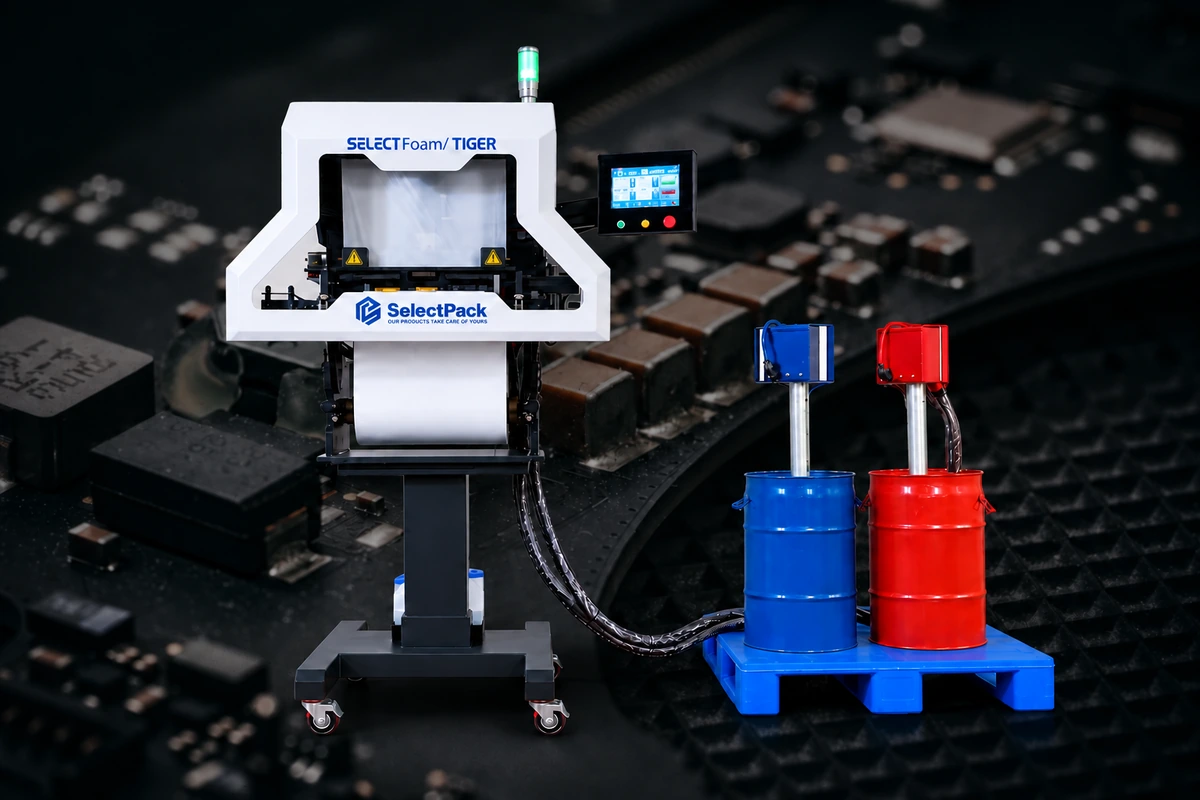
Use the SelectFoam equipment and material range to discuss how a foam-in-place process could support the mechanical packaging task. Ask separately for evidence if the proposal includes any ESD performance claim; do not infer that property from the machine type or foam description.
The review should end with an identifiable pack proposal, a clear division of approval responsibilities, and a list of any requirements still unresolved. Purchasing can then compare offers against the same product, materials, and acceptance conditions.