How a Strapping Machine Works: Feed, Tension, Seal, and Cut

目录

A strapping machine works by feeding strap from a coil, guiding it around a carton, bundle, or pallet, pulling the strap to the required tension, joining the strap ends, cutting the strap, and resetting for the next load. The cycle looks simple, but real reliability depends on how well the strap, machine settings, load shape, operator workflow, and maintenance routine fit together.

For buyers, the useful question is not only “how does a strapping machine work?” It is whether each step of the cycle can run consistently on the actual loads in the warehouse. A carton packing station, a mobile pallet strapping process, and a fully automatic conveyor line all use the same basic logic, but they create different risks.

Before choosing equipment, confirm the load type, strap material, strap width and thickness, coil size, required tension, seal method, working height, pallet access, and daily strap volume. A machine cannot fully correct an unstable pallet, poor strap quality, blocked pallet openings, or a workflow that forces operators to move loads unnecessarily.

How a Strapping Machine Works in One Cycle

Most strapping machines follow the same sequence. The amount of automation changes by machine type, but the core steps are similar.

StepWhat happensWhat can go wrong
FeedStrap is pulled from the coil and guided through the machine pathTwisted strap, poor roll winding, dirty guides, wrong strap width, blocked arch or pallet path
PositionStrap is placed around the carton, bundle, or palletStrap sits on a weak edge, misses the load center, interferes with labels, or cannot pass under the pallet
TensionThe machine or tool pulls the strap tightToo loose, carton crushing, load compression, inconsistent operator settings, poor retained tension
SealStrap ends are joined by heat, friction weld, metal seal, buckle, or another methodWeak joint, wrong material, worn sealing parts, contamination, incorrect weld or heat setting
CutThe strap is cut from the supply rollFrayed ends, long tails, dull blade, strap thickness mismatch, next-cycle feed problem
ResetThe machine prepares the next strap cycleStrap does not return correctly, sensors miss position, operator must rethread, cycle rhythm slows

This table is also a practical troubleshooting map. If a machine jams, do not start by changing every setting. Identify which step failed first, then check the strap, load, machine path, wear parts, and operator action around that step.

Machine Type Changes the Operator’s Role

Different strapping machines automate different parts of the cycle. This is why two machines can both be called strapping machines while solving very different warehouse problems.

Manual tools leave most of the process to the operator. The operator feeds strap around the load, pulls tension with a tensioner or powered tool, seals the joint, and cuts the tail. This can be flexible for low-volume or mixed work, but repeatability depends heavily on operator technique. If the decision is still between separate tools and a machine, compare strapping tensioners, sealers, cutters, dispensers, and machines by bottleneck before comparing machine models.

Semi-automatic carton machines usually sit at a packing station. The operator places the carton or bundle on the table, wraps or inserts the strap, and the machine handles tensioning, sealing, and cutting. They can work well when cartons repeatedly pass through one station.

Automatic arch machines use an arch or guide path to feed strap around the product. The operator or conveyor positions the item, and the machine cycles with less manual handling. This fits more standardized carton or bundle work where package size and flow are predictable.

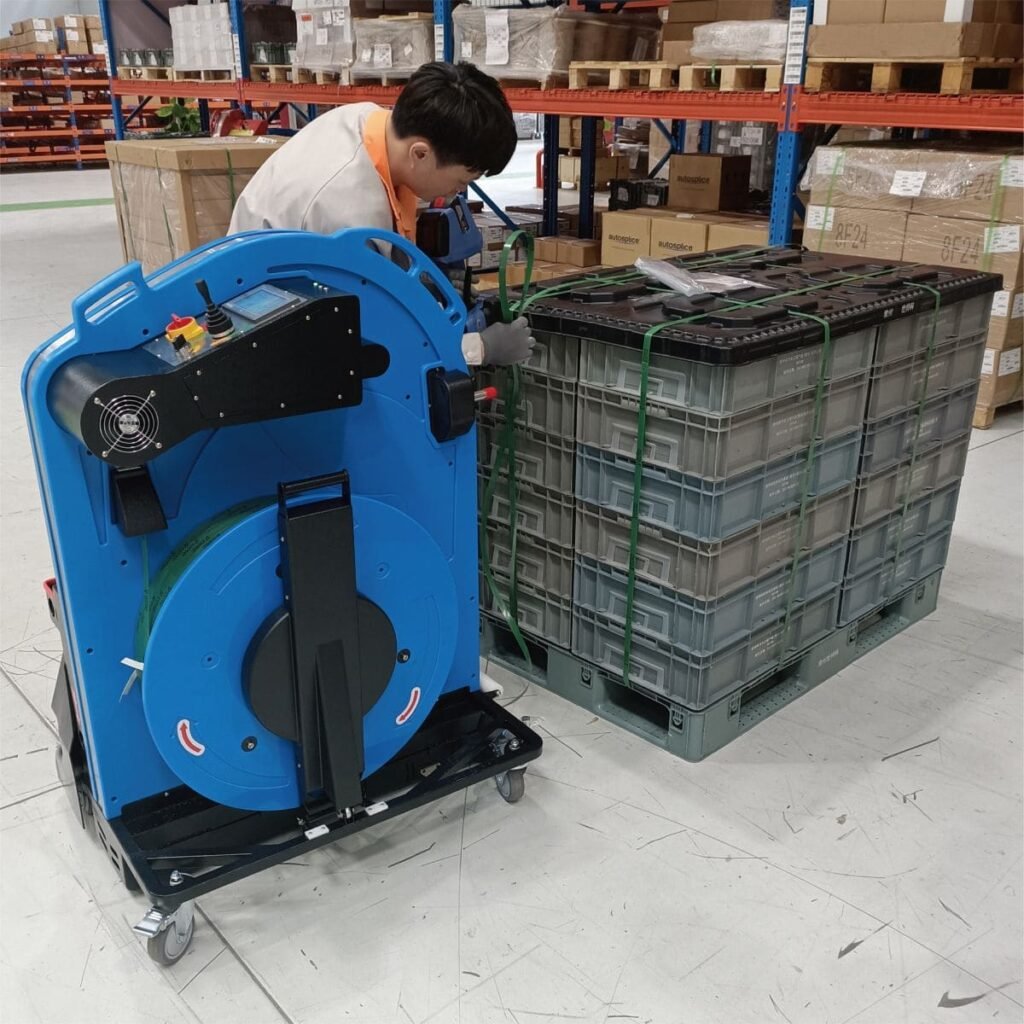
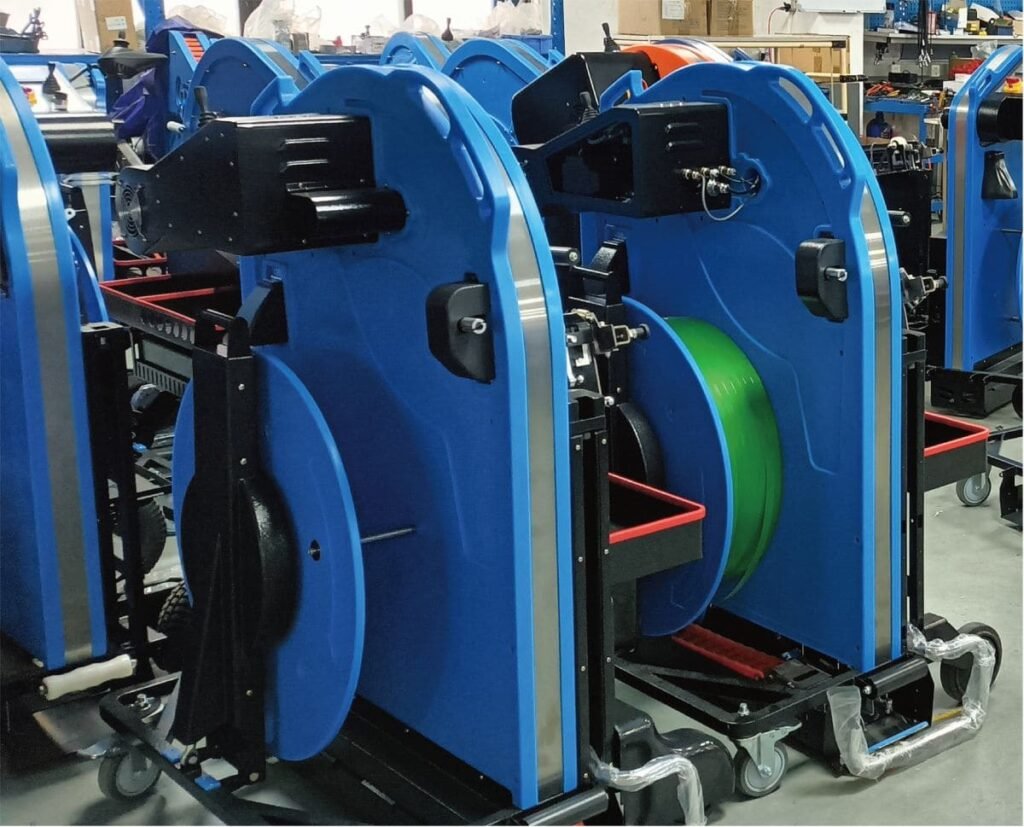
Mobile pallet strapping machines focus on the difficult pallet step: getting strap under or around the load without repeated bending, kneeling, or walking. They are most useful when pallets are already staged in different warehouse zones and moving every pallet to a fixed station would create congestion.

Fully automatic pallet systems are usually part of a controlled line. They may use conveyors, squaring devices, top-seal or side-seal heads, and programmed strap positions. They make sense when load dimensions, flow direction, and throughput justify fixed equipment.

Feed Path: The First Reliability Check

The feed path starts at the strap roll. From there, the strap passes through a dispenser, brake, guides, rollers, an arch, a lance, or an under-pallet path depending on the machine design.

Feed problems often look like machine failures, but many start with the consumable or setup. Check these details before blaming the drive motor or control system:

  • Strap material matches the machine: PP, PET, or another approved material.
  • Strap width and thickness are within the machine specification.
  • Coil outside diameter and core size match the dispenser or machine holder.
  • Roll winding is even, without collapsed edges or heavy twist.
  • Strap edge quality is clean enough to move through guides.
  • The feed path is free of dust, strap flakes, broken pieces, and adhesive debris.
  • Guides, rollers, and arches are aligned.
  • The roll brake or dispenser does not create excessive drag.

Machine-grade plastic strap must run consistently, not only meet a nominal width on the label. If feed issues begin after changing strap suppliers, run a short test with the previous strap and compare roll winding, stiffness, edge condition, and thickness.

Positioning: The Strap Must Hold the Right Part of the Load

The strap only works where it touches the load. Poor placement can leave the package unstable even if the machine completes a perfect cycle.

For cartons, the strap should support the closure or bundle without crushing weak corners, covering critical labels, or cutting into the board. One strap may be enough for small boxes or light bundles. Heavy cartons, long cartons, or export packs may need two straps or a different closure design.

For pallets, strap placement is more about load stability and movement. The strap should help keep the load together through forklift handling, storage, and transport. If the pallet is already leaning, loosely stacked, or compressible, strapping may reduce movement but will not redesign the load. The team may need better stacking, corner boards, edge protectors, stretch wrapping, dunnage, or a different pallet pattern before changing the strapping machine.

For under-pallet feeding, check the pallet base. A mobile or automatic feed system needs a clear path through or around the pallet. Closed decks, blocked bottom boards, damaged pallets, or very low clearance can prevent smooth strap feeding.

Tension: Tight Enough to Secure, Not Tight Enough to Damage

Tension pulls the strap tight around the load. The correct tension depends on product strength, package shape, strap material, seal method, and handling risk.

Too little tension can leave a loose strap that slips during handling. Too much tension can crush cartons, deform edges, damage product packaging, overload the seal, or make operators reduce settings informally to avoid claims. More tension is not automatically better.

Use tension settings by load family rather than relying on one default for every product. Review:

  • Carton strength and crush sensitivity.
  • Whether the product settles after strapping.
  • Whether the load has sharp or abrasive edges.
  • Whether PP or PET strap is being used.
  • Required retained tension after storage or transport.
  • Whether the machine tension range matches the application.
  • Whether operators can repeat the setting across shifts.

PP and PET strapping behave differently after tensioning. PP is often practical for cartons, bundles, and lighter loads. PET is often considered when heavier pallets or settling loads need stronger retained tension.

Seal Formation: The Small Joint That Carries Big Risk

The seal is where the strap ends become one holding loop. A strong strap with a weak joint still creates a weak package.

Common seal methods include heat sealing, friction welding, metal seals, buckles, and crimped joints. The correct method depends on strap material, machine type, required holding strength, and how the load will be handled.

When reviewing seal performance, check:

  • Strap material and surface are compatible with the seal method.
  • The seal or weld setting matches the strap thickness.
  • Sealing parts are clean and not worn.
  • Tension is not too high or too low before sealing.
  • Moisture, dust, oil, or strap flakes are not contaminating the joint.
  • The joint is consistent across repeated cycles, not only one demonstration.
  • Operators know what a failed or marginal seal looks like.

For nonmetallic strap discussions, buyers can use ASTM D3950 as a reference when talking with suppliers about strap properties, elongation, joint performance, and testing expectations. The standard does not choose a machine for you, but it gives a more disciplined vocabulary for comparing strap specifications.

Cutting and Reset: Small Problems Become Downtime

After sealing, the machine cuts the strap and prepares the next cycle. This step is easy to overlook until it causes jams, frayed ends, long tails, or rethreading.

Cutting quality depends on blade condition, strap thickness, strap material, cutter alignment, and residue around the cutting area. If the cut end deforms or leaves a tail, the next feed cycle may become unreliable.

Include the cutter in routine inspection. A dull or dirty cutter can create recurring downtime that looks like a feeding issue. The fix may be a wear part, cleaning routine, strap thickness correction, or supplier quality review rather than a major machine adjustment.

Carton Strapping and Pallet Strapping Need Different Layouts

The basic cycle is the same, but the workflow is different.

Decision pointCarton or bundle strappingPallet strapping
Main problemPacking station rhythm, closure reinforcement, bundle controlLoad movement, under-pallet strap path, operator bending, forklift flow
Product movementCarton usually moves to the machineMachine may need to move to the pallet, or pallet must flow through a fixed line
Strap materialOften PP for light to medium packagesPP or PET depending on load weight, settling, and transport risk
Tension riskCarton crush, board damage, label obstructionLoad shift, edge damage, retained tension loss
Layout checkTable height, arch size, conveyor connection, finished-pack flowPallet gap, load width and height, staging area, forklift traffic, battery or power routine
Better fit whenProducts are repeated at a fixed stationPallets are repeated, heavy, awkward, or strapped in several warehouse zones

This split matters because a carton machine may not solve a pallet handling problem. If operators mainly struggle with feeding strap under pallets, a fixed carton-style machine is probably the wrong category.

Where SelectPack’s Mobile Pallet Solution Fits

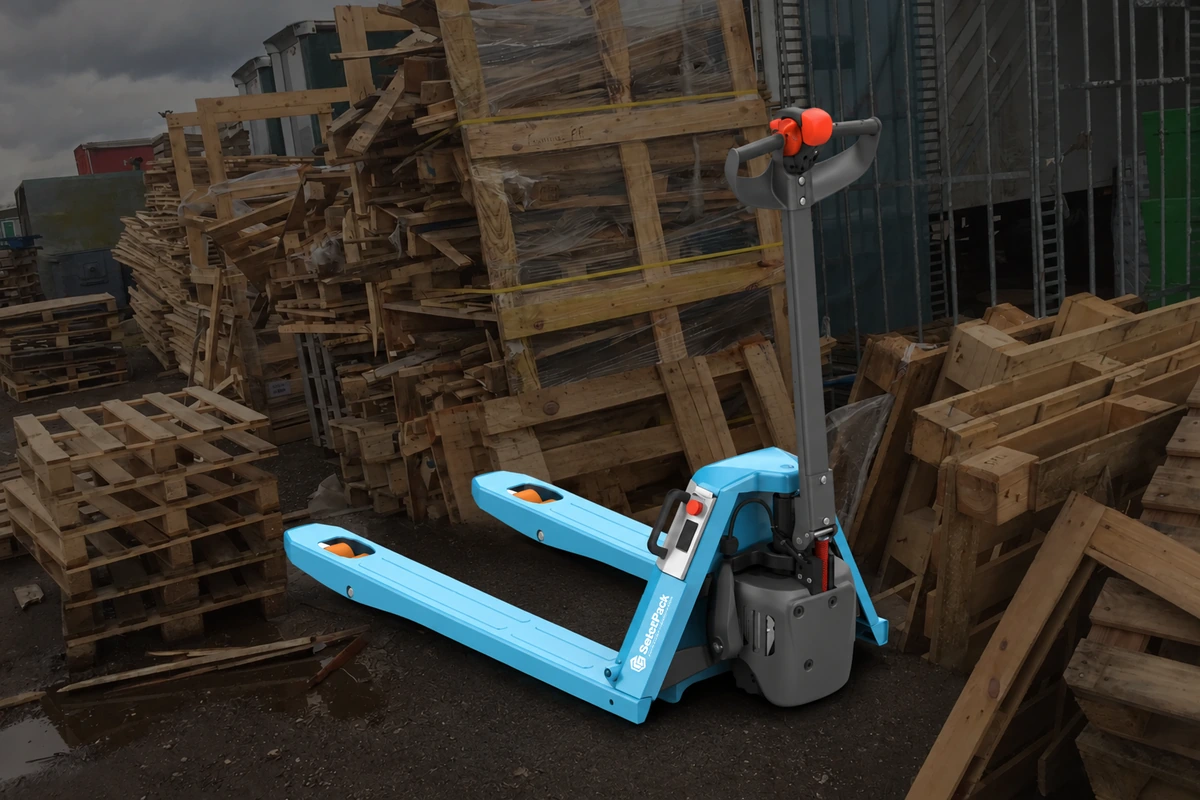
SelectPack’s mobile semi-auto 捆扎机 is most relevant when the load is already palletized and the hard step is feeding strap under or around the pallet. It is a pallet workflow solution, not a universal replacement for every strapping tool or carton machine.

It may fit when:

  • Operators currently bend, kneel, or walk around pallets for each strap.
  • Pallets are strapped in more than one warehouse zone.
  • A fixed strapping station would add unnecessary forklift movement.
  • PP or PET plastic strapping is used.
  • Pallet bottoms have enough open clearance for a strap-feeding path.
  • The team wants more consistent pallet strapping without installing a full conveyorized line.

It may not be the right first choice when:

  • The work is mainly light carton strapping at a bench.
  • Pallets have closed decks, low bottom clearance, or blocked strap paths.
  • Steel strapping is required.
  • The only problem is a weak seal on an otherwise acceptable manual process.
  • Loads are unstable before strapping and need better load preparation first.
  • The operation already has a high-speed conveyor line that needs a fixed automatic pallet system.

Buyers comparing mobile and fixed options can review SelectPack’s mobile semi-auto strapping machine as a pallet-focused example after defining the real workflow problem.

What to Check Before Requesting a Quote

A useful strapping machine quote needs more than a product name. Send the supplier enough information to match the machine to the application.

准备:

  • Load type: carton, bundle, tray, pallet, or mixed loads.
  • Product dimensions, weight range, and crush-sensitive areas.
  • Daily strap count and peak-hour volume.
  • Strap material, width, thickness, roll outside diameter, and core size.
  • Current seal method and common failure points.
  • Required number and position of straps per load.
  • Whether the load settles, shifts, or has sharp edges.
  • Photos or a short video of the current strapping cycle.
  • Working location: bench, conveyor, pallet staging area, dock, or production cell.
  • Power, air, battery, maintenance, and spare part expectations.
  • Pallet bottom opening, forklift traffic, and floor clearance if pallet strapping is involved.

If the supplier recommends a machine without asking about strap spec, load behavior, layout, and operator steps, the recommendation may be based on equipment category rather than application fit.

Validate the Cycle on Real Loads

Do not approve a machine only because it completes one clean demo cycle. Test the full feed, tension, seal, cut, and reset sequence on the loads that usually create trouble.

Use this validation sequence:

  1. Test the smallest, largest, heaviest, most fragile, and most awkward load.
  2. Use the actual strap material and coil format planned for production.
  3. Run enough cycles to show feed consistency, not only one successful strap.
  4. Check seal quality after handling, not only immediately after the cycle.
  5. Inspect carton edges, pallet corners, labels, and product surfaces for damage.
  6. Let compressible pallets sit long enough to show load settling.
  7. Move the load through normal forklift or conveyor handling.
  8. Record operator steps, bending, walking, rethreading, and rework.
  9. Confirm the maintenance team can access wear parts, blades, guides, and sealing areas.

For higher-risk shipping programs, transport packaging test procedures can help frame validation beyond a simple in-house handling check. Not every warehouse needs formal lab testing, but the same idea applies: test the package through the route it actually faces.

Common Mistakes When Reading the Machine Cycle

Avoid these mistakes:

  • Treating every jam as a machine defect before checking strap quality and roll winding.
  • Increasing tension to hide a weak seal.
  • Choosing PET strap without confirming machine and cutter compatibility.
  • Testing only easy cartons when the real problem is heavy or unstable pallets.
  • Ignoring pallet bottom clearance before choosing a mobile feed system.
  • Expecting strapping to fix a poorly stacked or leaning load.
  • Forgetting that operator movement can be the bottleneck even when the machine cycle is fast.
  • Skipping routine cleaning around feed, seal, and cut areas.

The best machine choice usually comes from observing the current cycle. Watch where the operator waits, bends, rethreads, pulls, adjusts, or repairs the load. That step often explains which equipment level is actually needed.

Final Takeaway

A strapping machine works through a controlled cycle: feed, position, tension, seal, cut, and reset. Each step must match the strap, load, equipment type, and workflow.

For simple carton work, the main decision may be station layout and cycle rhythm. For pallet work, the bigger issue is often operator movement, pallet access, load stability, and retained tension. The right machine is the one that runs the full cycle reliably on real loads, with real strap, in the actual warehouse layout.

分享此帖:

大家好,我是来自 SelectPack 团队的 Harlan,我们专注于防护包装解决方案和仓库效率。.

SelectPack拥有超过16年的行业经验,已与30多个国家的客户合作,包括第三方物流供应商、仓储物流中心和出口包装团队。我们致力于帮助企业减少包装损坏、控制成本并简化出库流程。.

通过这些文章,我分享了一些实用的见解,以帮助企业选择合适的包装系统,并构建更高效、可扩展的包装工作流程。.

防护包装专家

大家好,我是这篇文章的作者。.

在 SelectPack,我们为全球客户提供支持——从第三方物流公司和物流中心到以出口为重点的制造商——提供可靠的保护性包装系统,以提高效率并减少运输损坏。.

如果您计划进行包装升级或需要帮助选择合适的解决方案,请随时联系我们,我们将为您提供量身定制的系统建议。.

立即获取报价

节省成本 · 提升品质 · 极速交付
并以前所未有的速度满足您的硬件需求。

下载产品手册

输入您的电子邮件地址,即可获取产品手册和证书的下载链接。