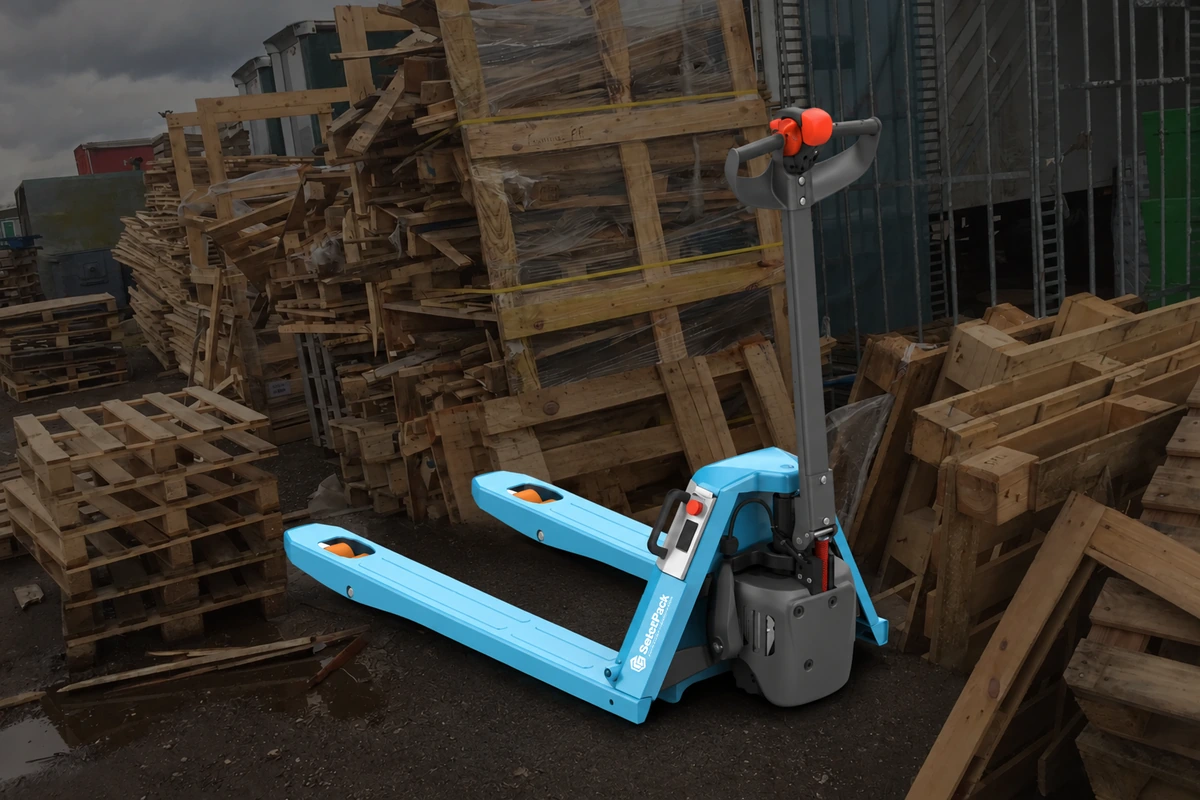
An electric pallet jack fits a pallet only when its fork spacing, fork length, lowered height and load-wheel path suit the pallet’s actual construction and intended entry direction. Rated capacity answers a different question: it does not prove that the truck can enter, support or withdraw from that pallet.
Start with the pallets you handle, including supplier pallets and less common sizes. Compare their openings and underside structure with the drawing for the exact truck configuration, then arrange an appropriate fit check. A pallet’s outside length and width are useful identifiers, but they do not describe the complete entry path.
Which Fork Dimensions Need to Match the Pallet?
Check the complete fork assembly against both pallet openings, not just a single width from the truck specification. The outer edges, individual fork sections and load wheels must all have a suitable path.
| Truck dimension | Compare with | Question it answers |
|---|---|---|
| Fork outside width | Position and span of both openings | Can both forks enter together? |
| Individual fork width | Each clear opening | Does either fork meet a block or stringer? |
| Lowered fork height | Lowest usable entry clearance | Is there vertical room along the path? |
| Fork length | Entry depth and support arrangement | Is engagement suitable without unwanted projection? |
| Load-wheel position and assembly | Bottom boards and internal spaces | Can the wheel assembly travel and operate as intended? |
Ask for a dimensioned drawing when the specification table does not identify the measurement points. “Fork width” can refer to the width of one fork, the spacing between forks or the outside width across both. Those values are not interchangeable.
The truck body’s overall width is another separate measurement. It matters for access around the pallet and through the workplace, but it does not establish the fork assembly’s fit inside the pallet.
Measure the Entry Side You Will Actually Use
Pallet compatibility is specific to an entry direction. Record the side from which the operator must approach, because a usable opening on one side does not establish access from another.
For each pallet design, record the outside dimensions, construction type, clear openings and underside arrangement. Identify blocks, stringers, bottom boards, runners and any features extending into the path. Use the smallest relevant opening along the intended insertion route, rather than only the gap visible at the front edge.
A pallet described as accessible from several sides still needs to be checked against the handling equipment involved. A fork opening does not by itself confirm that a pallet jack’s load wheels can pass through and work within the underside structure. Ask the pallet supplier to confirm the intended pallet-truck entry directions when the description is ambiguous.
Include normal dimensional variation and condition in the review. A reference drawing describes a design; the receiving operation handles real pallets. Damaged or distorted pallets should be handled through the site’s inspection and isolation process, rather than treated as a reason to force a truck into a restricted opening.
HSE’s pallet safety guidance treats the load, handling method and pallet condition as part of suitability. Matching the footprint alone leaves those questions unanswered.
Why Do Bottom Boards and Load Wheels Matter?
An electric pallet jack’s load wheels form part of the compatibility check. A fork-tip opening can look suitable while a bottom board or internal obstruction prevents the complete assembly from entering or lifting as intended.
Review where the wheels sit at the required fork engagement depth. Show the supplier the pallet’s underside arrangement and identify the route from the entry edge to the working position. Confirm how the proposed wheel and fork assembly interacts with that design, using the manufacturer’s instructions and an appropriate sample assessment.
Do not assume that a different wheel arrangement solves every entry problem. Single or tandem wheels, their location and the surrounding fork geometry must be considered as a specified assembly. Nor should a buyer infer that a small front roller makes an incompatible pallet acceptable.
The withdrawal path matters too. Check that the selected configuration can leave the pallet in the normal operating sequence without catching underside components. Do not modify a pallet or truck during a purchasing trial to obtain a pass unless the relevant manufacturer has assessed and approved that change.
How Should You Evaluate Fork Length and Lowered Height?
Fork length must suit the pallet’s support arrangement, while lowered height must suit the actual vertical entry path. Neither dimension should be chosen from a generic “standard pallet” assumption.
Fork length: check engagement and the far side
Use the pallet drawing to identify the required engagement and approved support points. A short fork assembly that enters easily does not automatically provide suitable support. A longer assembly needs a separate check for projection beyond the pallet and interference with adjacent goods or structures.
For pallets placed closely together, consider the space beyond the target pallet. The supplier needs to know that operating arrangement as well as the pallet length. Physical fit, load stability and truck capacity remain separate acceptance conditions.
Lowered height: use the limiting clearance
Compare the specified lowered fork height with the lowest usable opening along the route. The product table’s ground clearance is not a substitute for lowered fork height; the measurements describe different parts of the truck.
Ask how the drawing accounts for the wheel assembly and operating position. For a low-entry pallet, provide measured clearances and the pallet drawing instead of requesting an unspecified clearance margin. There is no single additional gap that establishes compatibility for every pallet design, condition and floor arrangement.
Build a Pallet-by-Pallet Fit Matrix
Approve compatibility for each pallet family and intended entry direction. A successful assessment of one frequently used pallet should not become an approval for every incoming supplier pallet.
| Record | Information to retain |
|---|---|
| Pallet identity | Supplier, design or revision, outside dimensions |
| Intended entry | Approach side and required operating position |
| Geometry | Opening measurements, underside structure, support points |
| Truck configuration | Model, fork assembly, wheel arrangement, drawing revision |
| Assessment result | Pass, unresolved condition or unsuitable configuration |
| Evidence and approval | Sample used, observations, responsible reviewer |
Keep unresolved results visible. For example, an illustrative assessment could find that one pallet allows front entry but has an unconfirmed wheel path from the side. That result supports a restricted or pending decision, not a general “fits” label.
Arrange trials through qualified personnel following the truck manufacturer’s instructions and the site’s handling controls. Agree what constitutes suitable entry, lifting, support and withdrawal before the trial. Where dimensions or pallet construction change, review the affected matrix entries.
What Should You Send When Choosing a SelectPack Truck?
Send the actual pallet geometry and entry requirement before selecting a fork configuration. Then assess load capacity and workplace access alongside the fit result.
The electric walkie pallet jack guide provides the broader equipment selection context. For a comparison of MantisLite and MantisMax configurations, request the current drawings rather than treating every published dimension as applicable to every supplied truck.
Provide pallet dimensions, entry directions, opening measurements, underside construction and load information. Include the less common pallets that must remain usable, not only the easiest example. Contact SelectPack with those details to confirm a suitable truck-and-pallet combination before ordering.