
Industrial facilities generate enormous volumes of used corrugated cardboard every day. Inbound raw materials arrive packed in heavy-duty cartons, components are unpacked at receiving docks, and finished goods are repackaged for outbound shipment. Over time, empty boxes accumulate across warehouses, production floors, and fulfillment centers, becoming a constant operational by-product rather than a one-off inconvenience.
At the same time, these same facilities continue to spend money on two related areas: protective void fill materials for outbound packaging, and cardboard waste disposal for used cartons. Paper cushions, air pillows, or foam packaging are purchased on a recurring basis, while waste cardboard is collected, stored, baled, or hauled away—often at rising costs due to labor, space constraints, and disposal fees.
An industrial cardboard shredder connects these two cost centers. Instead of treating used cardboard as waste, facilities can process it on site and reuse it as protective packaging material. This shifts cardboard from a disposal problem into a usable resource within daily packaging operations.
This article focuses on one practical and decision-critical question: How long does an industrial cardboard shredder take to pay for itself? By examining costs, savings, and realistic usage scenarios, we aim to provide a clear framework for evaluating ROI in industrial environments.
What ROI Means for an Industrial Cardboard Shredder
Return on investment (ROI) is often discussed in broad terms, but in an industrial packaging context, it has a very specific meaning. For equipment such as an industrial cardboard shredder, ROI is not driven by resale value or productivity output alone. Instead, it is primarily defined by cost avoidance—reducing or eliminating ongoing expenses that already exist in daily operations.
In practical terms, ROI answers a simple question: At what point do the accumulated savings from reduced material purchases and waste handling equal the initial cost of the machine?
Unlike revenue-generating machinery, a cardboard shredder does not directly produce sellable goods. Its value comes from replacing purchased consumables and reducing waste-related expenses. The financial return is therefore measured in reduced spending on void fill materials, reduced waste disposal and handling costs, and operational efficiency gains that lower indirect costs.
Because these savings recur month after month, the investment is best evaluated through payback period, rather than abstract ROI percentages. A machine that pays for itself in 12–18 months is considered highly attractive in industrial packaging, as it then generates pure savings for the remainder of its useful life.
Initial Costs to Consider Before Buying
Understanding the initial costs associated with an industrial cardboard shredder is essential for an accurate ROI calculation. These costs can be divided into two main categories: equipment purchase cost and operating costs.
Equipment Purchase Cost
Industrial cardboard shredders differ significantly from light-duty or office-level machines. They are designed for higher throughput, thicker corrugated board, and continuous or multi-shift operation. The price difference reflects not just size, but durability, safety features, and long-term reliability.
From an ROI perspective, the key question is not whether the machine is “cheap” or “expensive,” but whether its capacity matches actual usage. An underpowered machine may cost less upfront but fail to generate sufficient savings, while an appropriately sized unit maximizes reuse and accelerates payback.
Operating Costs
Beyond the purchase price, operating costs influence the real return on investment. Fortunately, for industrial cardboard shredders, these costs are generally modest relative to the savings they enable.
Power Consumption — Industrial shredders consume electricity, but energy usage is typically low compared to heavy manufacturing equipment. In most facilities, power consumption represents a small fraction of total operating costs and rarely has a significant impact on ROI calculations.
Routine Maintenance — Routine maintenance may include periodic blade inspection, lubrication, and occasional replacement of wear components. Well-designed industrial shredders require minimal maintenance and are built for long service intervals, helping keep downtime and unexpected costs low.
Labor Involvement — Labor requirements depend on workflow design. In many facilities, cardboard shredding is incorporated into existing packing processes, meaning no additional labor is required. When this is the case, labor cost has little effect on ROI.
Where the Cost Savings Come From
The ROI of an industrial cardboard shredder is driven by multiple overlapping sources of savings. Understanding each one helps explain why payback periods can be surprisingly short.
Reduced Spending on Void Fill Materials
Void fill materials are a recurring expense in most industrial packaging operations. Shredded cardboard can replace or supplement paper cushioning, air pillows, bubble wrap, and foam-based fillers. For many shipments—particularly non-fragile or moderately fragile items—cardboard cushioning provides adequate protection at no additional material cost.
Producing void fill on site also eliminates reordering delays, storage requirements for bulk packaging materials, and dependency on external suppliers. This reliability is particularly valuable during peak seasons or supply chain disruptions.
Lower Cardboard Waste Disposal Costs
Disposing of used cardboard is rarely free. Even in regions with recycling programs, businesses often incur costs related to collection, handling, and storage. By converting cardboard into packaging material, waste volume is reduced, pickup frequency may decrease, and disposal fees can be lowered. In some operations, cardboard disposal costs are reduced to near zero.
Baling equipment, floor space, and labor are often required to manage cardboard waste. Shredding cardboard at the source reduces the need for these processes, freeing up space and simplifying waste management.
Improved Warehouse Efficiency
While harder to quantify, efficiency gains contribute meaningfully to ROI. Shredding cardboard reduces bulky waste accumulation, allowing facilities to reclaim valuable floor space. When void fill is produced on demand at the packing station, packers spend less time walking, retrieving materials, or waiting for restocks. Over time, these small efficiencies add up.
Typical Payback Period for Industrial Cardboard Shredders
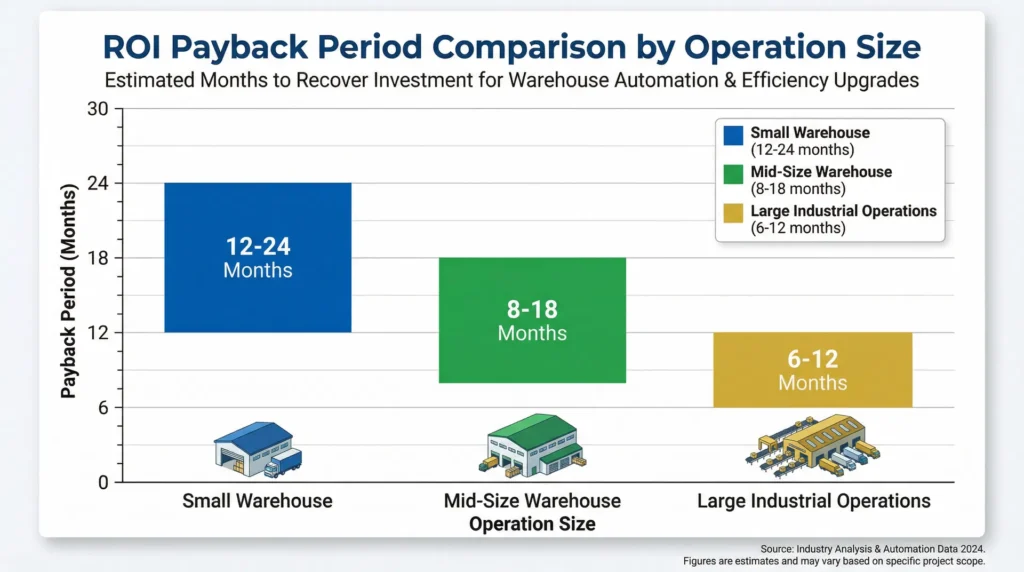
With costs and savings defined, the next question is how these factors translate into real-world payback timelines.
Small to Mid-Size Warehouses
Small to mid-size warehouses typically generate moderate volumes of cardboard and operate a limited number of packing stations. In these environments, shredded cardboard replaces part of purchased void fill, disposal costs are reduced but not eliminated, and the shredder is used consistently but not continuously.
For these facilities, typical payback periods range from 12 to 24 months, depending on usage consistency and local cost structures. This timeline makes the investment financially attractive, as the equipment continues generating savings for 5–10 additional years of operation.
High-Volume Industrial Operations
High-volume operations include manufacturing plants, large distribution centers, and 3PL facilities running multiple shifts. These facilities often generate large quantities of cardboard daily, operate multiple packing lines, and face higher waste handling and material costs.
Because shredded cardboard is used continuously, savings accumulate rapidly. In many such cases, payback periods of 6 to 12 months are achievable, particularly when purchased void fill is largely replaced. For these operations, the ROI case is compelling and the financial decision straightforward.
Cost Savings Breakdown: Where the Money Goes
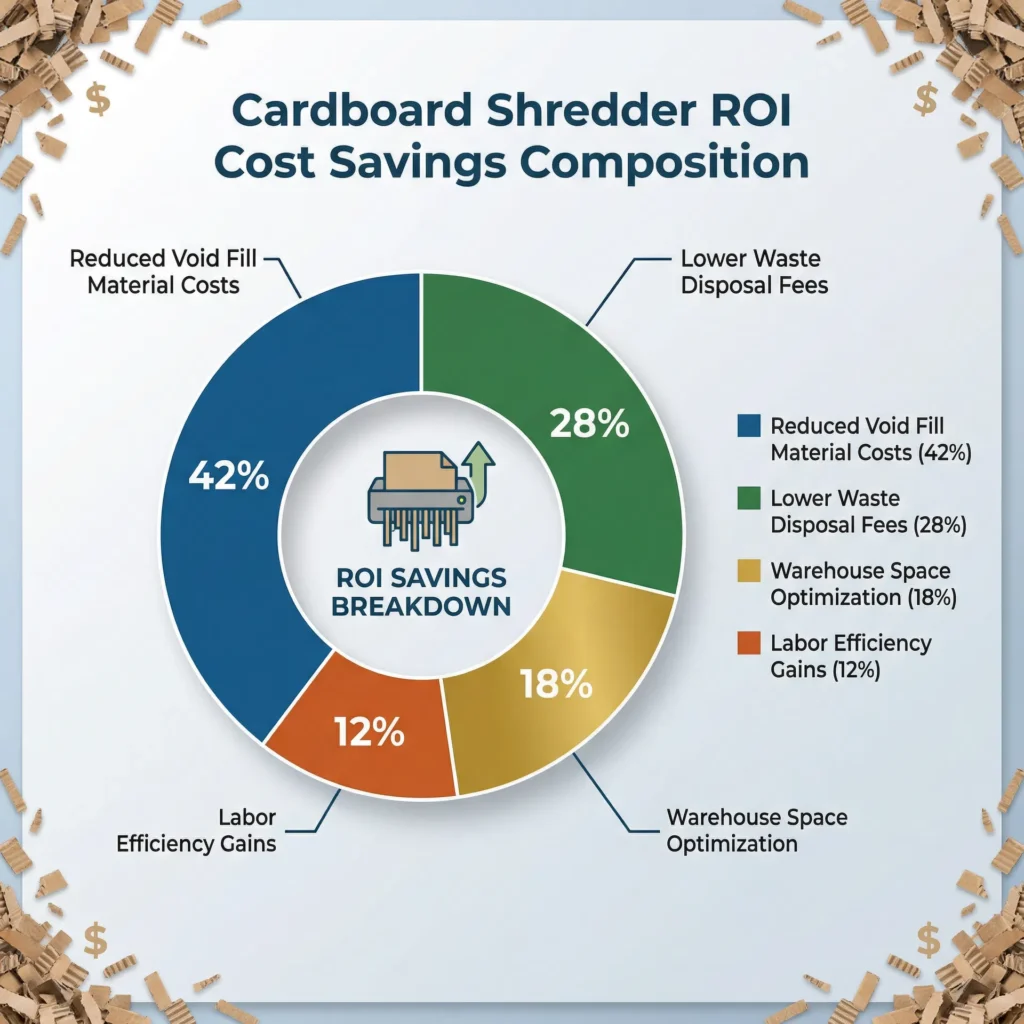
The chart above illustrates how different cost categories contribute to overall ROI. Material cost reduction—replacing purchased void fill with shredded cardboard—accounts for approximately 42% of total savings. Waste disposal cost reduction contributes 28%, while warehouse space optimization and labor efficiency gains add 18% and 12% respectively.
This breakdown is important because it shows that ROI is not dependent on a single factor. Even if one cost category underperforms, the other savings streams ensure a positive return. For example, if a facility has limited waste disposal costs, the material savings alone can still justify the investment.
Total Cost of Ownership: The Full Picture
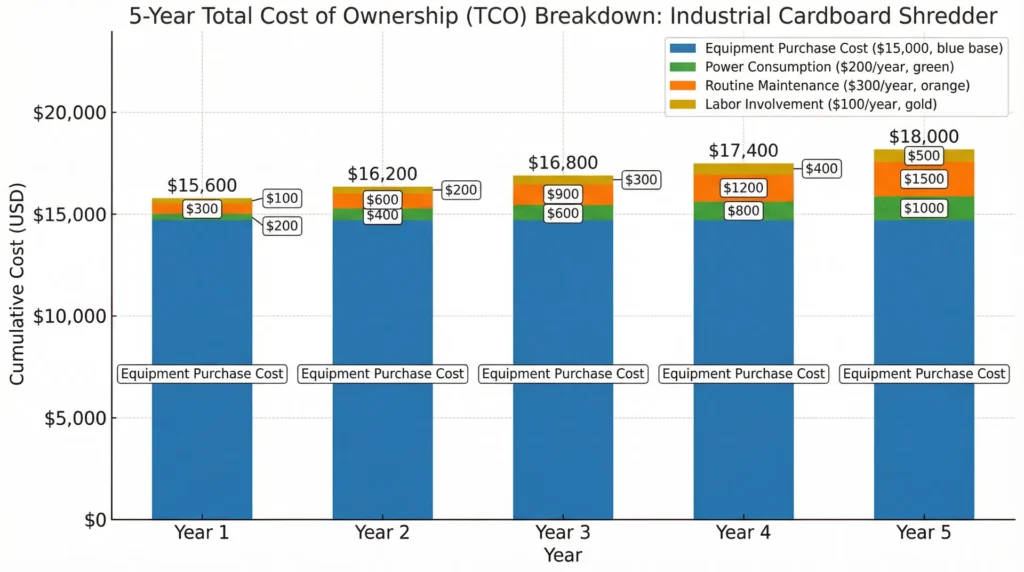
One common mistake in equipment evaluation is focusing only on the upfront purchase price. While purchase cost is important, it represents just one component of the overall investment. Total cost of ownership (TCO) includes initial equipment cost, energy consumption, routine maintenance, labor involvement, and floor space requirements.
As the chart illustrates, a $15,000 equipment investment combined with modest annual operating costs ($600/year total) results in a 5-year TCO of approximately $18,000. For a facility generating $30,000+ in annual savings, this investment is recovered well within the first two years, with substantial savings continuing thereafter.
When an Industrial Cardboard Shredder May Take Longer to Pay for Itself
Although industrial cardboard shredders deliver strong ROI in many environments, they are not universally fast-paying investments. Understanding scenarios where payback may take longer is critical for setting realistic expectations.
Low Cardboard Volume
Facilities that generate limited amounts of used cardboard may struggle to fully utilize an industrial shredder. When cardboard input is inconsistent or minimal, the machine operates below its designed capacity, reducing potential savings. For operations with low inbound packaging volume, a lighter-duty solution or alternative packaging strategy may be more appropriate.
Infrequent Shipping Operations
Some facilities ship products only periodically rather than daily. If packaging activity occurs in short bursts or seasonal windows, shredded cardboard may not be produced or consumed consistently. This can result in idle machine time, lower cumulative savings, and extended payback timelines.
Minimal Spending on Void Fill Materials
If a facility already spends very little on void fill—due to product design, shipment density, or existing reusable packaging—the cost-saving potential of shredded cardboard may be limited. In these environments, cardboard shredding may still reduce waste, but material cost savings alone may not justify rapid payback.
Is an Industrial Cardboard Shredder Worth It for Your Operation?
The decision to invest in an industrial cardboard shredder should be based on your specific operational context. Here are key questions to ask before making a commitment:
Do you generate 50+ boxes of cardboard waste per day? If so, you have sufficient feedstock to justify equipment investment.
Are you currently spending $500+ per month on void fill materials? If so, material cost savings alone can support ROI.
Do you pay for cardboard waste disposal? If so, you have a second major cost center that shredding can eliminate.
Do you have 2–3 square meters of available floor space? If so, installation is feasible without major workflow disruption.
Are your packing operations consistent and predictable? If so, you can reliably forecast savings and payback period.
If you answer “yes” to three or more of these questions, an industrial cardboard shredder is likely a sound investment for your operation. To explore specific models and get a customized ROI analysis based on your facility’s data, contact the SelectPack team for a detailed consultation.
Evaluating the Right Machine Size and Capacity
Selecting the appropriate equipment size is critical to achieving projected ROI. Undersized machines fail to process available cardboard, leaving waste unprocessed and savings unrealized. Oversized machines represent unnecessary capital expense if your facility cannot generate sufficient feedstock.
SelectPack offers a range of industrial cardboard shredders designed for different volume levels. The Hippo P20 is ideal for smaller operations and packing stations, while the HippoPlus P50 is engineered for high-volume industrial environments.
To determine the right size, assess your daily cardboard volume, packing station count, and void fill consumption. A SelectPack specialist can help match equipment capacity to your specific needs, ensuring maximum ROI and operational efficiency.
Conclusion
For most industrial facilities processing 50+ boxes per day with consistent cardboard waste generation, an industrial cardboard shredder delivers a compelling financial return. Payback periods of 6–24 months are typical, depending on operation size and cost structure. Beyond payback, the equipment continues generating savings for 5–10 additional years, making it one of the most cost-effective investments in packaging operations.
The financial case is strengthened by non-monetary benefits: reduced environmental impact, improved workplace safety by eliminating bulky waste, and greater operational flexibility through on-demand material production.
Ready to evaluate an industrial cardboard shredder for your operation? Request a quote and receive a customized ROI analysis based on your facility’s specific data. Or explore the complete cardboard shredder product range to compare models and specifications.
Related reading:
•Cardboard Shredder vs Buying Void Fill: Cost & Sustainability Comparison
•How to Choose the Right Cardboard Shredder for Your Business
•Cardboard Shredder for Packaging: How Businesses Turn Waste into Void Fill
•What Is a Cardboard Shredder?
•Explore Paper Cushioning Machines
•Explore Paper Bubble Machines
•Protective Packaging Solutions
References
1.U.S. Environmental Protection Agency. Waste Reduction and Recycling Guidelines. https://www.epa.gov/recycle
2.Packaging World. Industrial Equipment ROI and Cost Analysis. https://www.packworld.com/
3.Packaging Dive. Warehouse Automation and Efficiency Trends. https://www.packagingdive.com/
4.SelectPack Technology. Industrial Cardboard Shredder Product Specifications. https://selectpacktech.com/product-category/cardboard-shredder/