
Across modern supply chains, cardboard has become an unavoidable by-product of daily operations. Goods arrive in corrugated cartons, outbound orders require repacking, and empty boxes accumulate quickly at packing stations, warehouses, and back rooms. For many businesses, this used cardboard is treated as waste — something to be flattened, stored, and eventually removed by a recycling service.
At the same time, those very same operations are spending increasing amounts on protective packaging materials. Void fill, cushioning paper, bubble wrap, and foam all add recurring costs to shipping workflows. This creates a familiar contradiction: companies pay to get rid of cardboard waste, then pay again to buy packaging materials that serve a similar protective purpose.
On-site cardboard shredding using a dedicated cardboard shredder bridges this gap. By processing used cartons into usable void fill or cushioning material, businesses can turn a disposal problem into a packaging resource. However, the benefits depend heavily on choosing the right machine. A system that is too small may struggle to keep up with demand, while an oversized unit can become an unnecessary capital expense.
This guide focuses on how to choose a cardboard shredder that fits your actual operation — not just in terms of machine size, but also workflow, output needs, and long-term business goals.
Understand Your Cardboard Waste Profile
Before comparing machines or specifications, it is essential to understand the nature of the cardboard you generate. Many purchasing decisions fail because businesses focus on equipment first and waste characteristics second.
What Type of Cardboard Do You Handle?
Not all cardboard behaves the same when processed. The most common material in packaging environments is single-wall corrugated cardboard, typically used for shipping cartons and secondary packaging. This type is relatively easy to shred and produces consistent output.
Some operations, however, deal with heavier materials such as double-wall corrugated boxes or reinforced cartons used for industrial components. Thicker board requires more cutting force and may limit which machines are suitable. Additional variables include printed or coated cardboard, which can affect friction and cutting consistency, and oversized cartons that exceed standard input widths.
Identifying the dominant cardboard type in your operation helps narrow down suitable equipment and avoids premature wear or performance issues.
Daily and Weekly Cardboard Volume
Volume is often underestimated. Many businesses judge their needs based on peak moments rather than average throughput, or vice versa. Low-volume environments may generate cardboard gradually throughout the day — perhaps a few boxes per hour. In contrast, warehouses and fulfillment centers often experience concentrated bursts of cardboard waste during receiving or outbound processing.
Understanding volume requires looking at how much cardboard is generated per shift, whether waste is spread evenly or clustered, and seasonal fluctuations such as peak sales periods. This assessment directly influences whether a compact system or a higher-capacity solution is appropriate.
How Is Cardboard Currently Managed?
Current waste handling practices also matter. Some businesses already bale cardboard and sell it for recycling, while others pay for regular waste removal. Key questions include: Are you paying to remove cardboard waste? Is storage space for flattened cartons becoming an issue? A clear picture of existing costs and constraints provides a baseline for evaluating the value of on-site shredding. For a detailed cost comparison, see Cardboard Shredder vs. Buying Void Fill.
Types of Cardboard Shredders and Their Output — What’s the Difference?
Understanding how different cutting mechanisms work is essential before making a decision. Not all shredded cardboard looks or performs the same — and the differences matter significantly for packaging quality.
Strip-Cut Cardboard Shredders
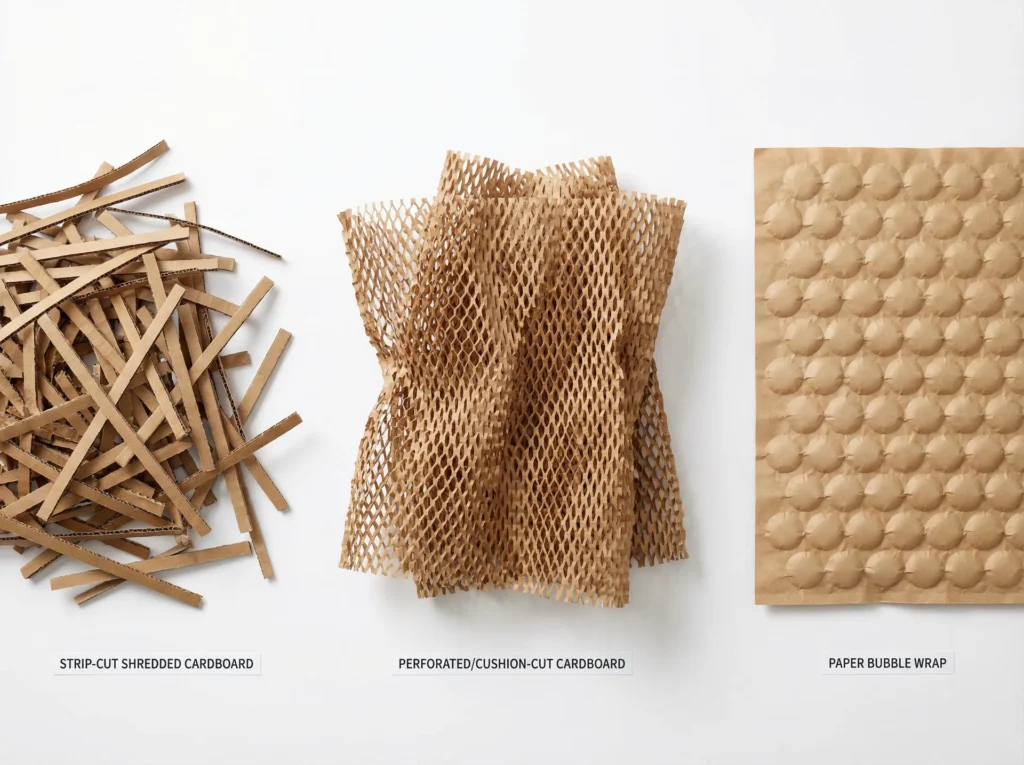
Strip-cut systems slice cardboard into narrow strips, typically 10–20 mm wide. The resulting material is loose and flat, suitable for light void filling where the primary goal is occupying empty space rather than absorbing impact. This output style is often used when products are lightweight, space filling is more important than shock absorption, or processing speed is prioritized over structural cushioning.
Strip-cut material is simple to produce but may not provide sufficient protection for heavier goods or fragile items that require impact resistance.
Perforated or Cushion-Cut Cardboard Shredders
Perforating machines — often referred to as cardboard perforators — expand cardboard by cutting and stretching it into a mesh-like lattice structure. This creates a springy, three-dimensional material that offers significantly better cushioning performance than strip-cut output.
The key visual difference: perforated output looks like an expanded metal mesh, with diamond-shaped or hexagonal openings, and has real spring and volume when you compress it. Strip-cut output, by contrast, is flat and loose with no structural memory.
Perforated cardboard is commonly used in e-commerce fulfillment, industrial shipping, and applications requiring improved shock absorption. This method transforms flat waste into a functional packaging material rather than simple filler. For businesses that need even more structured cushioning, paper cushioning machines offer a complementary paper-based solution.
How Cardboard Shredder Output Differs from Honeycomb Paper and Paper Bubble Wrap
It is worth clarifying the distinction between three paper-based cushioning materials that are often confused:
| Material | How It’s Made | Structure | Best Use |
| Strip-cut shredded cardboard | Cardboard shredder (strip blades) | Flat, narrow strips | Light void fill |
| Perforated/cushion-cut cardboard | Cardboard perforator (perforation blades) | Expanded mesh/lattice, springy | General cushioning & void fill |
| Honeycomb paper | Dedicated honeycomb paper machine | Regular hexagonal cells, kraft paper | Wrapping fragile items |
| Paper bubble wrap | Paper bubble machine | Raised hemispherical air bubbles pressed into kraft paper | Wrapping and surface protection |
The critical point: cardboard shredders convert your existing waste cartons into cushioning material at near-zero material cost. Honeycomb paper and paper bubble wrap require purchasing dedicated roll stock as input material. Both approaches have their place, but the economics and workflow implications are very different.
Choose the Right Output Style for Your Packaging Needs
The value of a cardboard shredding system depends largely on how the output is used.
Void Fill vs. Cushioning Material
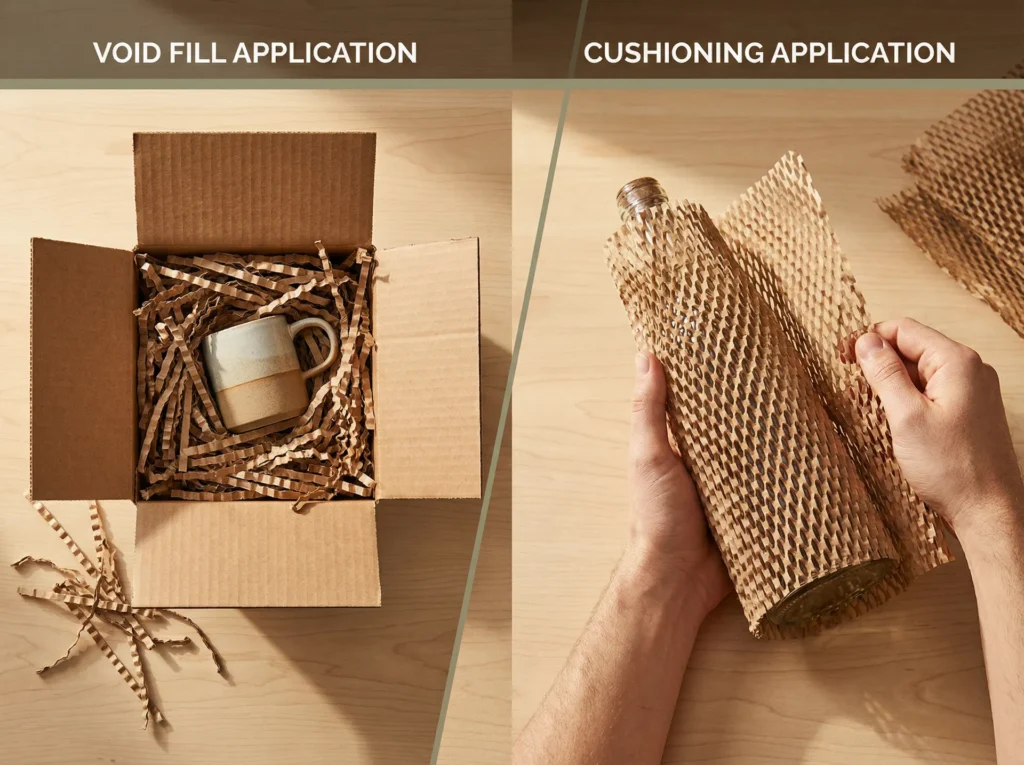
Void fill focuses on occupying empty space to prevent movement, while cushioning absorbs impact and vibration. Some businesses require both, but most lean toward one primary function.
Choosing the wrong output style can result in overuse of material, inadequate protection, or slower packing processes. Matching output to product characteristics is more important than maximizing output volume. If your products are fragile or high-value, a perforated cardboard shredder or a dedicated paper cushioning machine will serve you better than a basic strip-cut system.
Output Width and Expansion Ratio
Wider output can cover more surface area, while higher expansion ratios produce fluffier material from the same input. These factors influence how quickly packers can work and how much cardboard is consumed per box. Operations with high packing speeds often benefit from output that is easy to grab, separate, and place without additional handling.
Consistency and Professional Appearance
In B2B shipping, presentation matters. Consistent output contributes to a clean, professional look that reflects well on the brand, especially for customer-facing shipments. Irregular or inconsistent material can slow down packing and reduce perceived quality.
Matching Shredder Capacity to Your Operation Size
Choosing the right cardboard shredder capacity is less about maximum power and more about operational fit. In most packaging environments, the decision comes down to two categories: desktop units and floor-standing systems.
Desktop Cardboard Shredders
Desktop cardboard shredders are designed for compact spaces and moderate workloads. They are commonly used in small e-commerce operations, offices, or packing rooms where cardboard waste accumulates gradually. These machines typically handle standard single-wall corrugated cartons, operate intermittently throughout the day, and fit directly on or beside packing tables.
Desktop systems work best when one operator manages both shredding and packing, allowing cardboard to be processed as needed rather than in large batches.
SelectPack’s Desktop Cardboard Perforator Hippo P20 is a smart solution for medium-volume shipping departments. It processes standard and mid-size cartons into resilient cushioning material, helping operations reduce reliance on plastic fillers. Reliable, low-maintenance, and compact enough for any workbench.
Floor-Standing Cardboard Shredders
Floor-standing cardboard shredder systems are intended for higher-volume environments where cardboard waste accumulates quickly. Warehouses, 3PLs, and distribution centers often rely on a centralized shredding point that supplies multiple packing stations. Compared to desktop units, floor-standing machines offer higher throughput, greater stability for continuous operation, and the ability to handle larger or thicker cartons.
SelectPack’s Heavy-duty Cardboard Shredder HippoPlus P50 is built for continuous operation in dispatch centers and production environments. With a cutting speed of 18 m/min and 15 mm material capacity, it turns bulky cartons into clean-cut cushioning in seconds — without clogging or overheating.
How to Choose Between Desktop and Floor-Standing Models
The choice depends on a combination of factors rather than a single metric. Daily cardboard volume, number of packing stations, and available space all play a role. As a general guideline, one or two packers with limited space often benefit from a desktop system, while multiple packers with steady demand usually require a floor-standing solution. Planning for realistic growth — rather than worst-case scenarios — helps avoid unnecessary investment.
Key Technical Specifications to Compare
Once capacity and type are clear, technical specifications help refine the decision.
| Specification | What to Look For | Why It Matters |
| Cutting width | Should match your most common carton size | Avoids pre-cutting and reduces handling time |
| Max cardboard thickness | Single-wall (3–5 mm) vs. double-wall (6–10 mm) | Prevents stalling and blade wear on heavy board |
| Motor power | Higher wattage = more consistent performance under load | Prevents stalling during peak processing |
| Throughput speed | Measured in meters/minute | Must match packing station demand to avoid bottlenecks |
| Noise level | dB rating at 1 meter | Critical for office-adjacent or open-plan environments |
| Duty cycle | Continuous vs. intermittent rating | Determines if the machine suits your daily workflow |
Noise Level and Workplace Comfort
Noise is often overlooked until installation. Office-adjacent packing areas require quieter operation, while warehouse environments may tolerate higher sound levels. Considering workplace comfort improves adoption and long-term usability — a machine that operators find unpleasant to use will quickly be underutilized.
Conclusion: Making a Smart, Long-Term Investment
Choosing the right cardboard shredder is not about selecting the most powerful or feature-rich machine. It is about aligning equipment with real operational needs, space constraints, and long-term goals.
By understanding your cardboard waste profile, defining clear objectives, and evaluating capacity, workflow, and ownership costs, you can make a decision that supports efficiency, cost control, and sustainability — without unnecessary complexity. A well-matched system becomes part of daily operations, quietly turning waste into value and supporting smarter packaging practices over time.
If you’re ready to evaluate which system fits your operation, contact the SelectPack team for a tailored recommendation, or explore the full cardboard shredder range to compare models.
Related reading:
•Cardboard Shredder for Packaging: How Businesses Turn Waste into Void Fill
•Cardboard Shredder vs. Buying Void Fill: Cost & Sustainability Comparison
•Cardboard Shredder FAQs for Businesses
•Explore Paper Cushioning Machines
•Explore Paper Bubble Machines
References
1.American Forest & Paper Association. Paper Recycling Success Story. https://www.afandpa.org/our-work/sustainability/recycling
2.U.S. Environmental Protection Agency. Containers and Packaging: Product-Specific Data. https://www.epa.gov/facts-and-figures-about-materials-waste-and-recycling/containers-and-packaging-product-specific
3.Packaging World. Corrugated Packaging Market Trends. https://www.packworld.com/