
Packaging operations across warehouses, fulfillment centers, and manufacturing facilities are under growing pressure. On one side, shipping volumes continue to rise as e-commerce expands and supply chains become more complex. On the other, packaging costs—materials, labor, storage, and waste handling—are steadily increasing. At the same time, businesses face mounting expectations to reduce waste and improve sustainability performance.
Within this environment, one packaging decision appears repeatedly: how to manage void fill. Protective packaging materials such as paper fill, air pillows, bubble wrap, or foam are essential for preventing damage during transport, yet they represent a recurring operational cost. For many businesses, void fill is treated as a consumable expense—necessary, predictable, and difficult to optimize.
At the same time, most packaging operations generate a continuous stream of used corrugated cardboard. Inbound shipments arrive in boxes, components are unpacked before assembly, and cartons accumulate quickly at receiving and packing stations. This cardboard is often flattened, stored, and removed by recycling services, sometimes at a cost.
This creates a practical dilemma: should a business continue buying void fill materials while paying to dispose of cardboard waste, or should it invest in a cardboard shredder to convert used cartons into packaging material on site?
This article compares these two approaches—using a cardboard shredder versus purchasing void fill—from the perspectives of cost, sustainability, and operational efficiency. The goal is not to promote a single solution, but to provide a clear, decision-oriented comparison that helps warehouses, fulfillment centers, and manufacturers evaluate which option best fits their packaging needs.
Understanding the Two Packaging Approaches
What Is a Cardboard Shredder?
A cardboard shredder is used in packaging operations to convert used corrugated boxes into protective void fill or cushioning material. By processing cardboard on site, businesses can reuse packaging waste directly within their shipping workflow. For a more detailed explanation of how cardboard shredders work and where they are commonly used, you can read our in-depth guide on what a cardboard shredder is.
What Does “Buying Void Fill” Mean?
Buying void fill refers to the traditional approach of sourcing protective packaging materials from external suppliers. These materials are delivered to the facility, stored on site, and consumed during daily packing operations. Common types of purchased void fill include paper-based cushioning, air pillows, bubble wrap, foam sheets, and molded inserts. Each material has specific protective characteristics and is suited to different product types.
This model relies on ongoing procurement. Void fill materials must be reordered regularly, managed as inventory, and stored until use. Costs are incurred not only for the materials themselves, but also for transportation, storage space, and handling. As shipping volume increases, consumption rises proportionally, making void fill a recurring and scalable expense.
Cost Comparison: Cardboard Shredder vs Buying Void Fill
Upfront Costs
The most visible cost difference between these two approaches lies in initial investment. Purchasing void fill requires little or no upfront equipment cost. Materials can be ordered as needed, making this option attractive for businesses seeking to avoid capital expenditure.
In contrast, adopting a cardboard shredder involves purchasing equipment. Industrial cardboard shredders vary widely in price depending on capacity, output style, and durability. Smaller desktop units may represent a relatively modest investment, while high-capacity floor-standing machines require a higher upfront commitment.
However, upfront cost alone does not determine long-term value. Equipment investment must be evaluated in relation to expected usage, waste volume, and potential savings over time. For operations generating significant cardboard waste, the initial expense may be offset by reduced spending on void fill and waste disposal.
Ongoing Operating Costs
Beyond initial purchase, both approaches carry ongoing costs that affect total expenditure. Purchased void fill materials generate continuous expenses. Each shipment requires a certain amount of fill, and material costs scale directly with shipping volume. Over time, these recurring purchases can represent a substantial portion of packaging budgets.
Cardboard shredders introduce different operating costs. Electricity consumption, routine maintenance, and occasional servicing contribute to ongoing expenses. Labor is also a factor, although shredding is often integrated into existing workflows rather than requiring dedicated staff. In many operations, these operating costs remain relatively stable and predictable. Once installed, a shredder processes cardboard at a consistent cost per unit of output, regardless of fluctuations in material prices or supplier availability.
Cost per Package Analysis
To understand the true financial impact, it is useful to compare cost per shipment rather than total spend. When buying void fill, cost per package depends on material type, usage volume, and supplier pricing. Lightweight materials may appear inexpensive individually, but costs accumulate quickly across thousands of shipments.
With a cardboard shredder, cost per package is influenced by equipment amortization, operating expenses, and the availability of cardboard waste. Because the raw material is already on site, incremental cost per package tends to decrease as shipment volume increases. While exact figures vary by operation, businesses with steady cardboard waste streams often find that on-site shredding delivers a lower and more controllable per-package cost over time.
ROI Timeline and Cost Breakeven Analysis
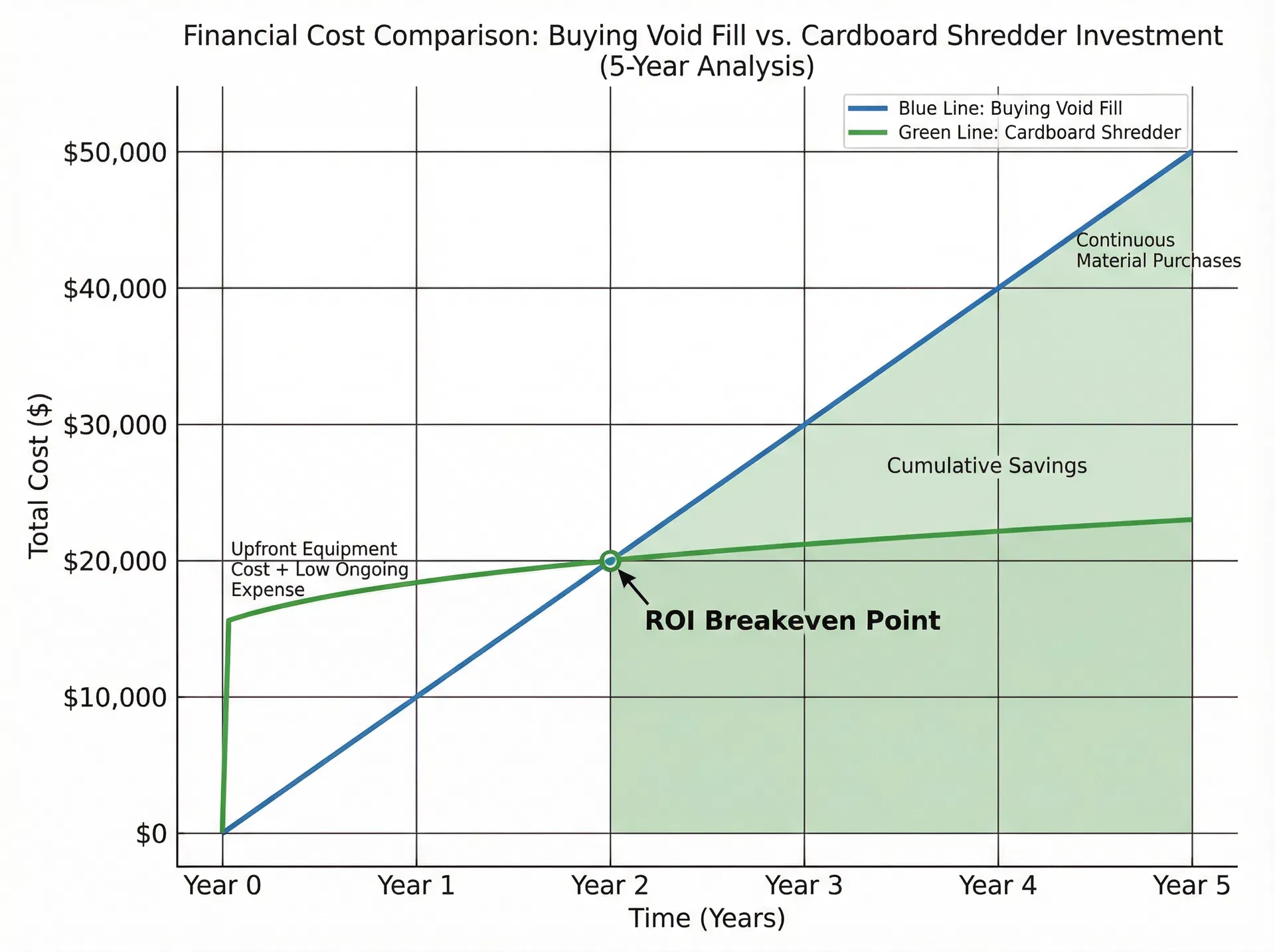
The chart above illustrates a typical cost trajectory for a mid-volume warehouse operation. The cardboard shredder requires an upfront investment of approximately $15,000, but the ongoing operating costs are substantially lower than continuous material purchases. For most businesses processing 50+ boxes per day, the equipment pays for itself within 18–24 months. Beyond that point, every additional year generates significant savings.
Hidden and Indirect Costs
Some of the most significant cost differences are less obvious. Purchased void fill requires storage space, which competes with revenue-generating activities. Large volumes of bulky materials can quickly consume valuable warehouse real estate. Cardboard waste also carries hidden costs. Even when recycling is available, businesses often pay for collection, baling, or disposal. Handling waste cartons requires labor and movement, adding friction to daily operations.
Transportation costs further compound these issues. Purchased materials must be delivered, and waste cardboard must be removed. Each movement adds cost and complexity to the supply chain. By processing cardboard on site, businesses can reduce both inbound and outbound material flows, simplifying logistics and lowering indirect expenses.
Sustainability & Environmental Impact
Waste Reduction and Material Reuse
From a sustainability perspective, the difference between the two approaches is substantial. Buying void fill introduces new material into the system, much of which is used once and then discarded or recycled. Using a cardboard shredder extends the lifecycle of existing cardboard. Instead of being treated as waste immediately after unpacking, cartons are repurposed as protective packaging. This reuse reduces the total volume of material entering waste or recycling streams.
For businesses aiming to minimize waste, internal reuse represents a practical step toward more circular packaging practices. This aligns with principles outlined in the EPA’s waste reduction guidelines and supports corporate sustainability initiatives.
Carbon Footprint Comparison
Purchased void fill materials carry an embedded carbon footprint associated with manufacturing, packaging, and transportation. Even recyclable materials require energy to produce and distribute. On-site cardboard shredding shifts processing closer to the point of use. By eliminating the need to manufacture and transport additional void fill, businesses can reduce emissions associated with packaging materials.
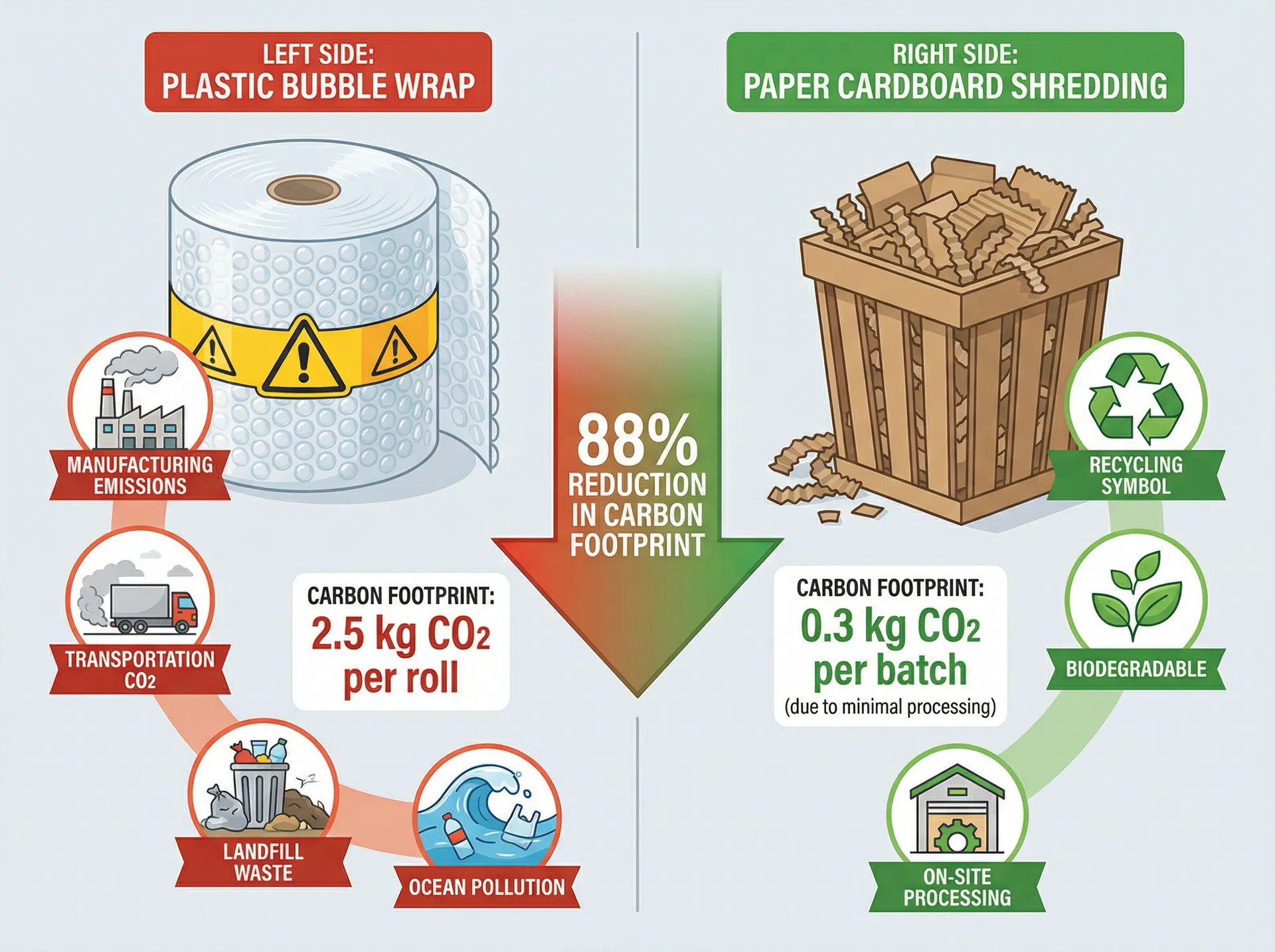
While shredding itself consumes energy, the overall carbon impact is often lower when compared with the full lifecycle emissions of purchased materials, particularly in high-volume operations. The research cited by Packaging Dive and the American Forest & Paper Association consistently shows that paper-based packaging solutions have significantly lower environmental footprints than plastic alternatives.
Alignment with Corporate Sustainability Goals
Many organizations now track packaging waste and material usage as part of broader sustainability or ESG initiatives. Reusing cardboard internally can support these goals by reducing material consumption and demonstrating responsible resource management. From a customer perspective, paper-based, recyclable packaging is often viewed more favorably than plastic alternatives. This perception can enhance brand image and reinforce sustainability messaging without requiring major changes to shipping practices.
Operational Efficiency and Workflow Impact
Packaging Speed and Flexibility
Operationally, the ability to produce void fill on demand offers significant advantages. A cardboard shredder allows packers to generate material as needed, eliminating delays caused by shortages or over-ordering. This flexibility makes it easier to adjust cushioning volume based on product size and fragility. Instead of relying on fixed material formats, operators can tailor packaging to each shipment, improving protection while reducing waste.
Space Utilization in the Warehouse
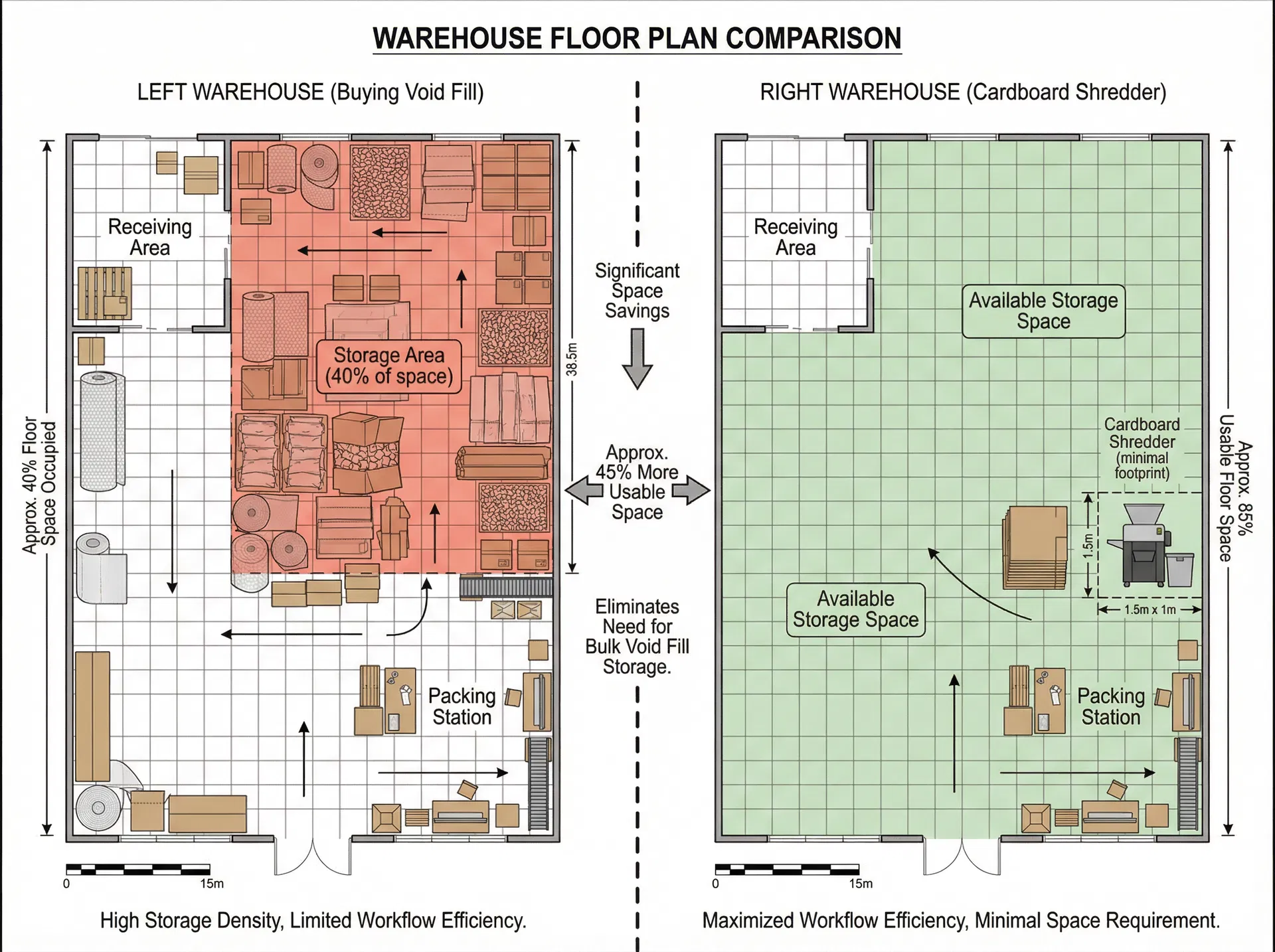
Space is a critical constraint in most warehouses. Purchased void fill often requires dedicated storage areas, which may expand as shipment volumes grow. A cardboard shredder occupies a fixed footprint, but it reduces the need for storing both empty cartons and bulk packaging materials. By converting cardboard directly at the point of use, businesses can streamline material flow and free up space for core operations.
Consistency and Packaging Performance
Consistency in packaging quality affects both damage rates and customer experience. Shredded cardboard provides reliable cushioning for a wide range of products, offering stability and shock absorption when applied correctly. While it may not replace specialized materials for highly sensitive items, cardboard-based void fill performs effectively for many everyday shipping scenarios. Its adaptability allows packers to achieve consistent protection without excessive material use.
Scalability for Growing Businesses
Packaging decisions that work today may not remain effective as a business grows. Order volume, product mix, and operational complexity tend to change over time, which makes scalability an important factor when comparing a cardboard shredder with purchased void fill.
For smaller businesses or early-stage operations, buying void fill can still make practical sense. Shipment volumes may be relatively low, cardboard waste generation inconsistent, and available space limited. However, as volume increases, the economics shift. A mid-volume warehouse processing 100–500 shipments per day will likely find that a cardboard shredder becomes cost-effective within the first two years. High-volume fulfillment centers and distribution networks often benefit from multiple shredders or larger capacity systems, as the per-unit cost of processing cardboard continues to decline with scale.
Real-World Use Cases
E-commerce and Fulfillment Centers
E-commerce fulfillment centers generate enormous volumes of cardboard waste. Inbound inventory arrives in corrugated cartons, and outbound orders require protective packaging. For these operations, a cardboard shredder can process hundreds of cartons per day, converting waste into usable material. The combination of high volume, consistent waste generation, and significant material consumption makes shredding economically attractive. Many large fulfillment centers now operate multiple shredders to match packing station demand.
Manufacturing and Distribution
Manufacturing facilities that receive components in corrugated packaging face a similar situation. Incoming cartons are unpacked, and the facility must then source protective materials for outbound shipments. By installing a shredder, manufacturers can close the loop—using inbound waste as outbound protection. This approach is particularly effective in industries with standardized product sizes and predictable packaging requirements, such as electronics, appliances, and industrial equipment distribution.
Which Option Is Right for Your Business?
Choosing between a cardboard shredder and purchasing void fill depends on several factors:
Choose a cardboard shredder if:
•Your operation processes 50+ boxes per day
•You have consistent cardboard waste generation
•You want to reduce long-term packaging costs
•You have available floor space (even a few square meters)
•Sustainability is a business priority
•You want to reduce dependence on external suppliers
Continue buying void fill if:
•Your operation is very small (fewer than 20 shipments per day)
•Cardboard waste generation is highly irregular
•You lack space for equipment installation
•Your primary concern is avoiding upfront capital expense
•You require highly specialized cushioning materials for fragile goods
For many mid-sized operations, a hybrid approach works well: use a shredder for standard void fill and cushioning, while maintaining a small inventory of specialized materials for high-value or extremely fragile items.
Conclusion
The decision between a cardboard shredder and purchasing void fill is fundamentally a question of economics, sustainability, and operational fit. While purchasing void fill offers simplicity and no upfront cost, a cardboard shredder delivers lower long-term expenses, reduced environmental impact, and greater operational control for most mid-volume and high-volume operations.
For businesses processing 50+ shipments per day with consistent cardboard waste, the financial case for shredding is compelling. Equipment typically pays for itself within 18–24 months, after which cumulative savings grow significantly. Beyond cost, the sustainability benefits—88% lower carbon emissions, reduced landfill waste, and support for corporate ESG goals—make shredding an attractive choice for environmentally conscious organizations.
The most important step is to assess your own operation: measure your daily cardboard waste, calculate your current void fill expenses, and evaluate your available space. With these numbers in hand, the right choice becomes clear.
Ready to evaluate a cardboard shredder for your operation? Contact the SelectPack team for a customized cost analysis and product recommendation. Or explore the full cardboard shredder range to compare models and specifications.
Related reading:
•What Is a Cardboard Shredder?
•How to Choose the Right Cardboard Shredder for Your Business
•Cardboard Shredder for Packaging: How Businesses Turn Waste into Void Fill
•Industrial Cardboard Shredder ROI: How Long Does It Take to Pay for Itself?
•Explore Paper Cushioning Machines
•Explore Paper Bubble Machines
References
1.U.S. Environmental Protection Agency. Waste Reduction and Recycling Guidelines. https://www.epa.gov/recycle
2.American Forest & Paper Association. Cardboard Recycling and Sustainability. https://www.afandpa.org/our-work/sustainability/recycling
3.Packaging World. Packaging Materials and Environmental Impact. https://www.packworld.com/
4.Packaging Dive. Sustainable Packaging Trends and Cost Analysis. https://www.packagingdive.com/