
In many packaging operations, cardboard shredders are adopted as a practical way to reuse used corrugated boxes and reduce reliance on purchased void fill. When selecting a cardboard shredder, businesses often focus on visible specifications such as motor power, cutting speed, or machine size. However, one critical factor is frequently overlooked: the output type of the shredded cardboard.
The way cardboard is cut—whether into straight strips or expanded mesh—has a direct impact on packaging efficiency, cushioning performance, material consumption, and overall operating cost. Choosing the wrong output type can result in inadequate product protection, wasted material, or unnecessary slowdowns on the packing line.
This article explains the two most common cardboard shredder output types—strip-cut and mesh-cut cardboard—and compares their structural characteristics, packaging performance, and ideal use cases to help businesses make an informed decision.
What Are Cardboard Shredder Output Types?
Cardboard shredder output types refer to the physical form of the cardboard after it passes through the cutting rollers. Different cutting patterns produce different material behaviors, which directly affect how the cardboard performs as packaging protection.
Strip-Cut Cardboard Explained
Strip-cut cardboard is produced by cutting corrugated cardboard into long, narrow strips. These strips remain relatively flat and linear, maintaining much of the original cardboard’s rigidity.
Key characteristics of strip-cut cardboard include:
•Consistent strip width and length
•Minimal stretching or expansion
•Stable, predictable structure
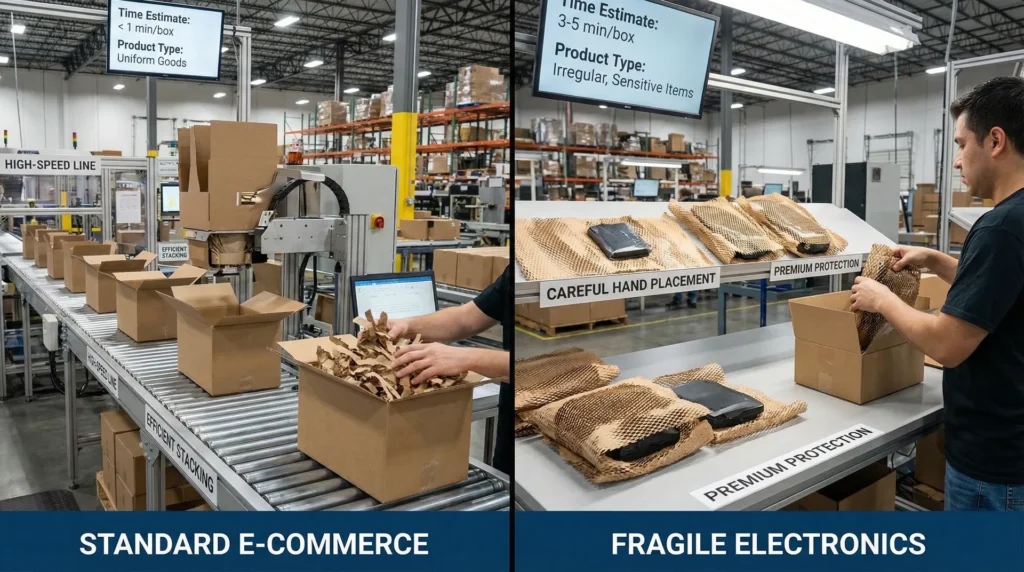
Strip-cut output is commonly used as void fill, where the primary goal is to occupy empty space inside cartons and prevent product movement during transport. It is especially effective in standard box sizes and high-volume packaging environments where speed and simplicity are priorities.
Mesh-Cut Cardboard Explained
Mesh-cut cardboard, also referred to as perforated or expanded cardboard, is created by cutting and simultaneously stretching the cardboard into a net-like structure. This process increases the material’s volume while reducing its density.
Key characteristics of mesh-cut cardboard include:
•Expandable, flexible structure
•Net or honeycomb-like appearance
•Improved wrapping and cushioning ability
Mesh-cut cardboard is often used for wrapping and cushioning, particularly when packaging fragile, irregularly shaped, or high-value products that require enhanced protection.
Strip-Cut vs Mesh-Cut: Structural Differences
Shape and Physical Structure
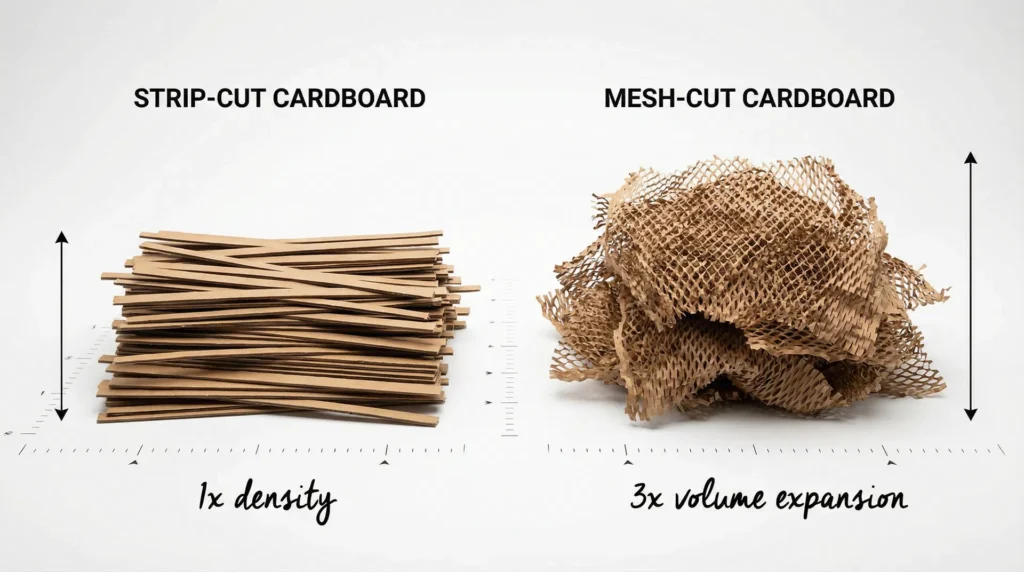
Strip-cut cardboard maintains a linear, flat profile. The cutting process produces uniform strips that stack neatly and occupy minimal storage space. The material retains the stiffness of the original corrugated cardboard, making it predictable and easy to handle.
Mesh-cut cardboard undergoes a transformation during cutting. The simultaneous stretching creates a three-dimensional, net-like structure with significantly greater volume. A single sheet of mesh-cut material can expand to fill more space than an equivalent weight of strip-cut cardboard.
Cushioning and Shock Absorption
The structural difference directly translates to different protective capabilities:
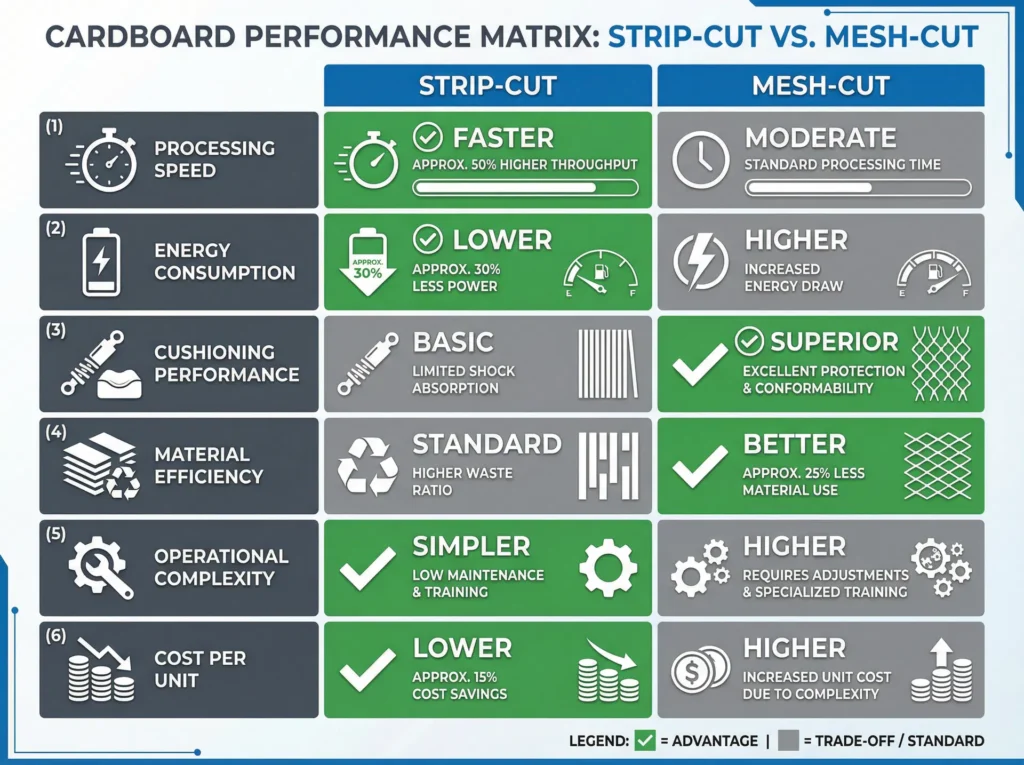
•Strip-cut provides basic void fill and some cushioning through its linear structure, but offers limited shock absorption due to its rigidity.
•Mesh-cut conforms to product shapes and compresses more easily, providing superior shock absorption and protection for fragile items.
Flexibility and Wrapping Capability
Strip-cut cardboard is stiff and difficult to wrap around irregular shapes. Mesh-cut cardboard, by contrast, is flexible and can be easily molded around products of varying shapes and sizes, making it ideal for wrapping applications.
Packaging Use Cases: When to Choose Strip-Cut Cardboard
Ideal Scenarios for Strip-Cut Output
Strip-cut cardboard is most effective in packaging operations that handle:
•Uniform, non-fragile products
•Standard carton sizes
•High-throughput packing lines
When speed and efficiency are critical, strip-cut output provides a reliable and straightforward solution.
Typical Industries Using Strip-Cut
Common users of strip-cut cardboard include:
•E-commerce fulfillment centers
•Warehousing and distribution operations
•Manufacturing facilities packaging parts or components
These environments often prioritize consistent output and fast packing cycles.
Operational Advantages
Strip-cut cardboard offers several operational benefits:
•Higher processing speed compared to mesh-cut output
•Lower energy consumption due to simpler cutting mechanics
•Easier operation and reduced maintenance requirements
For businesses focused on throughput and cost control, strip-cut output is often the most practical choice.
Packaging Use Cases: When Mesh-Cut Cardboard Performs Better
Ideal Scenarios for Mesh-Cut Output
Mesh-cut cardboard is better suited for packaging situations involving:
•Fragile or breakable products
•Irregular or complex shapes
•High-value items requiring enhanced protection
In these cases, product safety often outweighs speed considerations.
Typical Industries Using Mesh-Cut
Industries that frequently use mesh-cut cardboard include:
•Electronics and electrical components
•Glassware and precision instruments
•Industrial equipment and aftermarket spare parts
These products benefit from the superior cushioning and wrapping capability of mesh-cut material.
Protective Advantages
Mesh-cut cardboard provides:
•Improved shock absorption during handling and transport
•Better stabilization of products inside cartons
•Reduced risk of damage, returns, and re-packaging
For damage-sensitive shipments, mesh-cut output delivers measurable protection benefits.
Real-World Application Comparison
Cost, Efficiency, and Material Utilization
Material Consumption Comparison
While mesh-cut cardboard offers superior protection, it also consumes more material volume per unit weight. A kilogram of mesh-cut material occupies significantly more space than a kilogram of strip-cut cardboard.
For high-volume, low-value shipments, this expanded volume can increase storage requirements and handling costs. For fragile, high-value items, the protection benefits justify the additional material consumption.
Throughput and Speed Considerations
Strip-cut shredders typically operate at higher speeds, producing more linear feet of material per hour. Mesh-cut shredders require more complex cutting and stretching mechanisms, resulting in slower throughput.
For operations requiring rapid material production, strip-cut output is more efficient. For operations prioritizing product protection over speed, mesh-cut output is worth the throughput trade-off.
Total Cost of Ownership (TCO) Perspective
When evaluating cost, consider the complete picture:
•Material cost: Strip-cut is typically less expensive per unit weight
•Storage cost: Mesh-cut requires more storage space due to expanded volume
•Damage cost: Mesh-cut reduces returns and re-packaging expenses
•Labor cost: Strip-cut requires less training and oversight
For high-value or fragile products, the damage prevention benefits of mesh-cut cardboard often outweigh the higher material and storage costs.
Performance Metrics Comparison
Choosing the Right Cardboard Shredder Output for Your Business
Key Questions to Consider
Before selecting a shredder output type, ask yourself:
1.What types of products do you package? Fragile items require mesh-cut; uniform goods work well with strip-cut.
2.What is your current damage rate? High damage rates may justify mesh-cut’s protective advantages.
3.What is your packing speed requirement? High-speed operations favor strip-cut.
4.What is your storage space availability? Limited space may favor strip-cut’s compact form.
5.What is the value of your products? High-value items justify mesh-cut’s premium protection.
Strip-Cut, Mesh-Cut, or 2-in-1 Solutions
Many modern cardboard shredders offer 2-in-1 or adjustable output capabilities, allowing operators to switch between strip-cut and mesh-cut modes depending on the day’s packing requirements. This flexibility is particularly valuable for businesses with diverse product portfolios.
SelectPack’s HippoPlus P50 and Hippo P20 models both support adjustable output configurations, enabling businesses to optimize for both speed and protection as needed.
Sustainability Considerations
Both strip-cut and mesh-cut cardboard shredding contribute to sustainability by:
•Reducing reliance on virgin packaging materials
•Diverting cardboard waste from landfills
•Lowering the carbon footprint of packaging operations
For more on sustainable packaging practices, see our guide on sustainable packaging solutions and how on-demand packaging reduces waste.
Conclusion: Aligning Output Type with Packaging Strategy
The choice between strip-cut and mesh-cut cardboard shredder output is not a one-size-fits-all decision. It depends on your specific packaging requirements, product types, speed needs, and cost priorities.
Choose strip-cut if you prioritize speed, cost efficiency, and simplicity for uniform, non-fragile products.
Choose mesh-cut if you prioritize product protection, wrapping capability, and damage prevention for fragile or high-value items.
Consider 2-in-1 solutions if your operation requires flexibility across diverse product types.
By understanding the structural and performance differences between these output types, you can select a cardboard shredder that aligns with your packaging strategy and delivers the right balance of efficiency, protection, and cost-effectiveness.
For personalized guidance on selecting the right cardboard shredder and output configuration for your business, contact SelectPack’s packaging experts today. We’re here to help you optimize your packaging operations.
Related Resources
•How to Choose the Right Cardboard Shredder for Your Business
•Cardboard Shredder vs Buying Void Fill: Cost & Sustainability Comparison
•Industrial Cardboard Shredder ROI: How Long Does It Take to Pay for Itself?
•Cardboard Shredder for Packaging: How Businesses Turn Waste into Void Fill