A paper bubble machine is a packaging device used by packaging businesses to convert kraft paper rolls into embossed, bubble-textured cushioning material. Instead of purchasing pre-made plastic bubble wrap, companies can produce protective paper bubble packaging on demand directly at the packing station.
The machine reshapes flat paper into a three-dimensional bubble structure, creating air-pocket-like cushioning using paper rather than plastic film. The result is a flexible, shock-absorbing material suitable for wrapping, interleaving, and void fill applications.
Unlike simple paper dispensers, a paper bubble machine actively forms the texture through mechanical embossing. This transformation increases the paper’s volume and cushioning capability, allowing it to perform similarly to conventional bubble wrap while maintaining recyclability.
In practical terms, it turns standard kraft paper rolls into ready-to-use protective packaging material within seconds. Learn more about our kraft paper bubble machine products such as the Pangolin series.
Definition
Paper bubble packaging, sometimes called paper bubble wrap, refers to paper that has been mechanically embossed into a concave-and-convex texture resembling traditional plastic bubble wrap. The raised structure creates air gaps and layered cushioning zones that help absorb impact during shipping.
Key characteristics include:
•Made primarily from kraft paper
•Embossed bubble texture
•Flexible and lightweight
•Fully recyclable in standard paper streams
Although it does not contain sealed air pockets like plastic bubble wrap, the structured paper layers trap air within the folds and surface geometry. This design provides shock absorption and surface protection for many light to medium-weight products.
Paper bubble packaging is commonly used for:
•Wrapping fragile goods
•Surface scratch protection
•Carton lining
•Void fill in shipping boxes
Its main appeal lies in combining protective performance with sustainability. Businesses can maintain packaging protection standards while reducing reliance on plastic materials. For more information about sustainable packaging alternatives, see our guide on air cushion packaging solutions.
How Does a Paper Bubble Machine Work?
Understanding how a paper bubble machine operates helps clarify why it improves both workflow efficiency and material consistency.
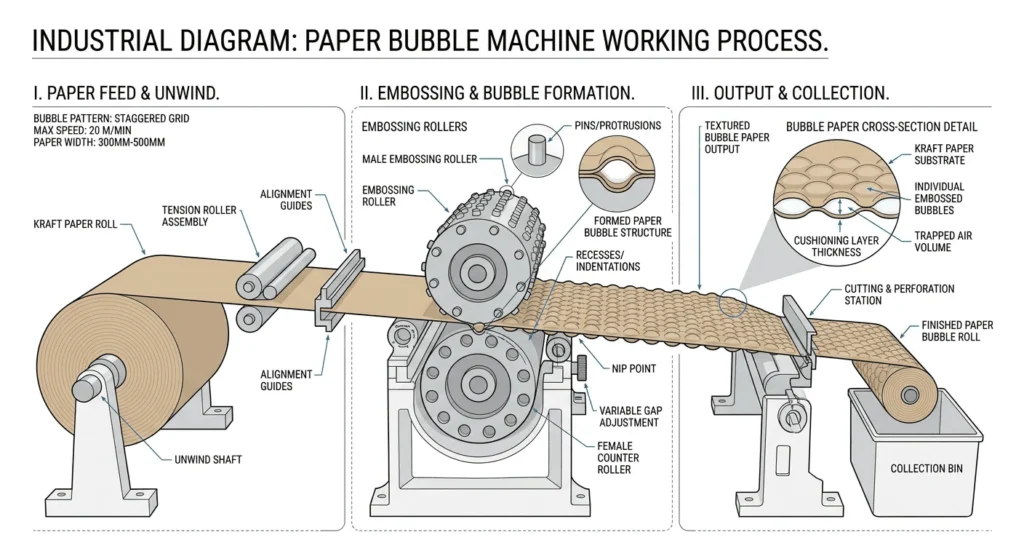
Paper Feeding System
The process begins with loading a roll of kraft paper into the machine. The paper is guided through a feeding system designed to maintain proper alignment and tension.
Tension control is critical. Too loose, and the embossing will be inconsistent. Too tight, and the paper may tear. Modern machines include calibrated rollers to ensure stable feeding throughout continuous operation.
Once aligned, the paper advances into the forming section. For high-volume operations, understanding the production volume requirements is essential to selecting the right equipment.
Embossing & Forming Process
The core of the machine is the embossing mechanism. Specially engineered forming rollers press and shape the flat paper into a bubble-like texture.
As the paper passes between the rollers:
•Pressure creates raised and recessed patterns
•The structure expands the paper’s volume
•Air pockets are naturally formed between layers
This mechanical forming process increases the paper’s cushioning ability without adding adhesives or additional materials. The transformation happens instantly, allowing for continuous production.
The bubble geometry is designed to balance flexibility with structural strength. The paper remains easy to wrap around products while maintaining protective thickness. For detailed information about how the embossing process works, see our article on how paper bubble machines work.
Output & Cutting
After embossing, the formed paper exits the machine as a continuous sheet of bubble-textured cushioning.
Depending on the model, operators can:
•Pull and tear manually
•Use an integrated cutter
•Pre-set specific lengths
This flexibility allows packing teams to produce exactly the amount needed for each shipment, reducing material waste. For information about output speeds, consult our guide on paper bubble machine output speed.
Why Packaging Businesses Use Paper Bubble Machines
The adoption of paper bubble machines in modern packaging operations is not only about sustainability. It is also about operational control, workflow efficiency, and long-term cost management.
On-Demand Cushioning
Traditional bubble wrap requires stocking bulky rolls in storage areas. Paper bubble machines eliminate this dependency by producing material as needed.
This reduces:
•Overstocking
•Warehouse space usage
•Material waste
Teams can adjust output instantly based on shipment size or protection requirements. Learn more about on-demand paper bubble versus pre-made cushioning rolls to understand the efficiency gains.
Sustainability Strategy
Many brands are under pressure to reduce plastic usage in packaging. Paper bubble packaging offers a visible and measurable shift toward paper-based materials.
Benefits include:
•Recyclable packaging streams
•Reduced plastic waste
•Improved brand perception
•Alignment with ESG initiatives
For businesses serving environmentally conscious markets, this transition can strengthen customer trust and regulatory compliance. See our comparison on paper bubble versus plastic bubble wrap for environmental impact details.
Cost Control
Cost comparison often extends beyond the unit price of materials.
Paper bubble machines can contribute to savings by:
•Reducing purchased plastic bubble rolls
•Lowering storage requirements
•Minimizing disposal costs
•Providing predictable material consumption
While there is an upfront equipment investment, many businesses evaluate total packaging cost over time rather than per-roll price alone. For detailed ROI analysis, see our article on paper bubble machine ROI.
Operational Efficiency
Workflow efficiency is another significant driver.
By placing the machine directly at the packing station:
•Operators avoid walking to retrieve materials
•Material flow becomes linear
•Packaging time per parcel may decrease
In high-volume operations, small improvements in handling time can result in meaningful productivity gains. For industrial applications, see our guide on industrial paper bubble machines for high-volume operations.
Applications of Paper Bubble Packaging
Paper bubble packaging is versatile and fits multiple industry environments.
E-commerce Fulfillment
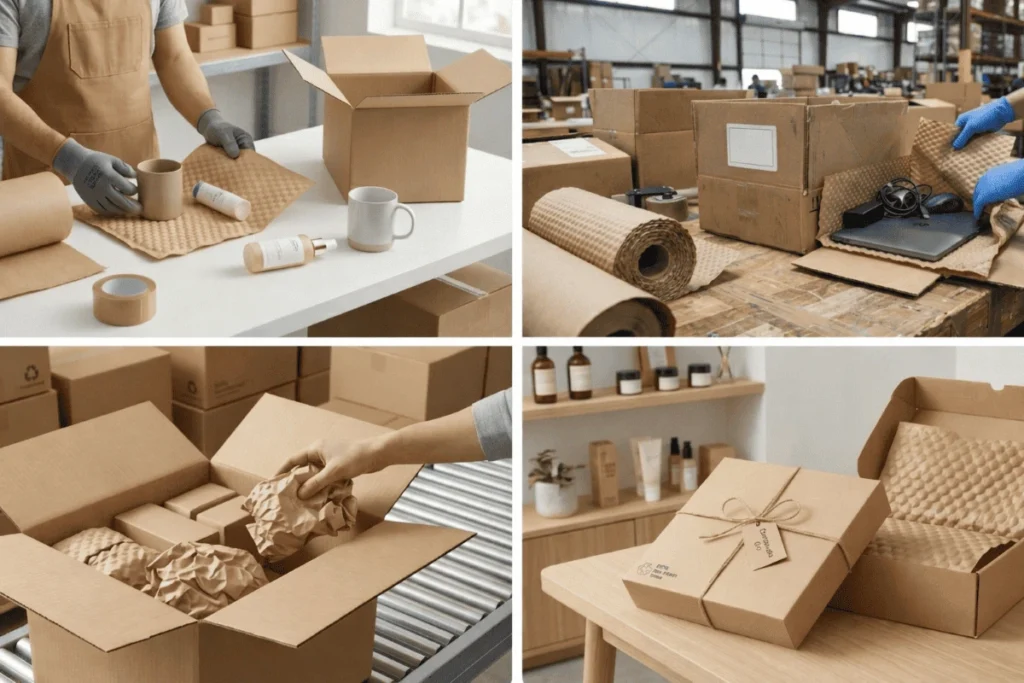
E-commerce businesses frequently ship lightweight, fragile items. Paper bubble material is suitable for:
•Wrapping cosmetics
•Protecting small electronics
•Cushioning accessories
•Filling void space inside cartons
Its lightweight nature helps maintain shipping cost control, making paper bubble wrap a practical alternative to plastic bubble cushioning in parcel shipments. Learn more about paper bubble machines for e-commerce fulfillment.
Industrial & Manufacturing
Manufacturers often require surface protection for components during storage and transport.
Paper bubble can be used for:
•Interleaving metal parts
•Wrapping precision components
•Protecting painted surfaces
The embossed structure prevents direct surface contact between stacked items.
Retail & Gift Packaging
Retail brands increasingly prioritize presentation. Paper bubble packaging offers:
•A natural kraft appearance
•Sustainable branding alignment
•A premium unboxing feel
It can function both as protection and as a visible design element.
Electronics & Light Fragile Products
For light to medium-weight electronics, the structured paper provides:
•Shock absorption
•Scratch prevention
•Flexible wrapping
While it may not replace heavy-duty foam systems, it is highly effective for many common parcel types. For more information about protective packaging solutions, see our air cushion packaging guide.
Paper Bubble vs Traditional Bubble Wrap
When businesses evaluate switching materials, the comparison between paper bubble and plastic bubble wrap is unavoidable. While both serve protective functions, their performance, storage, and environmental impact differ in meaningful ways.
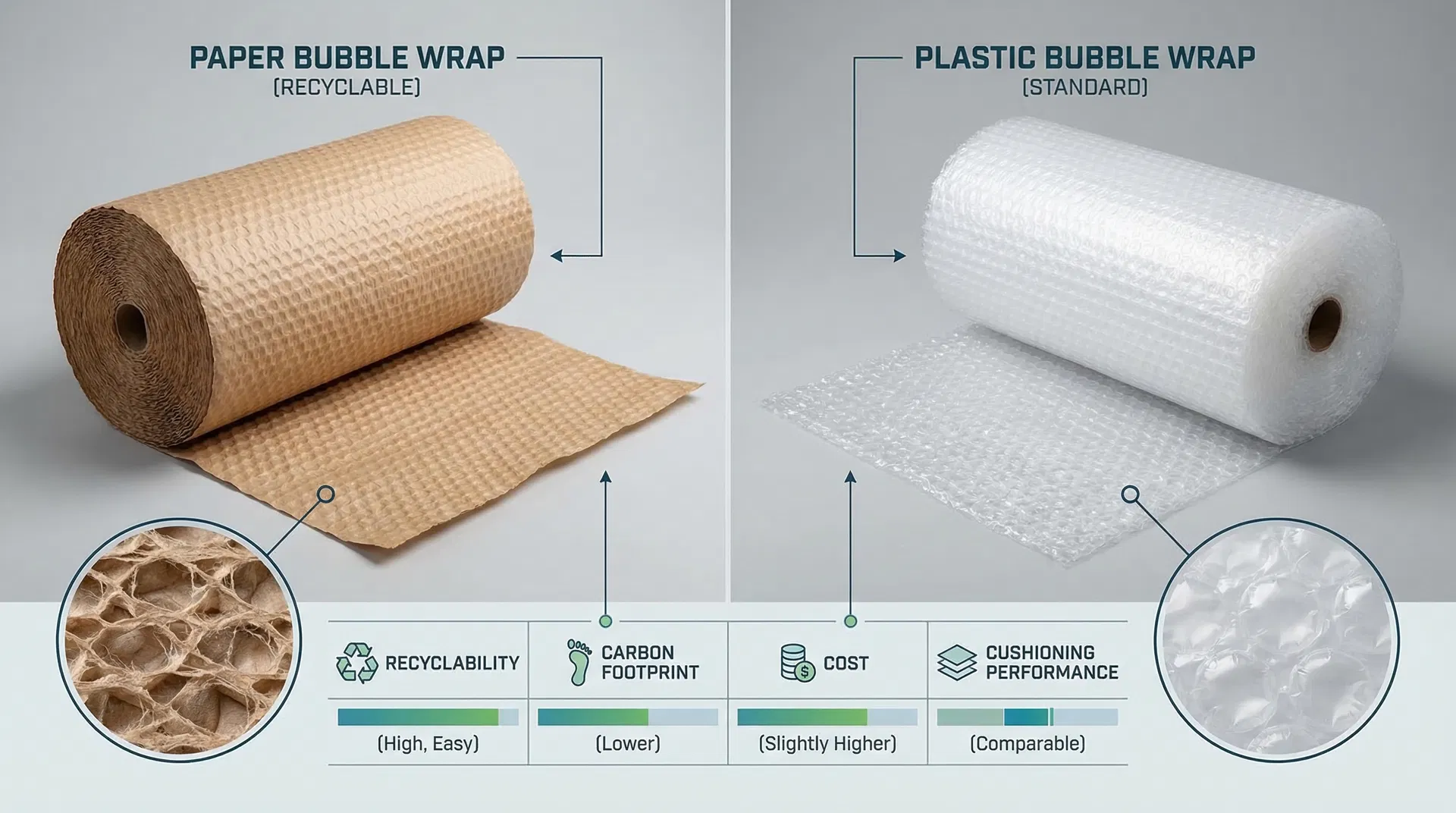
Material Comparison
Traditional bubble wrap is made from polyethylene plastic film with sealed air pockets. Paper bubble packaging, by contrast, is formed from kraft paper through mechanical embossing using a paper bubble machine.
Key differences:
•Plastic bubble wrap contains trapped air inside sealed pockets
•Paper bubble relies on structured geometry and layered air gaps
•Plastic requires specialized recycling streams
•Paper can typically enter standard paper recycling systems
From a material standpoint, paper bubble eliminates plastic content while maintaining cushioning structure. For an in-depth comparison, see our article on paper bubble versus plastic bubble wrap.
Cushioning Performance
Plastic bubble wrap is known for high impact absorption due to sealed air pockets. Paper bubble packaging does not replicate that exact mechanism, but its embossed structure creates layered cushioning zones that disperse shock energy.
In many common packaging scenarios — such as cosmetics, accessories, small electronics, and light industrial components — paper bubble provides sufficient protection when properly applied.
However, for extremely heavy or highly fragile products requiring maximum impact absorption, foam-in-place or engineered cushioning systems may still be necessary.
The key consideration is matching material performance to product risk profile.
Storage & Logistics
Plastic bubble wrap is bulky. Even compressed rolls occupy significant storage space.
Paper bubble machines reduce this issue because:
•Only flat kraft paper rolls are stored
•Cushioning material is produced on demand
•No need to store pre-expanded bubble rolls
For facilities with limited warehouse space, this can represent a practical advantage.
Environmental Impact
Environmental considerations often drive the shift toward paper-based packaging.
Plastic bubble wrap:
•Is recyclable in some regions but not universally
•Often ends up in mixed waste streams
•Contributes to plastic reduction concerns
Paper bubble packaging:
•Is typically recyclable with paper
•Contains no plastic film
•Aligns with plastic-reduction initiatives
For brands positioning themselves around sustainability, this difference can be strategically significant.
How to Choose the Right Paper Bubble Machine
Selecting the right paper bubble machine for your packaging business should be based on operational data rather than assumptions. Production volume, workflow layout, and material consumption all influence the ideal machine configuration.
Production Volume
Start by estimating:
•Daily parcel count
•Average cushioning usage per parcel
•Total paper consumption per shift
High-volume operations require machines with higher output speeds and stable feeding systems.
For high-volume fulfillment centers, investing in a higher-capacity paper bubble machine can significantly improve packing speed and material consistency. See our guide on choosing the best paper bubble machine for small businesses for detailed selection criteria.
Paper Width Compatibility
Paper rolls typically come in specific widths, such as 350 mm or 500 mm.
The machine must support the required width based on:
•Product size
•Wrapping style
•Carton dimensions
Wider paper may increase versatility but also requires larger machine capacity. For detailed information, see our article on how to choose the right paper bubble machine.
Speed & Output Rate
Output speed is commonly measured in meters per minute.
Consider:
•Packing line speed
•Number of operators
•Workflow synchronization
If the machine cannot keep pace with the packing process, it may create bottlenecks. Learn more about paper bubble machine output speed to ensure proper equipment matching.
Technical Requirements
Confirm:
•Voltage compatibility (e.g., 110V / 220V)
•Maintenance accessibility
•Spare parts availability
Operational reliability matters more than peak speed in many B2B environments.
Conclusion
A paper bubble machine is a packaging device that transforms flat kraft paper into embossed cushioning material, enabling businesses to produce recyclable paper bubble packaging on demand.
For packaging operations seeking to reduce plastic dependency while maintaining protection standards, paper bubble technology offers a practical alternative. Beyond environmental positioning, it provides workflow advantages, storage optimization, and predictable material consumption.
Ultimately, the decision to implement a paper bubble machine should align with product protection requirements, packaging volume, and long-term operational strategy. When properly matched to application needs, it becomes not just a material replacement tool, but a structured improvement to modern packaging processes.
For more information about our paper bubble machine products and solutions, visit our product page or contact SelectPack today.
Related Articles
•How Does a Paper Bubble Machine Work? From Flat Paper to Protective Cushioning
•Industrial Paper Bubble Machines for High-Volume Packaging Operations
•How to Choose the Best Paper Bubble Machine for Small Businesses
•Paper Bubble Machine vs Bubble Wrap Cost: Which Packaging Option Saves More?
•Paper Bubble Machine ROI: Cost Savings for Warehouses and E-commerce Fulfillment Centers
•On-Demand Paper Bubble vs Pre-Made Cushioning Rolls
•Warehouses Switching to Paper Bubble Machines
•Paper Bubble vs Plastic Bubble Wrap
External Resources
•EPA Sustainable Packaging Guidelines