Return on Investment (ROI) measures the financial benefit of an investment relative to its cost. For paper bubble machines, ROI extends beyond simple material cost comparisons to include storage efficiency, labor productivity, and operational benefits.
A typical paper bubble machine investment of $5,000-$15,000 can generate annual savings of $30,000-$80,000, depending on your current packaging volume and costs. This translates to ROI periods of 2-6 months for many businesses—significantly faster than most packaging equipment investments.
Understanding Paper Bubble Machine ROI
Return on Investment (ROI) measures the financial benefit of an investment relative to its cost. For paper bubble machines, ROI extends beyond simple material cost comparisons to include storage efficiency, labor productivity, and operational benefits.
A typical paper bubble machine investment of $5,000-$15,000 can generate annual savings of $30,000-$80,000, depending on your current packaging volume and costs. This translates to ROI periods of 2-6 months for many businesses—significantly faster than most packaging equipment investments. Understanding how paper bubble machines work helps you better estimate your specific ROI potential.
Direct Cost Savings from Material Efficiency
The most obvious ROI component comes from reduced packaging material costs.
Material Cost Per Package
Traditional bubble wrap: $0.40-$0.80 per package (depending on bubble size, roll width, and supplier volume)
Paper bubble machine: $0.15-$0.35 per package (kraft paper material cost only)
For a business shipping 500 packages daily:
•Bubble wrap annual cost: 500 × $0.60 × 250 working days = $75,000
•Paper bubble machine annual cost: 500 × $0.25 × 250 working days = $31,250
•Annual material savings: $43,750
For detailed cost comparisons between paper bubble and traditional bubble wrap, see our comprehensive analysis.
Reduced Material Waste
On-demand production eliminates excess material usage common with pre-made cushioning. Operators can generate exactly the amount needed for each package, reducing waste by 15-30% compared to traditional methods.
For a business currently wasting $10,000 annually in excess cushioning materials, this represents an additional $2,000-$3,000 in annual savings.
Storage Space and Warehouse Efficiency
Storage costs represent a significant but often overlooked component of packaging expenses.
Warehouse Space Utilization
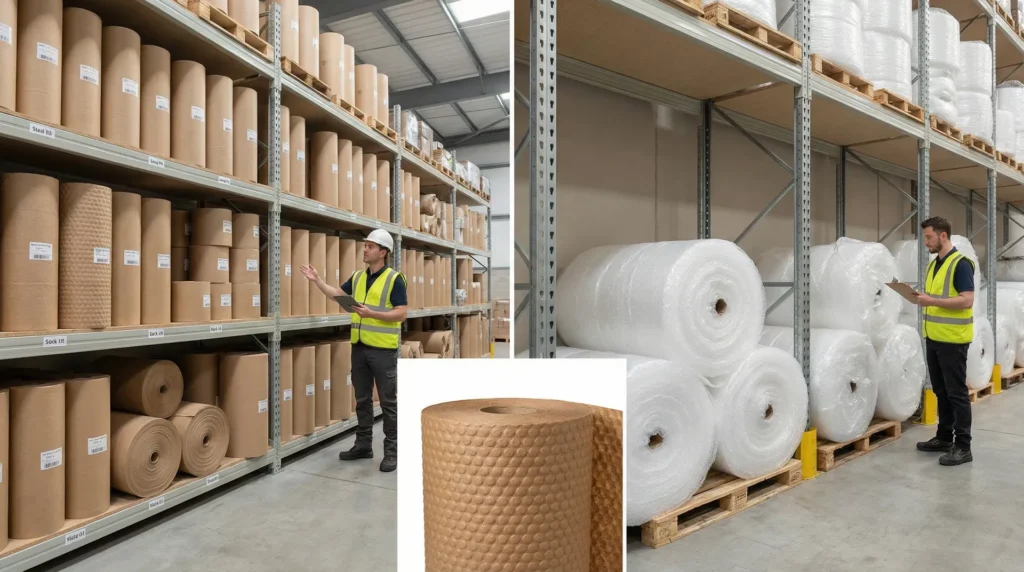
Plastic bubble wrap rolls are bulky and require substantial storage space. A single pallet of plastic bubble wrap occupies approximately 4 cubic meters of warehouse space and contains material for roughly 5,000-10,000 packages.
Kraft paper rolls are significantly more compact. The equivalent material for 10,000 packages occupies only 0.5-1 cubic meter of warehouse space.
Storage space savings: A business storing 10 pallets of bubble wrap (40 cubic meters) can reduce storage requirements to approximately 5 cubic meters—freeing up 35 cubic meters of valuable warehouse space. Many warehouses switching to paper bubble machines report similar space optimization benefits.
Real Estate Cost Implications
In urban fulfillment centers where warehouse space costs $15-$30 per square meter annually, 35 cubic meters of freed space (approximately 35 square meters of floor space) represents $525-$1,050 in annual savings.
In high-cost markets like major metropolitan areas, this savings can exceed $2,000 annually.
Labor and Operational Improvements
Beyond material and storage costs, paper bubble machines improve operational efficiency.
Reduced Packing Time
Studies show that on-demand cushioning production reduces average packing time by 10-15% compared to manual bubble wrap handling. Operators no longer need to:
•Manually pull and cut bubble wrap
•Replace empty rolls during packing
•Manage multiple SKUs of different bubble wrap sizes
For a packing team of 10 operators each processing 50 packages daily, a 10% time reduction equals approximately 50 packages of additional daily capacity—equivalent to hiring an additional part-time operator. This efficiency gain is particularly important in e-commerce fulfillment centers with high order volumes.
Labor Cost Savings
At an average labor cost of $18-$25 per hour, a 10% efficiency improvement for a 10-person packing team represents:
•Daily savings: 10 operators × 8 hours × 10% × $20/hour = $160
•Annual savings: $160 × 250 working days = $40,000
Reduced Training Requirements
Paper bubble machines are simpler to operate than managing multiple cushioning material types. New operators require less training, reducing onboarding costs.
Real-World ROI Examples
Example 1: Small E-commerce Business
Business Profile:
•Daily volume: 200 packages
•Current cushioning cost: $0.60 per package
•Warehouse space cost: $10/m² annually
•Current storage space for cushioning: 5 m²
Current Annual Costs:
•Material: 200 × $0.60 × 250 = $30,000
•Storage: 5 × $10 = $50
•Total: $30,050
With Paper Bubble Machine ($8,000 investment):
•Material: 200 × $0.25 × 250 = $12,500
•Storage: 0.5 × $10 = $5
•Total: $12,505
Annual Savings: $17,545
ROI Period: 5.5 months
Example 2: Medium Fulfillment Center
Business Profile:
•Daily volume: 1,000 packages
•Current cushioning cost: $0.50 per package
•Warehouse space cost: $20/m² annually
•Current storage space: 20 m²
•Packing team: 8 operators
Current Annual Costs:
•Material: 1,000 × $0.50 × 250 = $125,000
•Storage: 20 × $20 = $400
•Labor efficiency loss: $0 (baseline)
•Total: $125,400
With Paper Bubble Machine ($12,000 investment):
•Material: 1,000 × $0.22 × 250 = $55,000
•Storage: 2 × $20 = $40
•Labor efficiency gain: 8 × 8 × 10% × $20 × 250 = $32,000
•Total: $87,040
Annual Savings: $38,360
ROI Period: 3.8 months

Long-Term Financial Benefits
While the initial ROI period is typically 3-6 months, long-term benefits extend far beyond the first year. For businesses considering on-demand versus pre-made cushioning options, the long-term financial advantages become even more apparent.
5-Year Financial Projection
For a medium fulfillment center with $38,360 annual savings:
| Year | Cumulative Savings | Equipment Cost | Net Benefit |
| Year 1 | $38,360 | $12,000 | $26,360 |
| Year 2 | $76,720 | $12,000 | $64,720 |
| Year 3 | $115,080 | $12,000 | $103,080 |
| Year 4 | $153,440 | $12,000 | $141,440 |
| Year 5 | $191,800 | $12,000 | $179,800 |
Over 5 years, the initial $12,000 investment generates $179,800 in net benefits—a 1,498% return.
Equipment Lifespan and Replacement
Most paper bubble machines operate reliably for 7-10 years with proper maintenance. Even accounting for maintenance costs ($1,000-$2,000 annually) and eventual replacement, the long-term financial benefits remain substantial.
Sustainability and Brand Value
Beyond direct financial savings, paper bubble machines provide intangible benefits that enhance brand value and customer perception.
Environmental Impact
Paper bubble cushioning is recyclable through standard paper recycling streams, reducing plastic waste. This supports corporate sustainability goals and appeals to environmentally conscious consumers. Understanding the differences between paper bubble and plastic can help businesses choose the right cushioning solution based on protection needs, sustainability goals, and shipping requirements.
Brand Value Impact: Companies highlighting sustainable packaging practices report 5-15% improvements in customer perception and brand loyalty. For businesses with annual revenue of $5-$10 million, this can translate to $250,000-$1,500,000 in additional revenue.
Regulatory Compliance
As governments implement stricter plastic packaging regulations, paper-based alternatives provide future-proofing against potential compliance costs or restrictions.
Marketing Advantage
Sustainable packaging is increasingly used in marketing materials and e-commerce product listings. This can improve search engine rankings and customer engagement.
Calculating Your Specific ROI
To calculate your specific ROI, gather the following information:
Step 1: Current Packaging Costs
•Daily package volume: _____ packages
•Current cushioning cost per package: $_____
•Annual material cost: (Daily volume × Cost per package × 250 working days) = $_____
Step 2: Storage Costs
•Current storage space for cushioning: _____ m²
•Warehouse space cost: $_____ per m² annually
•Annual storage cost: (Storage space × Cost per m²) = $_____
Step 3: Labor Considerations
•Number of packing operators: _____
•Hourly labor cost: $_____
•Estimated efficiency improvement: _____ %
•Annual labor savings: (Operators × 8 hours × Efficiency % × Hourly cost × 250 days) = $_____
Step 4: Machine Investment
•Equipment cost: $_____
•Installation and setup: $_____
•Total initial investment: $_____
Step 5: Calculate ROI
•Total annual savings = Material savings + Storage savings + Labor savings = $_____
•ROI Period (months) = (Total initial investment ÷ Total annual savings) × 12 = _____ months
•Annual ROI percentage = (Total annual savings ÷ Total initial investment) × 100 = _____%
FAQ
Q: When will I see ROI from a paper bubble machine?
A: Most businesses achieve ROI within 3-6 months. Businesses with higher current packaging costs and larger volumes typically see faster ROI.
Q: What if my packaging volume is seasonal?
A: Even with seasonal fluctuations, annual ROI calculations remain favorable. The machine can be repositioned or stored during low-volume periods without affecting overall ROI. For more details on handling variable volumes, see our guide on choosing the right paper bubble machine.
Q: Are there hidden costs I should consider?
A: Primary costs include electricity (minimal—typically $50-$100 annually) and maintenance ($500-$1,500 annually for industrial models). These are typically offset by material savings.
Q: Can I upgrade my machine later?
A: Many manufacturers offer upgrade paths. However, most businesses find their initial machine selection remains appropriate for 5-7 years.
Q: How does ROI compare to other packaging equipment?
A: Paper bubble machines typically offer faster ROI than most packaging equipment. Comparable equipment like automatic bagging systems or shrink wrap machines often require 12-24 months for ROI.
Related Articles
For more information about paper bubble machines and packaging ROI:
•How to Choose the Right Paper Bubble Machine
•What Is a Paper Bubble Machine?
•How Paper Bubble Machines Work
•Paper Bubble vs Plastic Bubble Wrap Cost Comparison
•Why Warehouses Are Switching to Paper Bubble Machines
•Paper Bubble Machines in E-commerce Fulfillment
External Resources
Learn more about packaging ROI and industry best practices:
•EPA Sustainable Materials Management
•Packaging Dive: Industry Analysis
•American Packaging Association
Calculate Your ROI Today
Ready to understand your specific ROI potential? Our team can help you analyze your current packaging costs and project your savings with a paper bubble machine.