Choose shrink film gauge and width as part of one film specification. Width must cover the product through the actual film path and leave the sealing allowance required by the machine. Package performance depends on material family, resin grade, layer structure, orientation and gauge together—not gauge alone.
There is no safe universal width formula for every shrink wrapper. Centerfold, single-wound and sleeve film use different paths and seal patterns. Use the machine supplier’s model-specific sizing method, then prove the proposed roll on the limiting products.
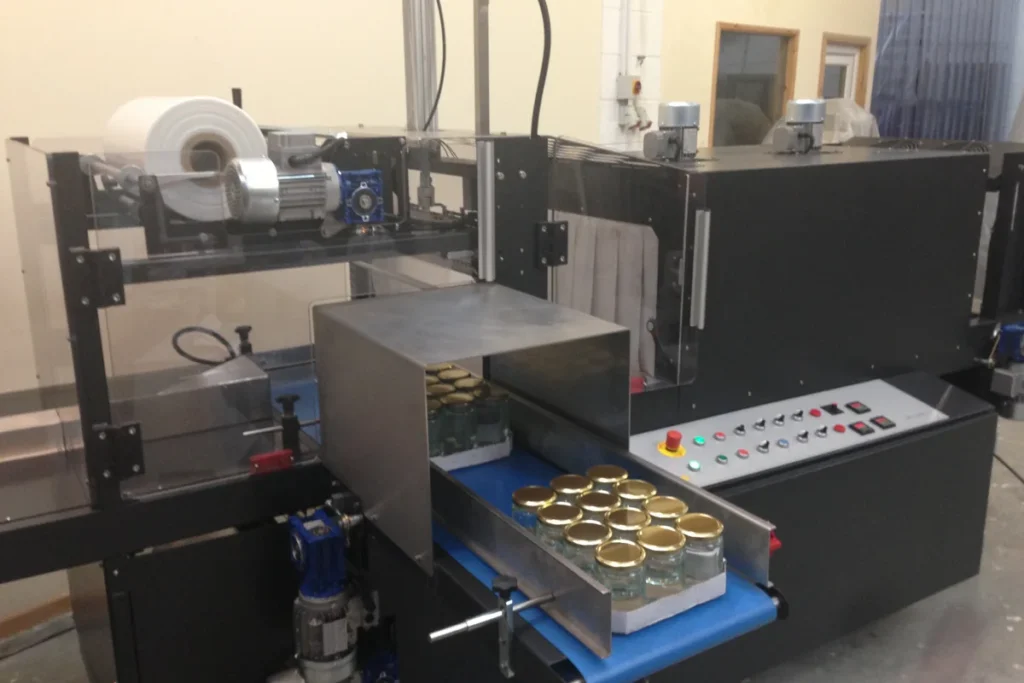
Step 1: Freeze the Package and Film Format
Before measuring web width, record:
- Product length, width and height in running orientation.
- Protrusions, trays, grouped units and acceptable end openings.
- Enclosed overwrap or open-ended sleeve objective.
- Centerfold, single-wound or sleeve film path.
- Seal locations and required trim or overlap.
- Minimum, maximum and irregular products in the SKU family.
If the material family is not selected, use the POF, PVC and PE comparison first. This page begins after the package style and film path are known.
Step 2: Establish the Width Candidate
Measure the maximum cross-section the web must cover in the chosen orientation. Give those dimensions and the package drawing to the equipment or film supplier. Require the width calculation to identify:
- Film format and measurement convention.
- Product dimensions used.
- Machine-specific seal, fold, overlap or trim allowance.
- Proposed nominal web width and its manufacturing tolerance.
- Smallest and largest products expected to use that width.
Do not approve a width described only as “fits the largest product.” A web can cover the largest item yet leave too much loose material around smaller packs. Where one width cannot serve the range reliably, divide products into defined width families rather than forcing one roll across every SKU.
Width trial evidence
During the trial, watch the film before shrinking as well as the finished pack. A proposed width fails the screen if it cannot track consistently, maintain the intended seal position, cover the product, or produce the allowed openings across the SKU family. Record the observed result; do not diagnose every failure as a width problem before checking alignment, tension and film identity.
Step 3: Select Grade, Structure and Gauge Together
Gauge is nominal thickness. It does not fully define strength, stiffness, sealing response, shrink force, optics or puncture behavior. Two films with the same polymer family and nominal gauge can perform differently because their grade, layer structure, orientation, additives and manufacturing tolerances differ.
Screen candidates against the actual duty:
| Duty input | Package evidence required |
|---|---|
| Product weight and edges | No puncture or loss of enclosure |
| Multipack handling | Units remain controlled through handling test |
| Compression-sensitive pack | No unacceptable distortion after cooling |
| Seal design | Continuous accepted seal at production rate |
| Conveyor contact | No repeatable scuff, snag or film damage |
| Presentation requirement | Approved appearance, label and barcode result |
| Storage and distribution | Package passes the defined downstream test |
Do not down-gauge from a single successful sample. Compare accepted packages per roll, start-up scrap, rejects, rework, line stability and downstream failures over a representative run.
Step 4: Confirm the Complete Roll Fits the Machine
Send a roll specification rather than material and gauge alone:
| Specification field | Compatibility check |
|---|---|
| Material family, grade and structure | Approved for the package and process |
| Nominal gauge and tolerance | Within machine and package window |
| Web width and fold | Fits guides, seal path and product family |
| Roll outside diameter and weight | Fits holder and loading method |
| Core inside diameter and face width | Fits shaft or roll supports |
| Unwind direction | Presents film correctly |
| Print, treatment or perforation | Compatible with tracking and sealing |
| Splice requirement | Compatible with operating and quality rules |
Confirm the allowable range for each field on the exact machine. A roll that fits the shaft can still be unsuitable if its weight exceeds the approved loading method or its geometry disrupts tension control.
Step 5: Release the Film by SKU Family
Run the smallest, largest, sharpest and least stable products in the family. Include start-up, steady operation, a normal restart and a roll change when those conditions affect performance. Record:
- Manufacturer, product code, material family, grade and structure.
- Gauge, width, fold, roll dimensions, core and lot.
- Machine, recipe, product orientation and target rate.
- Seal, shrink, product condition and downstream test results.
- Accepted output and rejects by cause.
- Approved SKU family and any excluded product.
If a gauge or structure change alters seal response, rebuild the authorized sealing process window instead of copying the former recipe.
Purchasing Control
The released description should identify the complete approved film, not “same polymer and gauge.” Treat a change in supplier, grade, layer structure, gauge tolerance, width, fold, core, roll geometry or treatment according to the site’s change-control and revalidation rules.
Review how a shrink wrap machine works if the film path is still unclear. Send the product envelope, package objective and full roll proposal with an inquiry for a SelectPack shrink wrapping configuration.