The best industrial strapping machine for heavy goods is the machine that can apply the right strap, at the right tension, in the right place on the load without adding unsafe handling or extra forklift movement. It is not always the highest-tension model, the largest arch, or the most automated system.
For many heavy pallet operations, the short list starts with three paths: a mobile semi-auto pallet strapping machine when finished pallets sit in several warehouse zones, a fixed pallet strapping station when pallet flow is controlled, or a fully automatic system when the load envelope and line speed justify integrated automation. If the application needs steel strapping, has closed-deck pallets with no strap path, or ships loads that are unstable before strapping, a plastic industrial strapping machine may be the wrong first fix.
Before requesting quotes, document the load weight range, product shape, edge risk, strap positions, current strap material, pallet bottom clearance, forklift route, operator access, and the failure mode you are trying to solve. Those details decide the correct machine category more reliably than a generic “heavy duty” label.
Best Industrial Strapping Machine for Heavy Goods: Quick Fit Map
Use this map to choose the first equipment direction. The final decision should still be proven with real pallets, real strap, normal operators, and the normal handling route.
| Heavy-goods condition | Better starting point | Verify before buying | Poor-fit signal |
|---|---|---|---|
| Dense pallets staged in several areas | Mobile semi-auto pallet strapping machine | Pallet bottom clearance, PP or PET strap spec, battery routine, and operator access | Every pallet must still be moved to one shared station |
| Repeated heavy pallets moving through one controlled line | Fixed semi-auto or automatic pallet strapping system | Load envelope, stop position, guarding, conveyor height, and service space | The fixed station creates forklift queues or blocks maintenance access |
| Heavy export pallets or loads that settle after strapping | PET-capable industrial strapping machine | Strap width, thickness, retained tension, seal quality, and edge protection | The machine is rated only for light PP strap |
| Sharp-edged metal, tile, boards, pipe, or stone | Machine plus edge protection process | Strap contact points, corner boards, tension range, and post-handling strap condition | Strap shows cuts, whitening, or abrasion after movement |
| Mixed-size pallets with variable staging locations | Flexible mobile or distributed workflow | Minimum and maximum pallet size, strap path, and operator reach | One fixed machine only works for the easiest pallet |
| Low-volume heavy loads or unusual one-off items | Manual or powered tools may be enough | Operator effort, seal consistency, and damage risk | Machine cost solves little because volume is too low |
| Steel strap requirement or no usable plastic strap path | Review another restraint method or steel strapping equipment | Load standards, customer requirement, edge risk, and safety process | The quoted machine only supports PP or PET plastic strap |
The useful buying question is not “What is the strongest industrial strapping machine?” It is “Which machine can repeat the approved strap path and tension on the hardest normal load?”
Define Heavy Goods by Failure Risk, Not Only Weight
Weight matters, but it is not enough to define the application. A rigid metal part bundle, a pallet of tile, a dense cartonized export load, and a long building material load can all be heavy, but they fail in different ways.
Record these load details before comparing machines:
- Typical and maximum load weight.
- Minimum and maximum pallet length, width, and height.
- Product shape: square cartons, long bundles, sheets, rolls, profiles, crates, or mixed loads.
- Whether the product is rigid, compressible, brittle, abrasive, or sharp-edged.
- Whether the load settles after strapping or during transport.
- Whether the load overhangs the pallet.
- Number of straps per load and target strap positions.
- Whether straps run across cartons, exposed product, edge boards, pallet openings, or corner protectors.
- Handling route after strapping: pallet jack, forklift, truck, container, export route, or repeated transfers.
- Indoor, outdoor, dusty, wet, cold-room, or high-debris staging conditions.
Two loads with the same weight can need different equipment. A square rigid pallet may need reliable tension and seal quality. A compressible pallet may need retained tension after dwell time. A sharp-edged load may need edge protection before it needs a stronger machine.
For dense building materials such as tile, panels, pipe, boards, or stone, the related heavy duty strapping machine checklist for building material pallets covers bottom clearance, dust, forklift movement, and edge risk in more detail.
Choose the Machine Category Around Material Flow
Heavy goods are expensive to move just for strapping. If a warehouse finishes pallets in several zones, a fast fixed machine can still create extra handling because every load must travel to the station. If a production line already sends every pallet through one controlled point, a fixed or automatic system may be the more disciplined choice.
Map the current flow:
- Where is the load built?
- Where does it wait before outbound movement?
- Where is strapping done today?
- How far does the operator walk per load?
- How many forklift moves happen only because of strapping?
- Where do forklifts, pallet jacks, operators, and staged pallets cross?
- Which side of the load is accessible during normal work?
- Where can the machine be parked, charged, cleaned, or serviced?
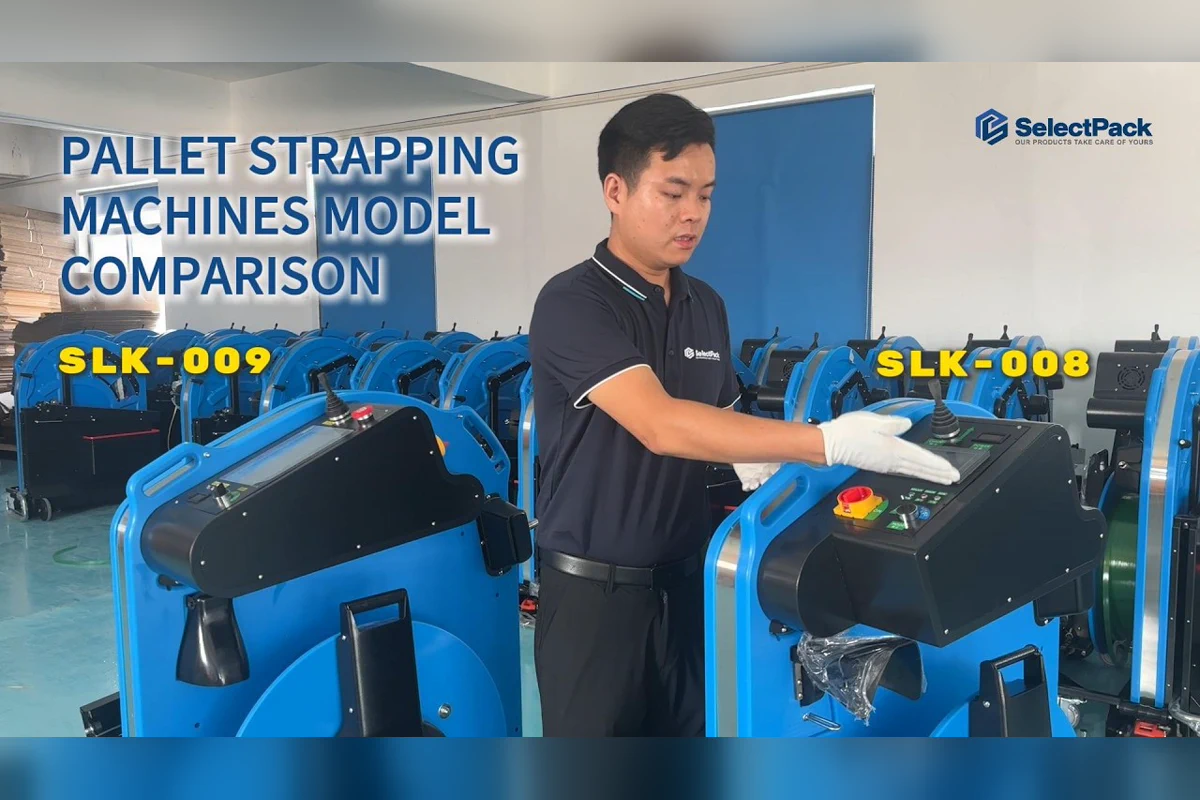
A mobile semi-auto strapping machine is most relevant when heavy palletized loads are already staged and the difficult step is feeding PP or PET strap under or around the pallet. It can reduce unnecessary pallet transfers when the pallet bottom path is open enough for the machine.
A fixed pallet strapping system fits better when pallet sizes are predictable, the facility can control the stop position, and there is enough space for infeed, outfeed, guarding, service panels, and rejected loads. A fully automatic system belongs in a higher-throughput line where the site can support conveyors, controls, guarding, and maintenance access.
If forklifts are part of the strapping area, treat layout as a material-handling decision as well as a packaging decision. OSHA’s powered industrial trucks guidance is a useful reference when teams review forklift movement, training, operating areas, and traffic risk around equipment.
Match Strap Material to the Load and the Machine
For heavy goods, strap material is part of the equipment decision. The best machine cannot make the wrong strap behave correctly.
Check these strap details:
- Material: PP, PET, steel, or another restraint method.
- Strap width and thickness.
- Coil outside diameter and core size.
- Breaking strength and retained tension requirement.
- Strap stiffness through the feed path.
- Seal method and seal consistency.
- Cutter compatibility with the selected strap thickness.
- Edge protection requirement.
- Strap position relative to forklift entry and product edges.
- Whether the machine is PP-only, PET-only, or PP/PET compatible.
PET often deserves review for heavy, dense, export-bound, or settling loads because retained tension matters after the pallet sits and moves. PP can still be correct for stable lighter loads, controlled internal movement, or cost-sensitive applications where the load does not relax enough to create risk. If the team is leaning toward polyester, the PET strapping machine guide for heavy loads explains when PET makes sense and when it can create unnecessary feed, seal, or cost problems.
For formal supplier discussions, ASTM’s nonmetallic strapping standard can help buyers frame questions around breaking strength, elongation, joint performance, and test expectations. It does not choose the machine for you, but it helps keep strap requirements specific instead of vague.
Verify the Pallet Access and Strap Path
Many heavy-goods strapping failures start at the strap path. The machine may have enough tension capacity, but the strap still has to travel cleanly around or under the load.
Inspect the hardest normal pallets:
- Fork opening height and bottom clearance.
- Closed decks, skids, blocked fork openings, or low-clearance pallet designs.
- Broken deck boards, sagging loads, nails, splinters, and loose dunnage.
- Stretch film tails or debris that can snag the strap.
- Product overhang that blocks the strap path.
- Strap position relative to forklift entry.
- Whether operators can see the strap line before tensioning.
- Whether both planned strap positions are reachable without awkward bending or unsafe reaching.
For mobile equipment, bottom clearance and strap travel are critical because the machine has to feed strap through the pallet area repeatedly. For fixed equipment, pallet stop position, guide alignment, conveyor height, and side clearance become just as important.
If the pallet blocks the strap path, do not treat more automation as the first fix. Standardize the pallet, clean the path, change strap positions, or review another load containment method before approving a machine.
Control Tension Without Damaging the Product
Heavy goods need enough tension to stay stable, but higher tension is not automatically better. Too much tension can crush cartons, chip tile edges, deform soft packaging, or weaken plastic strap where it crosses sharp or abrasive contact points.
During setup, define approved tension ranges by load family instead of using one setting for every heavy pallet. Test at least these cases:
- The easiest normal pallet.
- The heaviest pallet.
- The tallest or widest pallet.
- The sharpest-edge or most abrasive product.
- The most compressible or settling load.
- The pallet with the worst acceptable bottom clearance.
After each test, inspect strap position, edge marks, seal appearance, cut quality, product pressure marks, and pallet stability after movement. If the strap is cut, whitened, or damaged at an edge, fix the contact point with edge boards, corner protectors, strap repositioning, or a different material decision before raising tension.
Check Seal Quality as a System
A heavy load is only as secure as the joint. Strong strap with a weak seal still creates a weak package.
Ask the supplier to prove:
- The selected strap width and thickness are inside the machine range.
- The seal method is suitable for the strap material.
- Seal overlap and weld quality are repeatable.
- The cutter produces a clean end on the final strap spec.
- Dust, moisture, cold conditions, or product debris will not quickly degrade the seal area.
- Operators can recognize poor seals and recover from misfeeds without blocking the work area.
- Maintenance staff can access the wear parts that affect feed, seal, and cutting quality.
If a machine runs one demo roll cleanly but fails with the final PET or PP strap, the system has not been validated. Use the final strap specification during trials whenever possible.
Review Site Constraints Before Comparing Quotes
An industrial strapping machine can fit the load and still fail the site. Heavy goods usually live in crowded material-handling areas, so floor layout matters.
Confirm:
- Floor space for the machine, pallet, operator, strap roll, and spare material.
- Aisle width and forklift turning path.
- Infeed and outfeed space for fixed equipment.
- Where rejected or reworked loads will go.
- Power, air, battery charging, or spare battery requirements.
- Dust, debris, temperature, moisture, and cleaning conditions.
- Service-panel clearance and safe access to feed, seal, and cutter areas.
- Where operators stand during tensioning and inspection.
- Whether the machine blocks staging lanes, fire routes, or forklift visibility.
- Who owns daily inspection, cleaning, strap loading, and wear-part replacement.
For a wider pre-purchase screen across tools, machines, strap, operators, and site limits, use the plastic strapping equipment checklist before narrowing the quote list.
What to Send a Supplier Before Asking for a Recommendation
A useful recommendation needs application evidence. Send enough information for the supplier to explain why a specific machine fits your heavy-goods process.
Include:
- Photos of the loaded pallet from all sides.
- A short video of the current strapping process, if available.
- A photo of the pallet underside and intended strap path.
- Product type and failure risk: loose strap, load shift, edge cuts, weak seal, product damage, slow process, or operator strain.
- Minimum and maximum load dimensions.
- Typical and maximum load weight.
- Current strap material, width, thickness, coil size, and supplier.
- Number and position of straps per load.
- Pallet type, bottom opening, and any blocked strap paths.
- Edge protection method, if used.
- Daily or weekly load volume.
- Indoor, outdoor, dusty, wet, cold, or high-debris conditions.
- Whether loads are strapped in one station or in several zones.
- Forklift route, staging area, charging location, and maintenance responsibility.
- Test loads that must be proven before purchase.
Generic claims such as “this is our best industrial strapping machine” are not enough. A complete recommendation should connect the quoted machine to strap material, load dimensions, tension range, seal method, pallet access, workflow, maintenance, and validation.
Run a Real-Load Trial Before Standardizing
Do not approve a machine from catalog specifications alone. The trial should include the final strap, real pallets, normal operators, and the actual route the load follows after strapping.
A practical test sequence:
- Record the current process, strap specification, failure points, and rework rate.
- Confirm the machine is set up for the intended PP or PET strap.
- Strap the easiest normal load to confirm basic operation.
- Strap the heaviest load.
- Strap the load with the sharpest or most fragile edges.
- Strap the load that settles most after tensioning.
- Strap the pallet with the most difficult acceptable bottom clearance.
- Let settling loads sit long enough to show relaxation.
- Move the pallets through normal forklift, pallet-jack, staging, dock, or truck handling.
- Inspect strap tension, seal quality, edge damage, product condition, and load stability.
- Ask operators whether the process is repeatable without extra bending, walking, jams, or blocked aisles.
- Record maintenance access, cleaning needs, and recovery steps for failed feeds or weak seals.
For high-risk routes, ISTA’s transport packaging test procedures can help teams think beyond a clean warehouse demonstration and define a more realistic validation plan for distribution hazards.
When SelectPack Is a Good Fit
SelectPack is a better fit when the application needs a practical PP or PET pallet strapping workflow and the main problems are under-pallet feeding, operator movement, inconsistent manual strapping, or unnecessary pallet movement.
SelectPack is worth reviewing when:
- Heavy pallets are staged in several warehouse areas.
- The load can use PP or PET plastic strap.
- The pallet bottom path is open enough for mobile strap feeding.
- Operators currently bend, walk, or feed strap manually around heavy loads.
- Moving every load to one fixed station creates forklift traffic or waiting time.
- The operation needs a flexible pallet strapping solution rather than a fully conveyorized line.
The buying discussion should still confirm strap specification, pallet clearance, tension range, seal quality, charging routine, and service access. A mobile machine is useful only when it fits the actual pallet path.
When Another Solution May Be Better
An industrial strapping machine may not be the right fix when the failure starts outside the machine.
Review another path when:
- The load is unstable before strapping.
- Cartons are underfilled, crushed, or stacked poorly.
- Pallets are broken, closed-deck, blocked, or too inconsistent for a repeatable strap path.
- Product edges cut strap and edge protection is not allowed.
- Steel strapping is mandatory.
- A high-speed conveyorized line needs a fully engineered automatic cell.
- The shipping problem is mainly stretch wrapping, pallet quality, dunnage, blocking, or load stacking.
- Volume is too low for machine-level control.
- The only issue is a worn tool, poor strap roll, weak seal setting, or missing dispenser.
In these cases, fix the load build, pallet quality, material specification, edge protection, or line design before buying a machine. Otherwise the new equipment may inherit the same failure points.
Conclusion
The best industrial strapping machine for heavy goods is defined by fit: load risk, strap material, pallet access, operator movement, forklift flow, seal quality, maintenance, and real-load testing. A mobile semi-auto machine, fixed pallet station, and fully automatic line can all be correct in different facilities.
Start with the hardest normal load and the real material flow. Once the team knows the failure mode, strap requirement, pallet path, and test conditions, the machine choice becomes a practical configuration decision rather than a search for the strongest model name.