A PET strapping machine makes sense when the load needs stronger retained tension than a light PP strapping setup can provide, and when the equipment can feed, tension, seal, and cut polyester strap reliably. It is most relevant for dense pallets, export loads, building materials, metal parts, heavy cartons, and products that settle after strapping.
PET is not an automatic upgrade for every pallet. If the load is light, the route is controlled, the machine is designed only for PP, or the product has sharp edges with no protection plan, switching to PET can add cost or create new feed and seal problems. The useful decision starts with load behavior, then machine compatibility, then a controlled test on real pallets.
Before asking for a quote, confirm the strap width and thickness, coil size, required tension range, seal method, edge protection, pallet path, and whether a mobile or fixed workflow fits the warehouse.
PET Strapping Machine: Quick Fit Check
Use this table to screen whether PET and PET-compatible equipment deserve serious review.
| Application condition | PET is worth reviewing when | Check before switching |
|---|---|---|
| Heavy pallet loads | PP straps loosen, break, or allow movement after handling | Strap width, thickness, retained tension, and seal consistency |
| Dense or rigid products | The load has high weight concentrated in a stable but demanding shape | Edge contact, tension setting, and pallet stability after forklift movement |
| Building materials, panels, tile, pipe, or metal parts | The shipment has real damage risk if the strap relaxes | Whether edge boards or corner protectors are needed |
| Export or long-distance transport | Loads face repeated handling, vibration, storage time, or route changes | Real-load handling test and shipment validation plan |
| Pallets that settle after strapping | The strap becomes loose after the load compresses or shifts | Tension after dwell time, not only tension immediately after sealing |
| Multi-zone pallet staging | Finished pallets are strapped where they are built or staged | Whether a mobile PET-compatible pallet strapping process fits better than a fixed station |
If none of these conditions apply, PET may not improve the shipment enough to justify the material and equipment requirements.
Start With the Load, Not the Strap Name
The word “heavy” is not specific enough for equipment selection. A square pallet of dense cartons, a bundle of long metal profiles, and a pallet of ceramic tile may all need different strap placement, tension, and edge protection.
Record these details before choosing a PET strapping machine:
- Maximum and minimum pallet length, width, and height.
- Typical and maximum load weight.
- Whether the product is rigid, compressible, brittle, abrasive, or sharp-edged.
- Whether the load settles after strapping.
- Whether straps run across cartons, exposed product, boards, corner protectors, or pallet openings.
- Number and position of straps per pallet.
- Forklift, pallet jack, truck, container, or mixed handling route.
- Indoor, outdoor, dusty, cold-room, or wet staging conditions.
Weight matters, but load behavior matters more. A lighter pallet that compresses heavily can lose tension faster than a heavier rigid pallet. A dense pallet with sharp edges may need edge protection before it needs more tension.
When PET Strapping Is the Better Material
PET strapping is usually considered when retained tension is the real packaging problem. It can be a better fit than PP when the load must stay tight through settling, storage, forklift handling, and transport.
Good PET candidates often include:
- Heavy export pallets.
- Dense cartons or industrial parts.
- Building material pallets.
- Metal components or rigid bundles.
- Pallets that settle after the first tensioning cycle.
- Shipments with repeated transfer points.
- Loads where loose strap has already caused damage, claims, or rework.
If the team is still comparing material behavior, review the practical differences in polypropylene strapping vs PET for machine strapping. PET should solve a defined load stability problem, not simply replace PP because it sounds stronger.
For formal supplier discussions, ASTM’s nonmetallic strapping standard can help frame questions around breaking strength, elongation, joint performance, and test expectations.
Confirm the Machine Can Run PET
PET can be stiffer and more demanding than PP. A machine that runs light polypropylene strap cleanly may not handle PET unless the feed path, tension system, sealing head, and cutter are designed for it.
Check these machine details before ordering strap or equipment:
- Accepted strap material: PP only, PET only, or PP/PET compatible.
- Strap width range.
- Strap thickness range.
- Coil outside diameter and core size.
- Feed path clearance for stiffer strap.
- Tension range and adjustment method.
- Seal method and expected seal consistency.
- Cutter compatibility with the selected PET thickness.
- Strap dispenser or roll holder fit.
- Recovery process for failed feed, weak seal, or jam.
- Operator access for cleaning, inspection, and wear-part replacement.
Do not force PET into a machine built for lighter PP applications. Feed hesitation, incomplete sealing, poor cutting, or repeated jams can erase the benefit of a stronger strap.
Match the Machine Layout to the Pallet Workflow
For heavy loads, the machine category is a workflow decision as much as a strap decision. Moving every heavy pallet to a fixed strapping point may add forklift traffic, waiting time, and extra handling. Strapping the pallet where it is built or staged may be more practical when loads are spread across several warehouse zones.
Review the current material flow:
- Where is the load built?
- Where does it wait before outbound movement?
- Where is strapping done today?
- How far does the operator walk per pallet?
- How many forklift moves happen only because of strapping?
- Does the strap need to pass through the pallet opening or under the pallet?
- Can operators inspect strap position and seal quality without unsafe reaching?
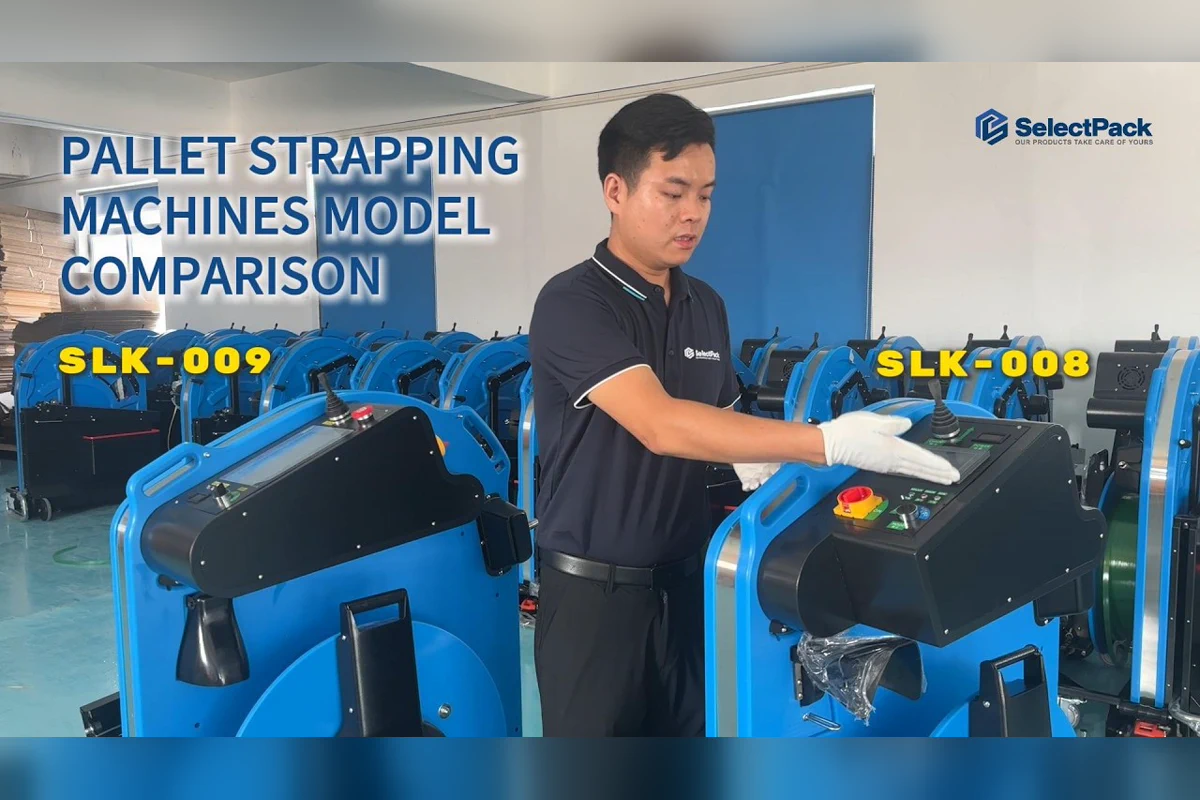
A mobile semi-auto strapping machine can be a better fit when pallets are staged in several areas and the goal is to reduce manual strap feeding, bending, and load movement. A fixed or automatic pallet strapping system can be better when the pallet flow is standardized and the facility can control stop position, clearance, and service access.
Control Edge Contact Before Increasing Tension
Heavy loads often have hard contact points. PET may hold tension well, but a strong strap can still be weakened by sharp product edges, abrasive surfaces, pallet corners, or exposed metal.
Inspect edge risk before increasing machine tension:
- Tile, panels, stone, or boards with hard corners.
- Metal parts, pipe, profiles, or machined components.
- Dense cartons with crushed or bulging corners.
- Pallet overhang that changes the strap angle.
- Stretch film tails, splinters, nails, or debris in the strap path.
Edge protectors, corner boards, or adjusted strap positions may be required. If the strap is cut or whitened at the edge after tensioning or forklift movement, the problem is not solved by using a stronger strap. The contact point must be corrected.
For dense building material pallets, the broader heavy duty strapping machine checklist covers bottom clearance, dust, forklift flow, and edge protection in more detail.
Test Seal Quality as Part of the System
A PET strap is only as reliable as the joint. Weak seals, inconsistent welds, dirty sealing areas, poor overlap, or incompatible strap thickness can make a strong strap behave like a weak package.
During setup and trials, inspect:
- Seal position and overlap.
- Weld consistency or joint quality.
- Strap slippage after tensioning.
- Cutting quality.
- Whether the seal area is affected by dust, moisture, or product debris.
- Whether operators can repeat the same result across a full shift.
If the machine seals PP well but PET poorly, do not treat that as a material failure. It may be a machine compatibility, strap thickness, heat setting, wear-part, or maintenance issue.
When PET Is Not the Right Fix
PET is not the right answer when the real problem sits somewhere else in the packaging system.
Avoid switching to PET as the first move when:
- The load is unstable before strapping.
- Cartons are underfilled, crushed, or poorly stacked.
- Pallets are broken, blocked, or inconsistent.
- The machine is not rated for PET.
- The load is light and stable enough for PP.
- The shipping route is short and controlled.
- Edge protection is needed but not allowed.
- Steel strapping or another restraint method is required.
- A fixed machine would create forklift congestion.
- The only goal is to reduce material cost.
In these cases, improve load build, pallet quality, strap placement, machine setup, or workflow first. PET can reduce some heavy-load risks, but it cannot repair an unstable pallet design.
Run a Controlled PET Trial Before Standardizing
Do not choose PET from a catalog alone. Test the strap and machine together on real loads.
A practical trial should include:
- Record the current PP or PET strap material, width, thickness, core size, supplier, and tension setting.
- Define the problem: loose straps, load shift, broken strap, weak seal, slow feeding, product damage, or rework.
- Run the selected PET strap on the actual machine or demo unit with the same machine specification.
- Test the easiest load, the heaviest load, the sharpest-edge load, and the load that settles most.
- Let strapped pallets sit long enough to show settling or relaxation.
- Move pallets through normal forklift, pallet jack, staging, and outbound handling.
- Inspect strap marks, edge cuts, seal quality, strap tension, and product condition.
- Ask operators whether the new process creates extra bending, walking, jams, or inspection difficulty.
- Compare damage risk, rework, cycle effort, and material cost against the current setup.
For high-risk routes, ISTA’s transport packaging test procedures can help teams think beyond a quick warehouse demonstration and plan a more realistic shipping validation.
Information to Send a Supplier
A useful recommendation needs more than “we need a PET strapping machine.” Send the supplier enough detail to match the machine, strap, and workflow.
Include:
- Photos of the loaded pallet from all sides.
- A photo or short video of the pallet underside and current strap path.
- Pallet dimensions and load height range.
- Typical and maximum load weight.
- Current strap material, width, thickness, coil size, and supplier.
- Number and position of straps per pallet.
- Whether straps go around the load, through the pallet opening, or under the pallet.
- Current pain point: loose strap, weak seal, feed errors, product damage, operator fatigue, or slow throughput.
- Edge protection method, if used.
- Daily or weekly pallet volume.
- Indoor, outdoor, dusty, wet, or cold-room conditions.
- Whether pallets are strapped in one station or across several zones.
- Available floor space, forklift route, charging plan, and maintenance responsibility.
The supplier should explain why the quoted machine fits the PET strap specification and the real pallet flow. Generic claims about strength are not enough.
Calculate Total Packaging Cost
PET often costs more per meter than basic PP, but roll price is not the only cost. The better comparison is total packaging cost for the load family.
Count:
- Strap material cost.
- Machine downtime or feed issues.
- Seal failures and rework.
- Damaged goods.
- Customer claims.
- Extra forklift moves.
- Operator time.
- Edge protectors or corner boards.
- Maintenance and wear parts.
For high-risk heavy loads, PET can be justified if it reduces real damage, rework, or shipment instability. For low-risk loads, a stronger strap may simply increase cost without changing the outcome.
Conclusion
A PET strapping machine is the right direction when heavy or settling loads need retained tension, and when the machine can run the selected polyester strap consistently. The decision should include strap width, thickness, tension range, seal quality, edge protection, pallet access, workflow, and real-load testing.
PET is a tool for a specific risk profile, not a default material upgrade. The strongest buying process starts with the load failure mode, confirms machine compatibility, tests the hardest pallets, and only then standardizes the strap and equipment configuration.